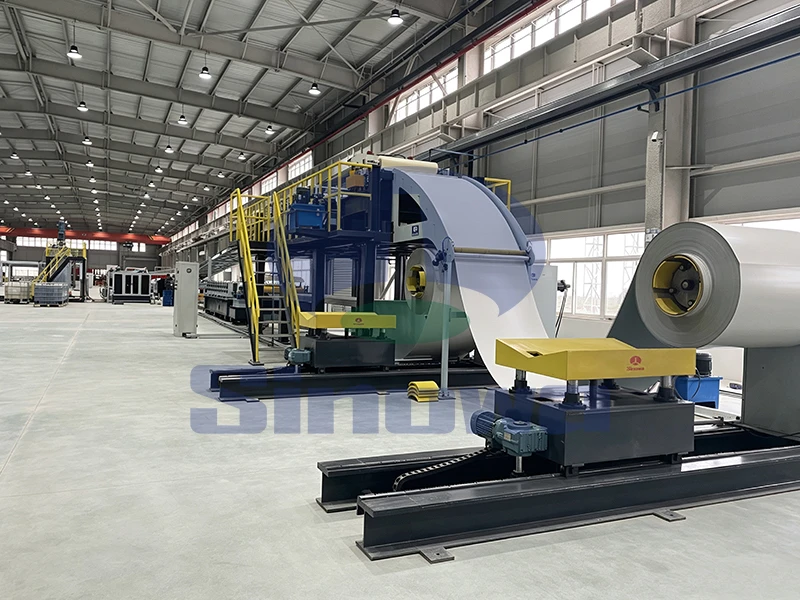
A cold room sandwich panel machine is a specialized continuous production unit engineered to fabricate insulated sandwich panels that serve as core building components for cold storage environments. It bonds two outer metal facings with a rigid foam insulating core under controlled pressure and temperature, forming a finished panel with integrated structural strength and thermal insulation performance. The machine automates material feeding, foaming, pressing, curing, cutting and discharging in a connected workflow, eliminating the inefficiency of manual panel assembly and ensuring consistent dimensional accuracy and stable heat preservation capacity of finished panels.
Working Principle
The working principle of the cold room sandwich panel making machine relies on in-situ foaming and composite lamination. Pre-profiled metal sheets are conveyed forward along the production line as the top and bottom surface layers. Liquid foaming raw materials are metered and mixed uniformly inside the high-pressure foaming unit, then continuously poured between the moving upper and lower metal sheets. The mixed foaming material expands gradually under suitable temperature conditions, fills the cavity between the two facings, and adheres tightly to the inner surface of metal sheets. The paired upper and lower pressing belts apply constant pressure to restrict the expansion thickness of foam, so the foam solidifies and cures into a dense, uniform insulating core. After full curing, the continuous composite slab is cut into specified lengths according to preset parameters, and complete sandwich panels are formed after trimming and discharging.
Machine Composition
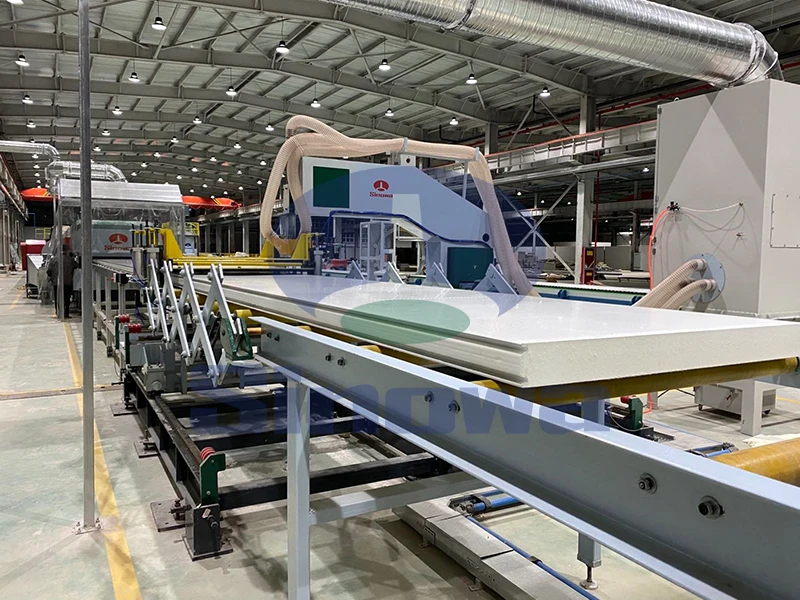
The complete cold room sandwich panel production line consists of multiple functional modules that coordinate with each other to finish continuous production. Each module undertakes an independent task and links seamlessly with adjacent units.
Uncoiling and pre-forming unit: It holds metal coils and carries out leveling, embossing, grooving and edge bending treatment for upper and lower surface sheets to shape the metal profile required for panel assembly.
High-pressure foaming and metering unit: It stores, meters and mixes two-component foaming raw materials, and delivers the well-mixed material evenly onto the lower metal sheet at a stable flow rate.
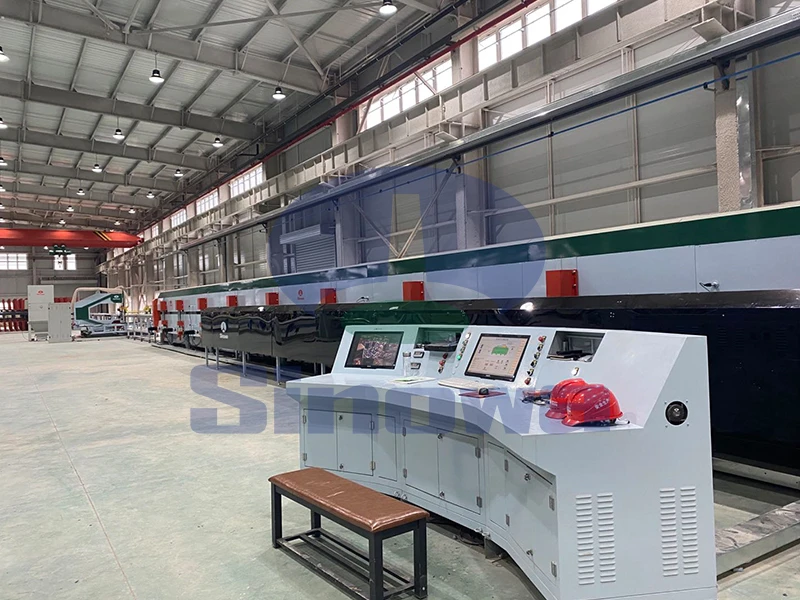
Continuous double-belt pressing unit: It adopts heavy-duty circulating steel belts to provide stable pressing force and supporting surface, controlling panel thickness while supporting the foaming and curing process.
Heating and curing unit: It maintains a stable thermal environment inside the pressing section to guarantee sufficient foaming reaction and complete curing of the insulation core.
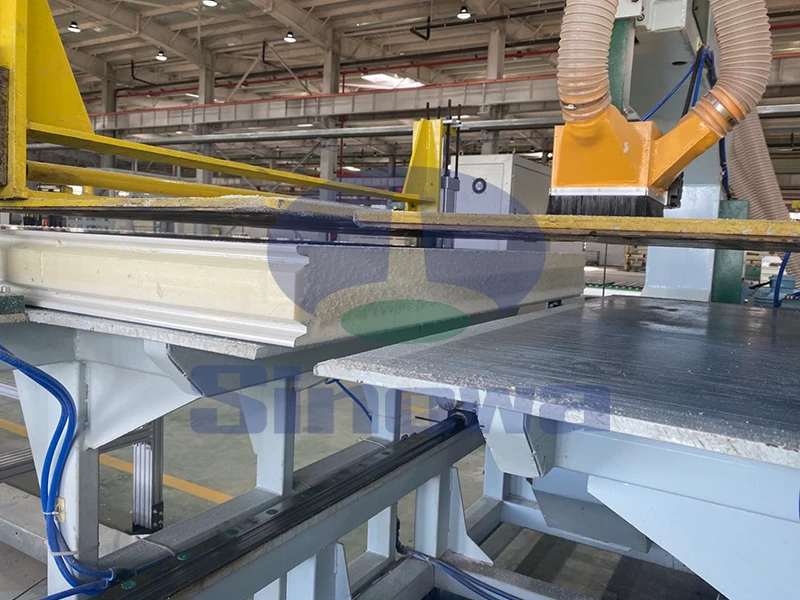
Fixed-length cutting unit: Equipped with flying saw cutting structure, it cuts continuous long panels into target sizes without stopping the running production line.
Trimming and edge processing unit: It removes excess burrs and irregular edges of cut panels to achieve neat panel end faces.
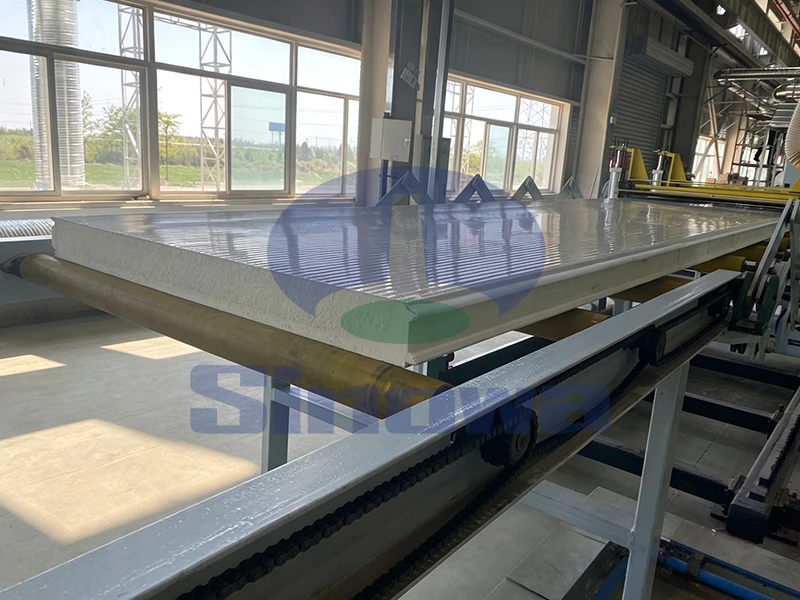
Discharging and stacking unit: It transports finished panels out of the line and stacks panels neatly for temporary storage.
Auxiliary transmission unit: A set of roller and belt conveyors connecting each station to realize steady material transfer.
Production Process Flow
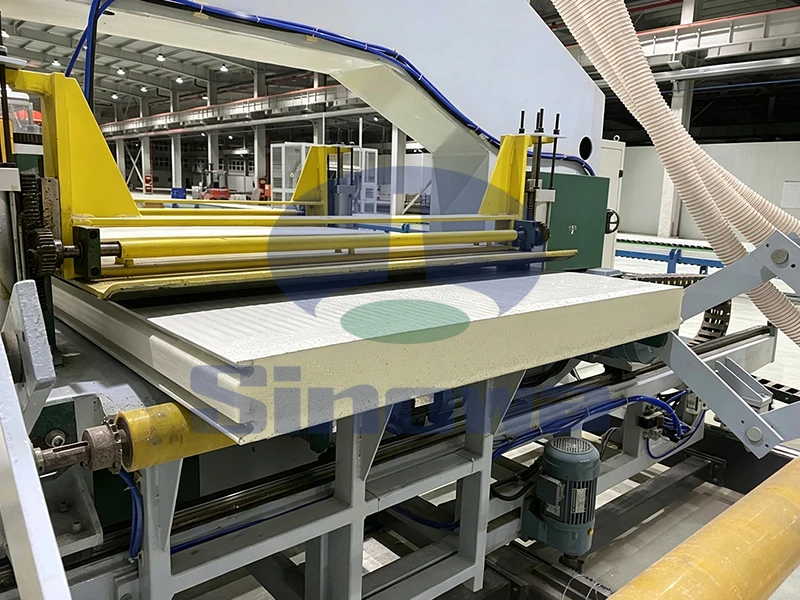
The production of cold room sandwich panels follows a closed continuous process. All parameters including material speed, foaming ratio, pressing pressure and curing temperature are matched to avoid defects such as voids, uneven thickness or poor adhesion.
Metal coil loading: Install raw metal coils on uncoiling racks, and feed metal sheets into the subsequent forming section.
Sheet leveling and profiling: Level the metal surface and process the lock seam or tongue-and-groove structure on sheet edges.
Material mixing and pouring: Start the foaming system, mix raw materials and pour the mixture onto the lower metal sheet at a uniform speed.
Composite pressing and foaming curing: The upper metal sheet closes over the foam material, and the composite enters the pressing and curing channel for expansion, bonding and solidification.
Fixed-length cutting: The continuous composite panel moves forward, and the flying saw cuts the slab according to the set panel length.
Edge trimming and inspection: Trim panel ends, visually check surface flatness, bonding condition and appearance defects.
Finished panel discharging and stacking: Qualified panels are conveyed out and stacked for packaging and transportation.
Available Panel Types and Application Scenarios
This cold room sandwich panel line can manufacture multiple types of insulated sandwich panels by adjusting raw material formulas and surface sheet styles. Different core materials bring different thermal insulation and mechanical properties to panels, adapting to various low-temperature and heat-preservation projects.
Polyurethane foam sandwich panels: Featuring low thermal conductivity, good sealing performance and lightweight structure, they are widely used for cold storage walls, cold room roofs, freezer compartments and fresh-keeping warehouses.
Polyisocyanurate foam sandwich panels: With enhanced fire resistance and high-temperature stability, they fit for medium and large cold storage projects and temperature-controlled workshops.
Rock wool sandwich panels: Taking rock wool as the core material, they have outstanding fire retardant performance, suitable for cold storage facilities with strict fire prevention requirements and combined temperature-controlled workshops.
Color steel faced sandwich panels: Using pre-coated color steel as surface layers, they have anti-corrosion and beautiful appearance, which are the mainstream choice for standard cold room construction.
Stainless steel faced sandwich panels: Resistant to moisture and corrosion, they are applied in seafood cold storage, food processing workshops and clean low-temperature rooms.
Equipment Advantages and Features
The cold room sandwich panel production machine improves the overall production quality and output efficiency of insulated panels compared with intermittent manual or semi-automatic equipment. Its structural design and control logic are oriented to long-time stable operation for panel manufacturing.
Continuous automatic production mode supports high hourly output and reduces labor investment in the production process.
Precise thickness control ensures the finished panels have consistent insulation effect and interchangeability during installation.
The foaming metering system realizes stable material proportioning, reducing raw material waste and lowering production cost.
The double-belt pressing structure makes the panel surface flat without pits, and the bonding strength between foam core and metal sheet is reliable.
Flexible adjustment for panel length, thickness and edge structure can meet customized requirements from different construction projects.
The whole line has a compact layout, occupying less workshop space and facilitating workshop arrangement.
Low noise operation and stable running state reduce frequent shutdown maintenance during mass production.
Control System and Quality Control
The cold room sandwich panel equipment is equipped with an integrated centralized control system. Operators set production parameters on the human-machine interface, including line speed, foaming flow, target panel thickness and cutting length. The system synchronizes the running speed of uncoiling, pressing and cutting units to avoid asynchronous operation that causes panel deformation. Real-time data of foaming pressure, heating temperature and running speed are displayed on the interface for operators to monitor the production status. For quality control, the production process carries out multi-stage inspection. During production, the system alarms automatically when key parameters deviate from the set range. After cutting, workers check panel dimensions, surface condition, core foaming uniformity and edge sealing effect. Unqualified products will be separated before stacking to prevent defective panels from entering the construction site. Key quality indicators focus on thermal insulation uniformity, interlayer bonding performance, dimensional tolerance and surface integrity.
Installation, Commissioning and After-sales Service
Before installation, the production site needs to be leveled and reserved with enough space for equipment layout, material transportation and finished product stacking. Technicians guide the positioning of each unit, connect transmission parts, install pipelines for foaming raw materials and complete circuit wiring. After mechanical assembly, the equipment goes through no-load test run first, then trial production with raw materials to adjust all process parameters until stable qualified panels are produced. After formal delivery, the service scope includes operation training for on-site operators, teaching of routine parameter adjustment and daily maintenance methods. Support is provided for troubleshooting guidance when abnormal conditions occur during operation. Spare parts supply channel is available for wearing components on the production line. Regular technical consultation can be obtained for equipment maintenance, line transformation and process optimization in the later operation stage, to extend the service life of the cold room sandwich panel manufacturing machine and keep stable production capacity.
Keyword: Cold Room Sandwich Panel Machine, Cold Room Sandwich Panel Line, Cold Room Sandwich Panel Production Line