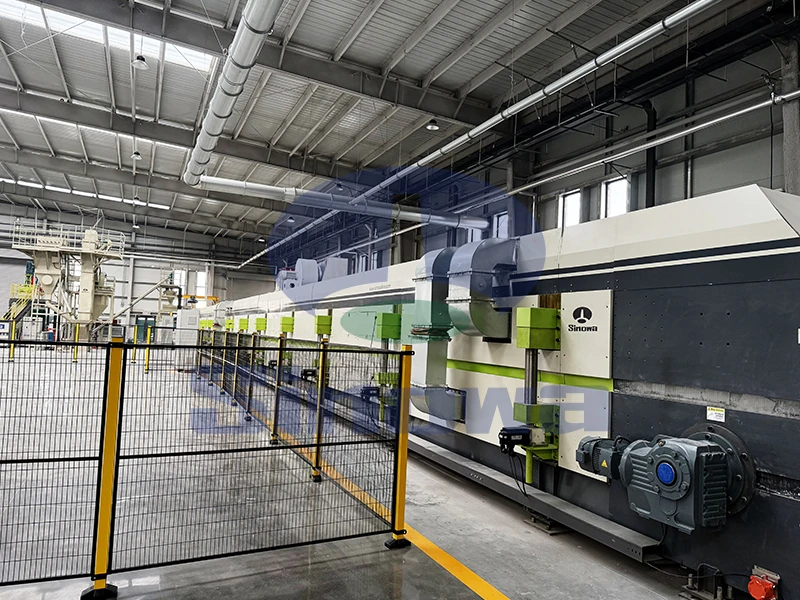
The insulated sandwich panel machine is a continuous forming production system engineered to manufacture composite insulated panels by bonding different core insulation materials with metal facings. It supports flexible switching among polyurethane (PU), polyisocyanurate (PIR), phenolic foam, rock wool, mineral wool and glass wool cores. This integrated production line realizes continuous feeding, compounding, curing, cutting and output in one workflow, serving as core manufacturing equipment for thermal insulation and building envelope panels.
Working Principle
This insulated sandwich panel equipment relies on mechanical positioning, continuous material transportation and in-situ composite curing to form finished sandwich panels. Metal surface sheets are unwound and pre-shaped to a designated profile before entering the laminating section. Loose or rigid core insulation materials are conveyed and aligned between the upper and lower metal facings. For foam-type cores including PU and PIR, liquid chemical raw materials are proportioned, mixed and sprayed evenly onto the core layer; chemical foaming and cross-linking reactions take place under controlled temperature and pressure to form a compact foam structure that adheres tightly to metal sheets. For fibrous cores such as rock wool, mineral wool and glass wool, adhesive is applied uniformly on the contact surfaces between the core and facings. The whole composite assembly is then pressed by upper and lower continuous laminating belts to maintain stable pressure during curing. After sufficient curing to secure interfacial bonding, the continuous panel strip moves forward to the cutting unit for fixed-length cutting, and finished panels are discharged and stacked.
Main Machine Components
The complete insulated sandwich panel production line consists of multiple interconnected functional units:
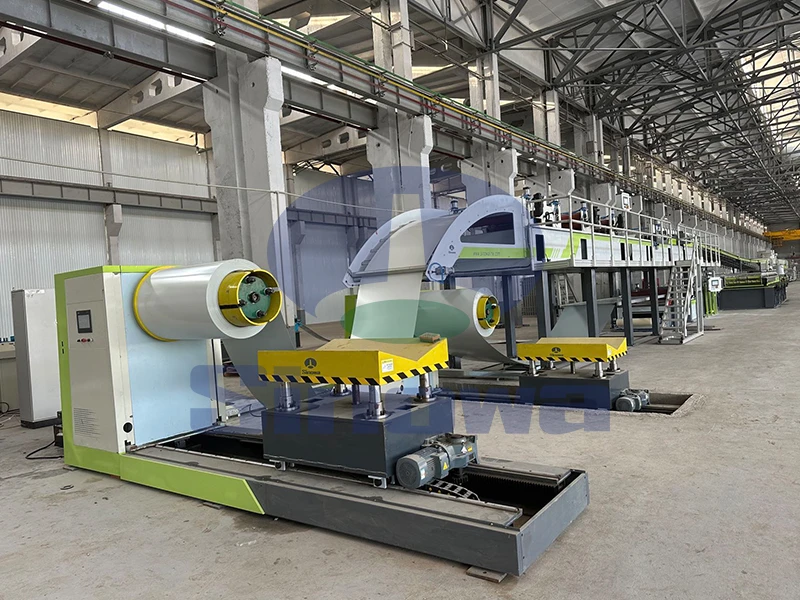
Metal sheet unwinding unit: holds and releases upper and lower metal coil materials, with tension adjustment to avoid wrinkling or deviation of facings.
Sheet forming and profiling unit: rollers shape flat metal sheets into the required surface profile, including flat, ribbed or corrugated shapes.
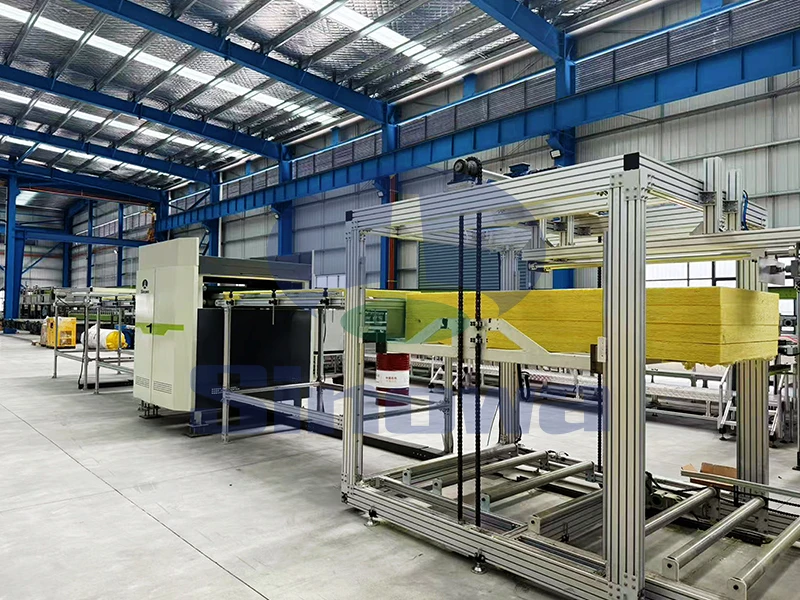
Core material feeding unit: handles automatic delivery of foam raw materials or fibrous insulation core boards, with positioning guides to ensure centering.
Foam metering and spraying unit: specially for PU and PIR production, accurately mixes two-component raw materials and sprays the mixture on a preset area.
Glue spreading unit: applies adhesive evenly on rock wool, mineral wool and glass wool surfaces to enhance bonding strength between core and facings.
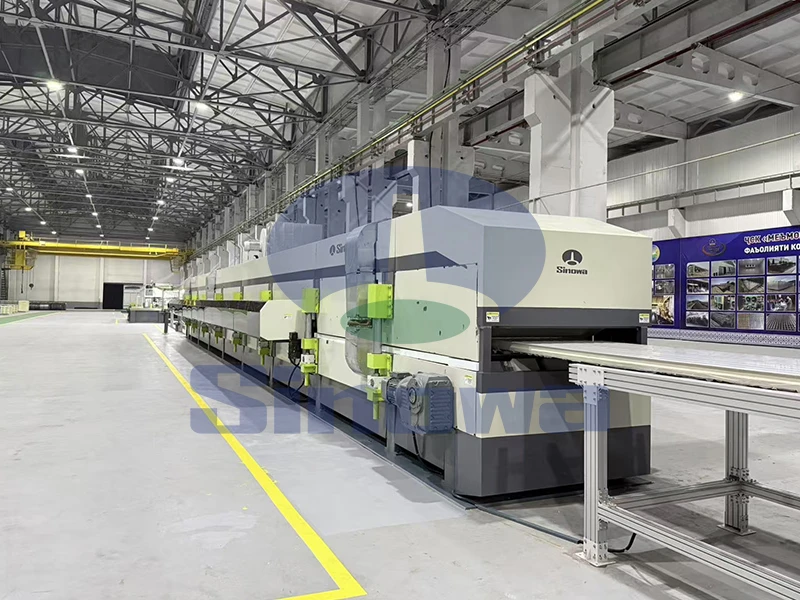
Continuous laminating and curing unit: composed of circulating pressing belts, heating modules and pressure adjustment structures, providing constant pressure and temperature for curing and compounding.
Fixed-length cutting unit: automatic flying saw that cuts continuous long panels into customized lengths without stopping the main line.
Edge trimming unit: trims uneven side edges of panels to guarantee consistent panel width.
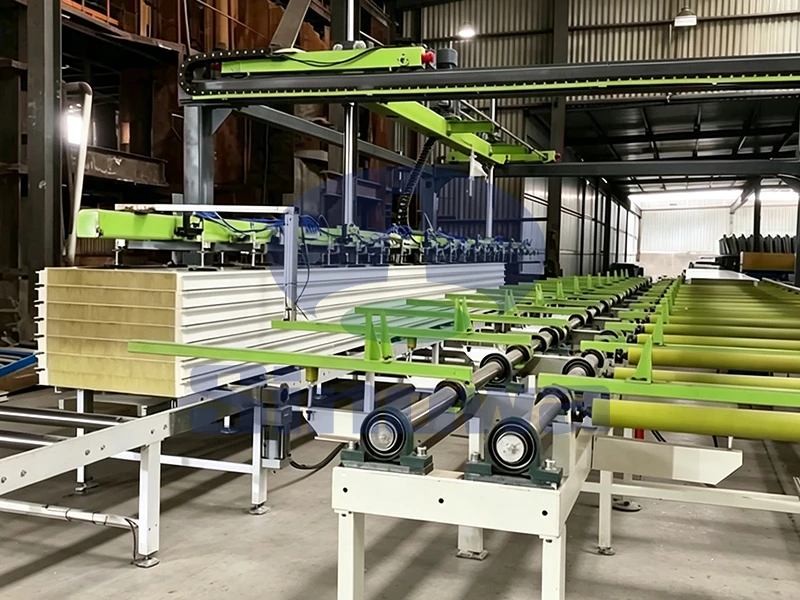
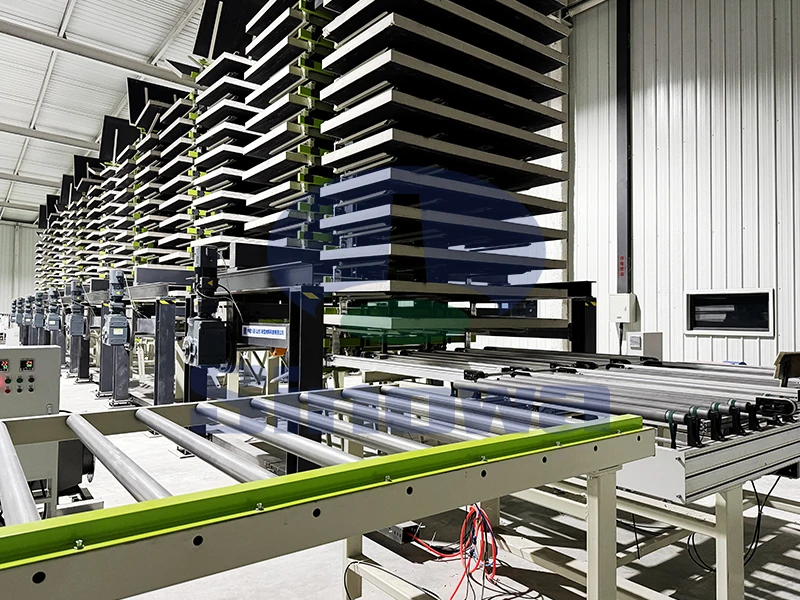
Discharging and stacking unit: conveys cut panels out and stacks finished products neatly.
Waste collection unit: collects cutting scraps and residual insulation waste generated during production.
Production Process Flow
The production follows a sequential continuous process, and different core materials only differ in the spraying or gluing segment:
Raw material preparation: load metal coils on unwinders and prepare insulation cores or chemical foaming raw materials.
Unwinding and profiling: metal sheets are unwound and roll-formed into target surface shapes.
Core alignment feeding: insulation cores are sent to the middle position between upper and lower metal facings.
Spraying or gluing: spray mixed PU/PIR liquid on the core, or spread adhesive on fibrous insulation surfaces.
Laminating compounding: upper and lower facings clamp the core material and enter the pressing curing section.
Curing forming: materials stay inside the laminating zone under stable temperature and pressure to complete foaming reaction or adhesive curing.
Continuous conveying: the integrated continuous panel moves steadily toward downstream stations.
Edge trimming: both sides of the panel are trimmed to achieve uniform width.
Fixed-length cutting: flying saw cuts panels according to preset length parameters.
Discharge and stacking: finished panels are transported out and stacked for packaging.
Available Panel Types and Application Scenarios
This insulated sandwich panel production line can produce multiple categories of insulated sandwich panels with different core materials, and each panel type matches suitable usage scenarios:
PU sandwich panels: feature lightweight structure and excellent thermal insulation performance. They are widely used for prefabricated cold storage rooms, refrigerated warehouses, temporary prefab buildings and interior partition systems.
PIR sandwich panels: deliver superior fire resistance and low thermal conductivity compared with ordinary PU panels. They are preferred for building roof and wall envelopes, logistics warehouses and clean workshop enclosures.
Phenolic sandwich panels: own good heat insulation and low smoke emission properties. They are suitable for public building partition walls, ventilation duct insulation and facilities requiring high smoke control performance.
Rock wool sandwich panels: take rock wool as the fibrous core with prominent fire retardant capacity. Common applications include factory exterior walls, fire compartment walls, large industrial workshops and data center enclosures.
Mineral wool sandwich panels: provide balanced thermal insulation and sound absorption effects. They are used for plant partition walls, noise reduction rooms and general thermal insulation building envelopes.
Glass wool sandwich panels: feature light weight and outstanding sound absorption performance. They are adopted for indoor sound insulation partitions, gymnasium wall systems and ventilation insulation structures.
Equipment Advantages and Characteristics
The insulated sandwich panel making machine integrates multi-material compatibility and continuous production capacity, bringing obvious operational benefits:
Multi-core compatibility: one single line can switch among PU, PIR, phenolic, rock wool, mineral wool and glass wool by adjusting feeding, spraying and gluing modules, reducing the need for separate dedicated production lines.
Stable continuous production: continuous laminating and flying cutting design avoid frequent start-stop interruption, improving overall production efficiency.
Adjustable product specifications: panel thickness, width, surface profile and finished length can be modified through parameter setting and roller replacement to meet diversified customization demands.
Reliable interfacial bonding: closed-loop pressure and temperature control in the curing section reduces the risk of delamination, bubbling or weak adhesion between core and metal facings.
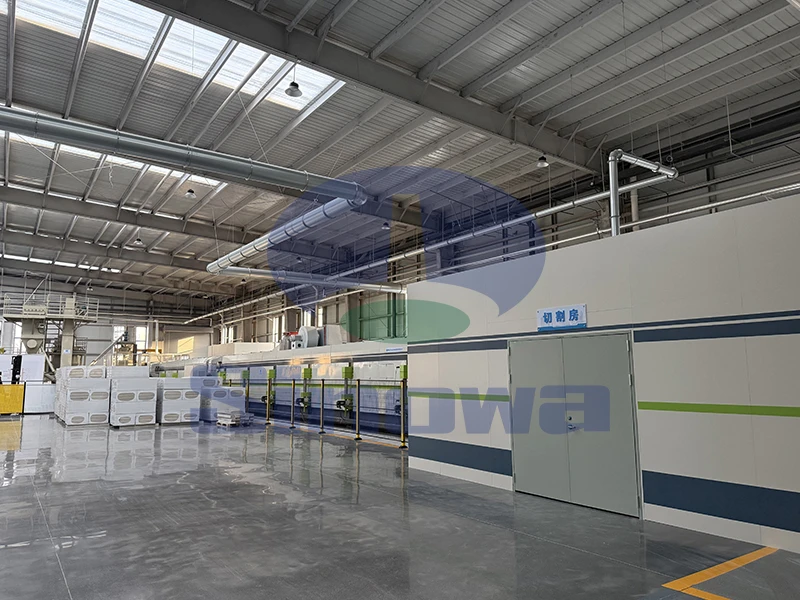
Compact layout design: the whole line arranges functional units in sequence to save factory floor space and facilitate daily operation and inspection.
Flexible operation mode: operators can switch between automatic continuous running and manual jogging mode for equipment testing and parameter adjustment.
Control System and Quality Control
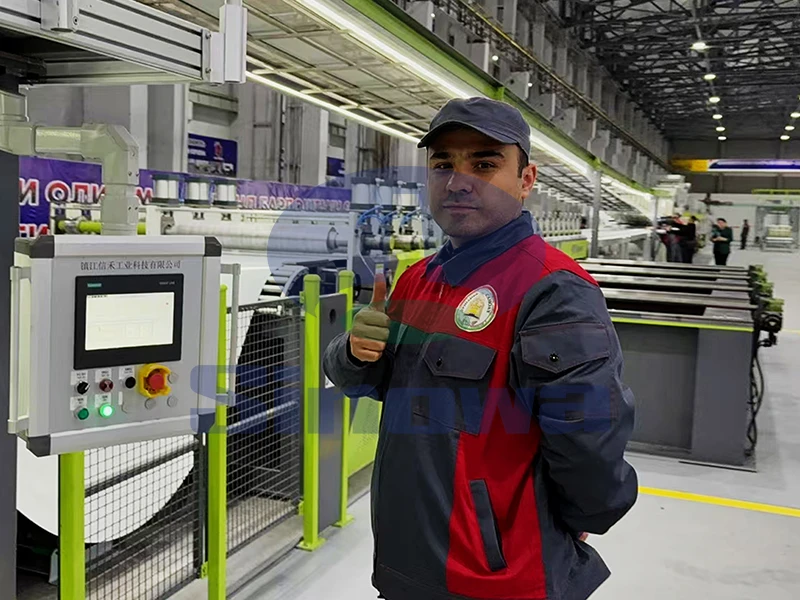
The insulated sandwich panel manufacturing machine is equipped with an integrated central control system to realize unified management of all functional units. The human-machine interface allows operators to set production parameters such as line speed, cutting length, spraying flow, laminating pressure and curing temperature. Real-time running data of each station is displayed on the screen, and abnormal signals will trigger alarm prompts for deviation, over-temperature or material shortage.
For in-line quality control, visual inspection stations are arranged after curing and cutting sections to check surface flatness, edge straightness and bonding appearance. Sampling inspection is carried out periodically to verify core filling uniformity and bonding condition. Production parameters can be recorded and stored, so operators can trace production conditions and adjust settings timely when quality fluctuation occurs. Deviation correction devices keep metal sheets and core materials centered during transportation to prevent offset and uneven panel thickness.
Installation Support and After-sales Service
Before formal commissioning, technical guidance is provided for site layout confirmation, foundation preparation, power supply and air source matching. Technicians guide the positioning, assembly, pipeline connection and wiring of each unit on site. After mechanical assembly is finished, joint debugging of transmission, spraying, pressing, cutting and control systems will be conducted step by step, together with trial production runs to verify line operation status.
After delivery, service support includes remote technical consultation for daily operation faults, guidance on routine maintenance such as roller cleaning, seal replacement and lubrication. Training is offered for on-site operators, covering normal startup and shutdown procedures, parameter adjustment, common fault judgment and daily maintenance standards. Spare parts supply channel is available for wearing components of the line. Long-term technical support helps users maintain stable operation and extend the service life of the insulated sandwich panel production machine.
Keyword: Insulated Sandwich Panel Machine, Insulated Sandwich Panel Line, Insulated Sandwich Panel Production Line