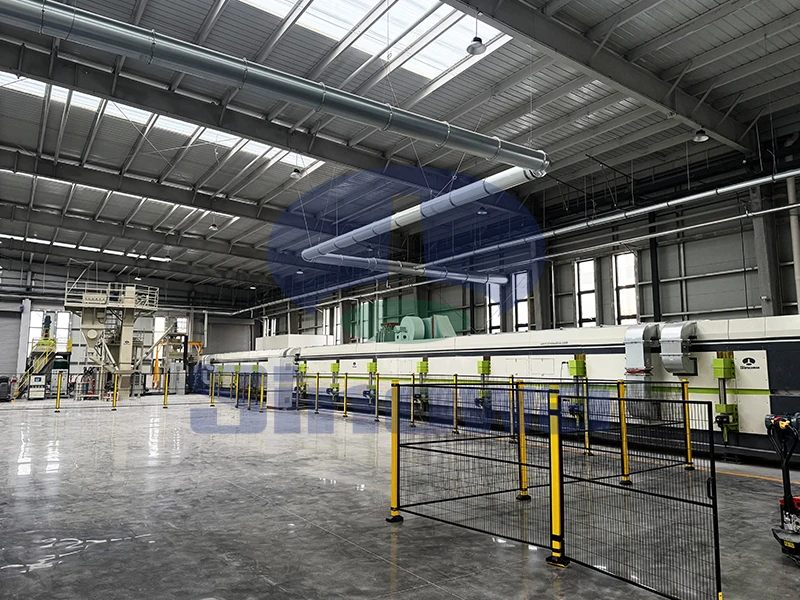
An insulated sandwich panel production line is a continuous automated manufacturing system designed to bond two metal facings with a core insulating material into rigid, integrated sandwich panels. The core working logic relies on synchronized feeding of surface sheets, accurate metering and distribution of foaming raw materials for foam-type cores, or mechanical positioning and compression for fibrous insulation cores, followed by controlled curing, shaping, trimming and cutting. For polyurethane and PIR materials, mixed chemical components undergo in-situ foaming and cross-linking reactions between the upper and lower facings to form a closed-cell thermal insulation layer. For phenolic foam, the specially formulated resin system cures under matched temperature conditions to form a flame-retardant cellular core. In the case of rock wool, mineral wool and glass wool, pre-formed fibrous insulation mats are laid between the facings, and adhesive agents are applied to create stable bonding between the fiber core and metal skins. Throughout the whole process, speed, pressure and temperature are coordinated consistently to ensure uniform thickness, stable bonding strength and flat panel surface without deformation.
Main Components of the Whole Line
The production system consists of interconnected functional sections that operate in synchronization:
Uncoiler section: Supports and releases coiled metal facings, with tension adjustment to maintain stable sheet feeding.
Sheet leveling and embossing unit: Flattens raw metal sheets and carries out surface embossing as required for panel texture.
Surface pre-treatment and coating station: Cleans sheet surfaces and applies bonding primer to improve adhesion between facings and core materials.
Core material feeding system: Separate modules for liquid foam raw material metering and spraying, as well as automatic feeding and alignment equipment for fibrous wool mats.
Double-belt laminating and curing machine: The core forming area where upper and lower belts apply constant pressure while maintaining the required curing temperature.
Continuous cutting and trimming unit: Performs side edge trimming and fixed-length cutting after the panel is fully cured and shaped.
Panel turnover and conveying platform: Transports finished panels, turns panels for stacking and inspection.
Stacking and packaging auxiliary unit: Arranges finished panels neatly and provides protective wrapping.
Production Process Flow
The continuous production follows a fixed sequential workflow adaptable for different core materials:
Loading metal coils onto uncoilers and adjusting feeding tension.
Leveling, cleaning and priming the upper and lower metal facings.
Selecting the corresponding core feeding mode: inject and spread mixed foaming materials for PU, PIR and phenolic; lay and position rock wool, mineral wool or glass wool mats evenly for fibrous cores.
Guiding the facings and insulation core into the double-belt laminator for pressing and thermal curing.
Transporting the semi-finished continuous panel out of the curing channel.
Trimming uneven side edges to guarantee consistent panel width.
Cutting the continuous panel into preset lengths.
Inspecting the appearance and dimension of individual panels.
Conveying qualified panels to the stacking area for collection and packaging.
Available Panel Types and Application Scenarios
This insulated sandwich panel line supports flexible switching to manufacture multiple categories of insulated sandwich panels, each with distinct performance characteristics for different usage environments.
PU sandwich panels: Lightweight with excellent thermal insulation performance, suitable for cold storage enclosures, temporary prefabricated buildings and interior partition structures.
PIR sandwich panels: Maintain stable insulation performance at relatively high temperatures, widely adopted for building roof and wall systems with high thermal efficiency requirements.
Phenolic sandwich panels: Feature favorable fire performance and low smoke generation, commonly used in public buildings, ventilation duct cladding and enclosed spaces with strict fire safety demands.
Rock wool sandwich panels: Made of inorganic fiber core, deliver outstanding fire resistance and sound absorption, applied to factory walls, partition walls and fire separation structures.
Mineral wool sandwich panels: Balance fire resistance and thermal insulation, fit for industrial workshops, logistics warehouses and exterior wall enclosures.
Glass wool sandwich panels: Offer good sound insulation and lightweight properties, frequently used for interior partition, acoustic treatment and ventilation enclosure projects.
Equipment Advantages and Features
The integrated production line brings multiple practical advantages for panel manufacturing.
High continuity and automation: Once parameters are set, the line runs continuously with minimal manual intervention, raising overall output efficiency.
Strong material compatibility: One production platform can switch among foam and fibrous insulation cores by replacing feeding modules, reducing investment in separate production equipment.
Stable panel forming quality: Constant pressure and temperature control inside the laminator reduce internal voids, uneven bonding and surface warping.
Flexible size adjustment: Panel thickness, width and cutting length can be adjusted within the design range to meet customized order requirements.
Low material waste: Precise raw material metering and accurate edge trimming cut unnecessary consumption of metal sheets and core raw materials.
Easy operation and maintenance: Modular structure allows independent inspection and maintenance of each functional section without shutting down the whole system for a long time.
Control System and Quality Control
The insulated sandwich panel machine is managed by a centralized control system. Operators set feeding speed, material ratio, curing temperature, pressure and cutting parameters through the human-machine interface. Real-time data of each station is displayed on the control terminal, and the system will send alarm prompts when parameters deviate from the set range. During production, regular on-site quality checks cover panel flatness, overall thickness, bonding condition between core and facings, edge straightness and cutting dimension accuracy. For foam core panels, the uniformity of core distribution is checked; for wool core panels, inspectors verify the alignment of fiber mats and full adhesion without gaps. Unqualified products will be separated at the inspection station to avoid entering the finished product stack. Historical production parameters can be stored for reference when reproducing panels with the same specifications.
Installation, Commissioning and After-sales Service
After insulated sandwich panel production equipment delivery, technical teams carry out on-site installation, including foundation alignment, assembly of each unit, connection of transmission pipelines and wiring of the control system. Commissioning work covers single-unit test run, synchronous linkage adjustment of the whole line, trial production with raw materials and parameter optimization until stable qualified panels are produced. Operation training is provided for on-site operators, covering standard startup and shutdown procedures, parameter setting, daily inspection items and common fault judgment. After formal production, after-sales support includes remote technical guidance for troubleshooting and regular follow-up services. Spare parts supply channels are available for wearing components. Technical consultation is also offered when users need to adjust production schemes or switch to new types of insulation cores.
Keyword: Insulated Sandwich Panel Production Line, Insulated Sandwich Panel Line, Insulated Sandwich Panel Machine