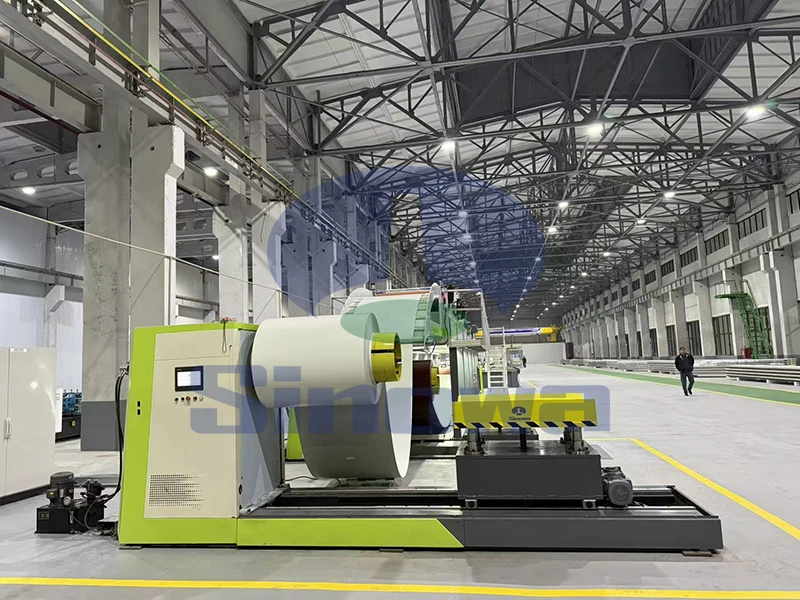
Polyurethane foam sandwich panel machinery is a continuous forming production system designed for manufacturing composite sandwich panels with rigid polyurethane foam as the core insulation layer. It completes material feeding, foaming, laminating, curing, shaping and cutting in a coordinated automatic operation. The core working principle relies on the in-situ chemical reaction of polyurethane raw materials. After the polyol and isocyanate components are accurately metered and fully mixed, the mixed liquid is evenly sprayed between two layers of surface materials. The mixture rapidly expands, foams and cures under controlled temperature and pressure conditions, forming a closed-cell foam core that bonds tightly with the upper and lower facings into an integrated sandwich panel structure. The whole reaction and composite process is continuously carried out on the production line to ensure stable bonding strength, uniform foam density and consistent panel thickness.
Main Components of the Whole Machine
The complete polyurethane sandwich panel machinery consists of multiple functional units that cooperate with each other to realize continuous production. Each unit undertakes an independent process task and is linked through transmission and signal systems.
Unwinding units: Used to place and release coil surface materials, which can adapt to different roll widths and keep the surface material flat and under constant tension during conveying.
Raw material metering and mixing station: Equipped with precision metering pumps and a high-pressure mixing head to deliver two-component polyurethane raw materials at a set ratio and achieve homogeneous mixing before spraying.
Spraying and distribution device: Distributes the mixed polyurethane material uniformly on the lower surface material to avoid local accumulation or blank areas of the foaming material.
Double-belt laminating and curing machine: Formed by upper and lower circulating steel belts, it provides stable clamping pressure and constant temperature environment for foaming, controlling the panel thickness and supporting the foam curing reaction.
Side trimming mechanism: Trims the excess edges on both sides of the formed panel to guarantee consistent panel width and neat edge profile.
Fixed-length cutting unit: Cuts the continuous long panel into finished products of preset length by flying cutting without stopping the production line.
Conveying and stacking platform: Transports the cut panels out of the forming area and arranges finished panels neatly for subsequent handling.
Auxiliary heating and exhaust assembly: Adjusts the ambient temperature for foaming reaction and discharges the trace gas generated during the curing process.
Production Process Flow
The production of polyurethane foam sandwich panels follows a continuous and sequential workflow, and every parameter in each step will affect the final quality of the composite board. Operators monitor the running state of each station to maintain production continuity.
Surface material loading and unwinding: The coiled facing materials are installed on the unwinding racks, and the materials are pulled forward synchronously with the line speed after tension adjustment.
Raw material preparation and proportioning: Polyurethane raw materials are stored in insulated tanks, transported to the mixing head after accurate flow measurement according to the designed formula.
Material spraying: The mixed foaming liquid is sprayed evenly on the moving lower surface material.
Laminating and foaming curing: The upper facing is closed and pressed together with the lower material through the double-belt machine; the polyurethane mixture expands and solidifies under pressure and heat to form a foam core and bond with facings.
Edge trimming: The rough edges on both sides of the continuous slab are cut off to obtain standard width.
Length cutting: The continuous panel is cut to the required finished length by the flying saw according to the set size.
Finished panel conveying and stacking: Qualified panels are conveyed to the stacking area for collection and temporary storage.
Inspection and transfer: Appearance inspection is carried out on stacked panels before packaging and shipment.
Available Panel Types and Application Scenarios
This set of machinery can produce multiple series of polyurethane foam sandwich panels by replacing different surface materials and adjusting production parameters. The diversified panel types can match the usage demands of different industries.
Metal-faced polyurethane sandwich panels: Using metal sheets as the front and back facings, with rigid PU foam as core.
Non-metal-faced polyurethane sandwich panels: Matching cement fiber boards, paper boards or other decorative sheet materials as surface layers.
Embossed or profiled polyurethane sandwich panels: Panels with special surface profiles produced by replacing forming molds.
Fire-retardant formula polyurethane sandwich panels: Manufactured by adjusting the raw material formula of the foam core.
These panels are widely adopted in many application scenarios. They serve as wall and roof enclosure materials for prefabricated buildings, cold storage and fresh-keeping warehouses because of outstanding thermal insulation performance. They are also used for partition walls of clean workshops and temporary modular housing. In addition, such composite panels can be applied to agricultural greenhouses, logistics storage facilities and sound-insulating enclosures for special spaces.
Equipment Advantages and Characteristics
Polyurethane foam sandwich panel production equipment has obvious technical advantages compared with intermittent panel making equipment, focusing on production efficiency, product consistency and operation controllability.
Continuous forming mode supports high line speed and large output, which is suitable for mass and stable production.
The high-pressure mixing system realizes uniform mixing of raw materials, helping the foam core obtain fine and closed-cell structure.
The circulating double steel belt system provides stable pressure control, so the thickness flatness of finished panels is well maintained.
Flexible adjustability for product specifications: panel width, thickness, production speed and raw material formula can be adjusted within the design range.
Good adaptability to various surface materials, compatible with different rigid and flexible facings.
Integrated structural design reduces intermediate manual links and lowers the interference of human factors on product quality.
The foaming system is equipped with anti-blocking and self-cleaning structures to reduce the frequency of maintenance of the mixing head.
Low energy consumption design of the heating and circulating system helps control the comprehensive operating cost of the production line.
Control System and Quality Control
The PU sandwich panel production line is equipped with an integrated centralized control system. The touch human-machine interface allows operators to set and adjust parameters such as line speed, raw material flow ratio, curing temperature and cutting length. Real-time data of each key station is displayed on the screen, and abnormal signals will trigger alarm prompts. The system supports parameter storage, which is convenient for calling the mature formula parameters for repeated production of the same panel type.
Quality control runs through the whole production process. During operation, the metering system keeps tracking the flow of polyurethane raw materials to prevent deviation of the mixing ratio. The pressure and temperature inside the laminating section are monitored to ensure sufficient foaming and complete curing. After cutting, the size, surface bonding condition, foam uniformity and appearance of panels are checked. If unqualified products are found, the control system can quickly adjust the corresponding process parameters to stabilize the product quality.
Installation, Matching and After-sales Service
Before installation, the site needs to be leveled and reserved with enough space for equipment layout, raw material placement and finished panel turnover. The polyurethane sandwich panel manufacturing equipment shall be installed and aligned according to the overall layout of the production line, and the connection of power supply, air supply and raw material pipelines shall be completed. After mechanical assembly, linkage debugging of each unit is carried out, including single-machine test run and whole-line trial production to verify the coordination of feeding, foaming, laminating and cutting actions. Supporting auxiliary facilities include raw material storage tanks, air compressors and waste collection devices.
For after-sales service, technical guidance is provided for PU sandwich panel line installation, commissioning and on-site trial production. Operation and daily maintenance training will be offered to on-site operators to help them master normal operation steps, routine inspection points and common fault judgment methods. Remote technical support is available to diagnose operational problems. Spare parts supply channels are provided for wearing parts of the production line. Regular follow-up services can be arranged to check the equipment operating condition and give suggestions on maintenance and production optimization.
Keyword: Polyurethane Foam Sandwich Panel Machinery, Polyurethane Sandwich Panel Machinery