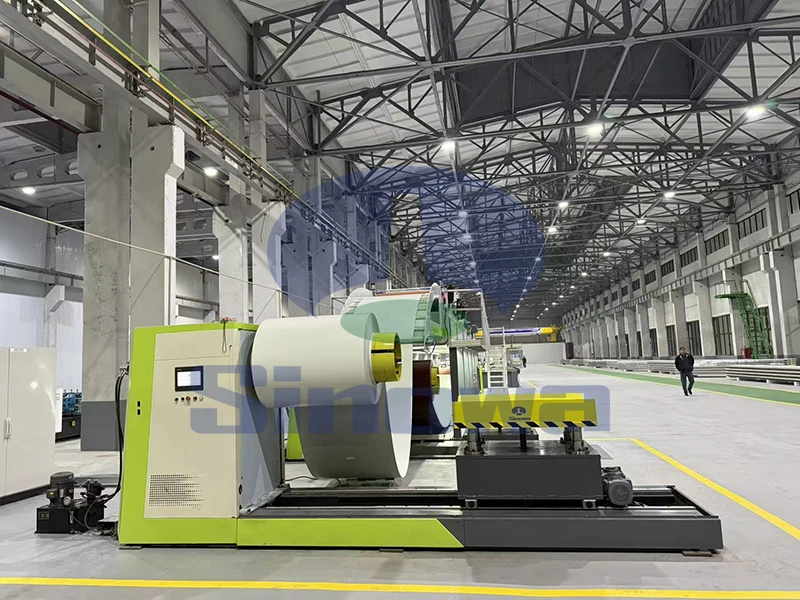
Polyurethane sandwich panel equipment is a specialized continuous production line designed for the automated fabrication of composite insulated panels with polyurethane foam as the core material. It relies on in-situ foaming and bonding reactions of polyurethane raw materials to permanently integrate surface facings and foam core into a unified structural panel. The whole production process is finished in a continuous running mode, which effectively avoids manual bonding defects and unstable foam density caused by discontinuous manufacturing. This set of industrial equipment converts liquid polyol and isocyanate components into rigid polyurethane foam under controlled temperature, pressure and mixing conditions, and completes forming, curing and cutting synchronously as the substrate moves forward.
Working Principle
The core working principle of polyurethane sandwich panel line is the chemical foaming and composite molding of two-component polyurethane raw materials. After accurate metering, the polyol and isocyanate materials are transported to a high-pressure mixing head for rapid and uniform mixing. The mixed liquid material is poured evenly between the upper and lower surface materials that are conveyed synchronously. Under the constant pressure and temperature environment inside the double-belt laminator, the mixed material undergoes polymerization, foaming and crosslinking reactions. The expanding foam fills the space between two facings and forms strong adhesive force with the inner surface of the facings. After sufficient curing, the continuous composite slab is cut into specified lengths by the cutting unit. The coordinated matching of material feeding speed, raw material flow rate, laminator running speed and temperature parameters ensures consistent foam cell structure, stable bonding strength and uniform panel thickness.
Main Components of the Whole Machine
The complete polyurethane sandwich panel production line consists of multiple functional units that operate synchronously. Each unit undertakes an independent production task and links with adjacent modules through signal interaction to realize continuous automatic production.
Raw material feeding and metering system: includes storage tanks, transfer pumps, high-precision metering devices and circulating pipelines for two polyurethane components, which stably controls the mixing ratio of raw materials.
Unwinding unit: used to load and release coiled surface materials, equipped with deviation correction function to keep the surface materials running along the central track.
Surface material pre-treatment section: completes surface cleaning, tension adjustment and preheating of facings to improve the bonding effect between facings and polyurethane foam.
High-pressure foaming and pouring unit: composed of mixing head, pouring trolley and driving mechanism, which can reciprocate to distribute mixed materials evenly in the width direction of the panel.
Double-belt laminator forming unit: the key forming part, providing constant clamping pressure and curing temperature, shaping the continuous panel and controlling the thickness precisely.
Traction unit: provides stable forward traction power for the upper and lower belts and composite slab, matching the overall production speed.
Cutting unit: flying saw cutting structure, cutting continuous panels to the required length without stopping the production line.
Stacking and discharging unit: automatically receives, arranges and stacks finished panels.
Auxiliary heating and cooling system: maintains the constant temperature state of raw materials and forming area to guarantee stable foaming reaction.
Production Process Flow
The manufacturing process of polyurethane sandwich panels is carried out continuously on the production line, and each process step is closely connected. Parameter adjustment of one process will affect the quality of subsequent finished panels.
Raw material preparation: Polyol and isocyanate are stored in separate tanks and kept at a preset temperature to maintain good fluidity.
Surface material loading and unwinding: Rolled facings are installed on the unwinding frame, and the equipment starts automatic deviation correction and tension control.
Surface material preheating and guiding: Upper and lower facings pass through the preheating section and enter the laminator in parallel with a fixed spacing.
Raw material metering and mixing: Two components are pumped into the mixing head according to the set proportion and fully mixed instantly.
Material pouring: The mixed polyurethane liquid is poured evenly between the upper and lower facings through the moving pouring trolley.
Foaming, pressing and curing inside laminator: The mixture foams and expands under pressure and heat, bonds tightly with facings and completes curing.
Continuous slab traction: The cured continuous composite slab is pulled out from the outlet of the laminator.
Length measurement and cutting: The length measuring device sends signals to the flying saw, and the slab is cut into finished panels of specified size.
Finished panel conveying and stacking: Cut panels are transported to the stacking station for automatic arrangement.
Inspection and offline: Operators conduct appearance inspection and transfer qualified products to the finished area.
Available Panel Types and Application Scenarios
This polyurethane sandwich panel machine can produce multiple categories of composite panels by replacing different surface materials and adjusting process parameters. Different panel configurations have different structural and thermal performance characteristics, so they are applied in diversified fields.
Metal-faced polyurethane sandwich panels: using metal sheets as both sides, with high mechanical strength, impact resistance and good weather resistance. They are widely used for wall and roof enclosure of industrial workshops, logistics warehouses, cold storage and clean workshops.
Non-metal faced polyurethane sandwich panels: matched with fiber cement boards, glass fiber mats and other non-metal facings. These panels have good fire performance and are suitable for partition walls of public buildings, interior decoration and special enclosure structures.
Lightweight flexible-faced polyurethane panels: adopt flexible composite film as surface layer, featuring light weight and good bending performance, commonly used for temporary enclosure, insulation lining and mobile facility decoration.
Special functional polyurethane sandwich panels: produced by adding functional additives into foam raw materials, with enhanced thermal insulation or sound insulation effects, suitable for low-temperature storage rooms, sound insulation rooms and constant-temperature workshops.
Advantages and Characteristics of the Equipment
This PU sandwich panel production line integrates mechanical transmission, fluid control and chemical reaction control. Compared with intermittent foaming equipment, it has obvious advantages in production efficiency and product stability, and can adapt to long-time continuous operation.
High continuous production efficiency: The line can run stably for a long time, and the output of panels is much higher than batch production equipment, which meets the demand of large-volume orders.
Stable product consistency: Closed-loop control of raw material ratio, temperature, pressure and speed reduces manual interference, so the density, thickness and bonding quality of different batches of panels keep stable.
Flexible product adjustment: The equipment can adjust panel width, thickness and raw material formula within the adjustable range, supporting the switching of multiple panel specifications.
Low material waste rate: The reciprocating pouring structure and accurate metering system reduce the excess consumption of polyurethane raw materials during production.
Compact layout: The whole line adopts modular layout, which saves workshop space and facilitates daily operation and routine maintenance.
Low labor dependence: Most procedures are automatically completed, only a small number of operators are required for patrol inspection and parameter adjustment.
Control System and Quality Control
The PU sandwich panel machine is equipped with an integrated centralized control system. The main control terminal displays the running status of each unit in real time, including raw material flow, running speed of laminator, temperature of each section, panel length and alarm information. Operators can set production parameters on the human-machine interface, and the system automatically realizes synchronous linkage of each functional unit. Once the parameters deviate from the set range, the system will trigger prompt alarm or slow-down protection to avoid mass defective products.
In terms of quality control, key monitoring points are set in the whole production process. The metering system keeps checking the feeding ratio of the two polyurethane components. The temperature sensors distributed in the laminator monitor the curing environment of foam core. The thickness detection device tracks the panel thickness dynamically. After cutting, the appearance of finished panels is checked to observe surface flatness, whether there are bubbles, missing pouring and separation between facings and foam core. Sampling inspection can be carried out regularly to check the foam cell condition and bonding effect, so as to adjust production parameters in time and maintain stable panel quality.
Installation, Commissioning and After-sales Service
The polyurethane sandwich panel production equipment is delivered in modular units. After arriving at the workshop, each module is hoisted and positioned according to the layout drawing, then mechanical connection, pipeline docking and circuit wiring are completed in sequence. After the mechanical assembly is finished, technicians carry out no-load test run of each single unit to check the operation of transmission, deviation correction, cutting and metering parts. Then the whole line linkage test and trial production are carried out. During trial production, parameters such as raw material ratio, temperature and speed are optimized repeatedly until the produced panels meet the required quality requirements, and then the equipment is handed over for formal production.
For after-sales support, relevant technical support covers operation training, regular maintenance guidance and fault troubleshooting. Professional training is provided for on-site operators, including standard operation procedures, parameter adjustment methods, daily lubrication and cleaning points, and common fault judgment. Remote technical support is available for daily operation problems. When equipment failure cannot be solved remotely, technical personnel can be arranged for on-site inspection and repair. Spare parts guidance service is also provided to help users prepare vulnerable parts reasonably and reduce the shutdown time caused by component damage. Regular maintenance reminders help users prolong the service life of the whole polyurethane sandwich panel manufacturing line and keep the equipment running in good condition.
Keyword: Polyurethane Sandwich Panel Equipment, PU Sandwich Panel Production Equipment