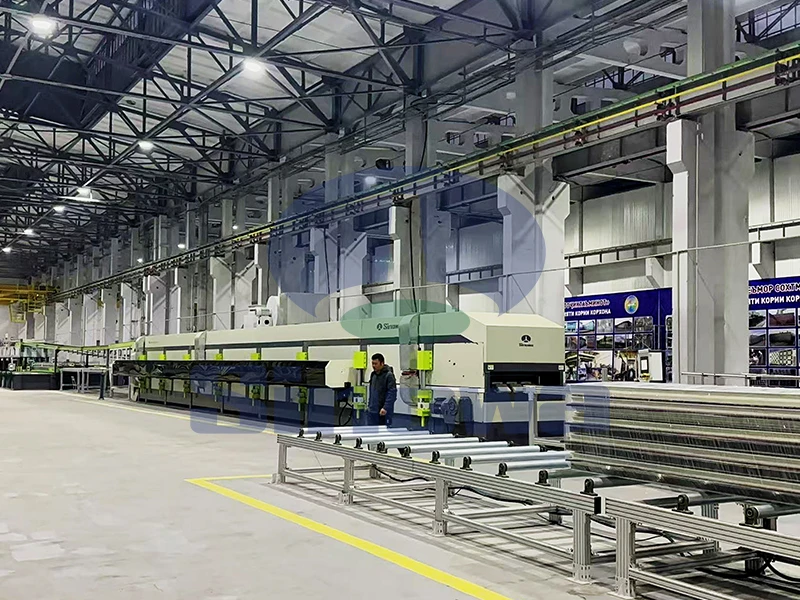
A PU foam board production line is a continuous automatic manufacturing system designed for the continuous foaming, forming, curing and cutting of polyurethane foam boards. It mixes polyether polyol, isocyanate and auxiliary additives under controlled conditions to trigger a chemical foaming reaction. The expanding material fills the forming cavity, stabilizes into a uniform foam structure, and goes through subsequent shaping and trimming to obtain finished rigid polyurethane foam boards. The whole production process relies on coordinated operation of mechanical transmission, raw material metering, mixing and temperature regulation to keep the foam density, cell structure and board dimension stable in long-run production.
Main Components of the Whole Line
The complete PU foam panel production line consists of multiple functional units connected in sequence. Each unit undertakes an independent processing task and synchronizes speed and parameters with adjacent modules to avoid defects such as uneven foaming, surface wrinkling or dimensional deviation.
Raw material storage and feeding unit: It contains sealed storage tanks for polyurethane raw materials and auxiliary agents, equipped with circulating stirring devices to prevent component stratification and precipitation.
High-pressure metering and mixing unit: Precision metering pumps deliver each raw component at a set ratio, and the high-pressure mixing head completes rapid and uniform mixing before foaming starts.
Continuous laminating feeding unit: It unwinds and conveys surface facing materials such as paper, aluminum foil or fabric to cover both sides of the foam core.
Double-belt forming machine: Two moving endless belts form a closed constant-thickness cavity. The mixed foaming liquid flows into this cavity and expands while moving forward with the belts.
Curing and conveying section: It provides a constant-temperature environment for the foam to complete chemical crosslinking and structural curing, ensuring sufficient strength and stable internal cells.
Continuous cutting unit: It includes horizontal cutting for fixed board thickness and vertical cutting for set board width, which cuts the continuous foam slab into standard single boards.
Automatic stacking and discharging unit: Finished boards are arranged neatly and stacked, ready for transfer to the packaging area.
Auxiliary heating and exhaust unit: It adjusts the ambient temperature of the forming zone and discharges trace gas generated during foaming properly.
Production Process Flow
The production follows a continuous closed flow without interruption under normal operation. Parameter adjustment can be carried out before starting the line to match different product requirements.
Preparatory stage: Check raw material liquid levels, start circulating stirring systems, preheat the mixing head and forming belts, and calibrate the metering ratio of all raw components.
Facing material unwinding: The upper and lower surface materials are unwound and pulled into the forming section at a synchronous speed.
Raw material metering and mixing: Polyurethane components and additives are pumped to the mixing head according to the preset proportion and mixed instantly.
Liquid pouring and foaming: The mixed liquid is poured evenly between the two layers of facing materials, and the foaming reaction begins immediately inside the closed forming cavity.
Shaping and curing: The foam expands and fills the cavity space, moves forward with the double belts, and completes curing within the set residence time.
Fixed-size cutting: The continuous cured foam strip passes through cutting devices to be divided into boards of required width and length.
Inspection and stacking: Operators or online sensors check the appearance and flatness of boards, then qualified products are stacked automatically.
Offline transfer: Stacked boards are transported out for packaging and storage.
Available Board Types and Application Scenarios
This production line can produce multiple types of rigid PU foam boards by adjusting raw material formulas, surface facing materials and process parameters. Different products have distinct physical properties and are applied in different fields.
Plain PU rigid foam board without facing: Lightweight foam core board with closed-cell structure, mainly used as the inner core of composite insulation structures.
Single-sided faced PU foam board: With one side covered by protective facing material, suitable for occasions requiring one-side protective surface.
Double-sided laminated PU foam board: Both sides are compounded with aluminum foil, kraft paper or other facings, featuring low thermal conductivity and good vapor barrier performance.
Special modified PU foam board: Made with adjusted formulas to obtain improved toughness or flame retardant performance for special usage environments.
Common application scenarios include thermal insulation for building exterior and interior walls, cold storage and refrigeration warehouse insulation layers, thermal preservation of pipeline and equipment enclosures, insulation core materials for mobile and prefabricated houses, as well as shock-absorbing and thermal insulation substrates for some transportation and industrial facilities.
Advantages and Characteristics of the Equipment
The continuous PU sandwich panel line realizes automated continuous production, which brings obvious advantages compared with intermittent foaming equipment. It can maintain stable product quality while raising output capacity.
High production efficiency: Continuous forming mode supports long-time non-stop running, greatly improving daily output and reducing labor cost per unit product.
Stable product consistency: Precision metering and constant-temperature forming control reduce fluctuation of foam density, thickness and thermal performance among batches.
Flexible product adjustment: Operators can change raw material ratio, belt clearance, running speed and facing types to switch between different foam board specifications quickly.
Good sealing of forming system: The closed double-belt structure reduces foam overflow, keeps the board surface smooth and reduces subsequent trimming waste.
Low operation intensity: Most procedures such as feeding, forming, cutting and stacking are automated, requiring only a small number of on-site staff for monitoring.
Compact layout design: The whole line can be arranged linearly according to the workshop space, which saves floor area and facilitates logistics flow of raw materials and finished boards.
Control System and Quality Control
The PU sandwich panel production line is equipped with an integrated central control system. Touch-screen human-machine interface allows operators to set, display and store key production parameters including raw material flow rate, mixing pressure, line speed, forming temperature and board thickness. The system supports real-time monitoring of running status, and will send out prompt alarms when parameters deviate from the set range.
For quality control, online monitoring modules track board thickness, surface flatness and continuity of foaming during operation. Sampling inspection is implemented regularly to check foam cell uniformity, dimensional tolerance and surface bonding quality between foam core and facing layers. Abnormal boards will be separated in time. All production parameter records can be saved for tracing when quality problems occur, helping technicians locate influencing factors and optimize process settings rapidly.
Installation, Matching and After-sales Service
Before installation, the PU sandwich panel machine supplier provides layout guidance for the workshop, including requirements for ground bearing capacity, power supply configuration and ventilation layout. Professional technical teams complete the assembly, pipeline connection, electrical wiring and linkage debugging of each unit on site. After mechanical installation, empty running test and trial foaming test will be carried out step by step to verify the coordination of all units until stable qualified products can be produced.
Matching supporting facilities include raw material circulating storage systems, workshop ventilation devices and waste collection devices for leftover foam trimmings. For after-sales service, technical support covers remote parameter guidance and on-site troubleshooting. Training for on-site operators is provided to teach daily startup, shutdown, routine maintenance and simple fault handling. Spare parts supply channel is available for wearing components of the line, helping users maintain long-term stable operation of the PU foam board production system.
Keyword: PU Foam Board Production Line, PU Foam Production Line, PU Foam Panel Production Line