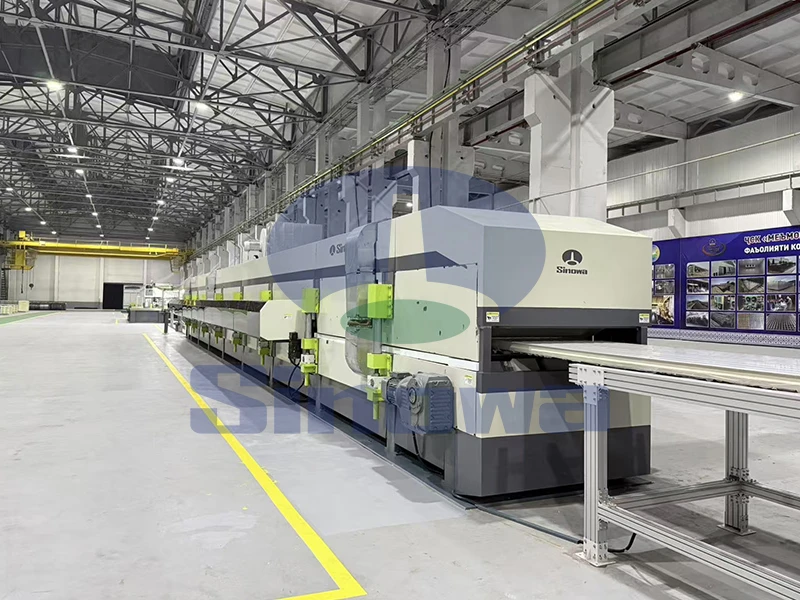
PU insulated panel making machine is a specialized continuous production equipment designed for manufacturing polyurethane sandwich insulation panels. It relies on the foaming and curing properties of polyurethane raw materials to bond different surface skins with the PU core layer integrally in a continuous forming process. The finished panels feature thermal insulation, structural stability and convenient installation, which are widely adopted in the construction and cold chain industries. This article systematically introduces its working principle, structural composition, production flow, applicable panel types, application scenarios, equipment strengths, control and quality management, as well as installation and after-sales support.
Working Principle
The whole production process is based on the chemical reaction of two-component polyurethane raw materials. Polyether polyol and isocyanate are delivered separately to the high-pressure mixing head, where they are fully mixed under a set ratio and pressure. After mixing, the liquid PU mixture is evenly poured onto the lower surface material moving forward along the production line. With the continuous advance of upper and lower face sheets, the mixed liquid expands gradually, foams and solidifies under controlled temperature inside the double-belt curing section. The foamed core layer adheres tightly to both upper and lower skins to form an integrated sandwich structure. After sufficient curing, the continuous slab is cut into specified lengths by the cutting unit, and then stacked for finished product collection. The matching speed of raw material feeding, surface material conveying and curing reaction determines the surface flatness, foam density and bonding effect of the final insulated panels.
Main Components of the Machine
The complete PU insulated sandwich panel machine consists of multiple functional units that coordinate with each other to realize automated continuous production. Each unit undertakes an independent task and keeps synchronous operation through linkage signals.
Raw material feeding and metering unit: Storage tanks, feeding pumps, precision metering devices and high-pressure mixing head for PU components.
Surface material unwinding unit: Unwinding racks for metal sheets or flexible facings, equipped with deviation correction devices to avoid offset of face materials.
Surface material pre-treatment unit: Roller leveling, cleaning and preheating mechanisms to improve the bonding performance between skins and PU foam.
Continuous double-belt conveyor and curing section: Upper and lower steel belts, heating system and pressure adjustment structure for foaming and shaping.
Edge sealing and trimming unit: Side guide rollers and trimming assemblies to control panel width and shape the edge structure.
Fixed-length cutting unit: Flying saw cutting mechanism to cut continuous panels into required dimensions without stopping the line.
Finished product conveying and stacking unit: Output roller table and automatic stacking frame for orderly collection of cut panels.
Auxiliary pneumatic and hydraulic unit: Air compressor, hydraulic station and pipeline system providing power for actuators.
Production Technological Process
The production of PU insulated panels follows a continuous closed-loop process. All parameters including material ratio, line speed and curing temperature need to be adjusted according to the target panel specification before formal production starts. Once stable, the line can run continuously for long periods.
Preparation stage: Load PU raw materials into storage tanks, install face material rolls on unwinding racks, and preheat the curing section to the set temperature.
Parameter debugging: Set raw material mixing ratio, conveying speed of face sheets, belt pressure and cutting length on the control interface.
Face material feeding and pre-treatment: Upper and lower surface materials are unwound, leveled and preheated, then enter the forming section synchronously.
PU material mixing and pouring: Two PU raw materials are metered quantitatively, mixed in the mixing head and uniformly distributed on the lower face sheet.
Foaming, pressing and curing: The mixed liquid expands inside the closed space between two face sheets, forms foam under constant pressure and temperature, and completes curing and bonding.
Edge trimming and shaping: The side parts of the continuous panel are trimmed to ensure consistent width and neat edges.
Fixed-length cutting: The continuous panel moves forward with the line, and the flying saw cuts it to the preset length automatically.
Finished product output and stacking: Cut panels are transported out, inspected preliminarily and stacked for subsequent packaging.
Available Panel Types and Application Scenarios
This production line can produce a variety of PU sandwich insulated panels by replacing different surface materials and adjusting foam formulation. Different combinations of face skins endow panels with different surface properties, and the PU core maintains stable thermal insulation performance.
Metal-faced PU insulated panels: Using color steel, galvanized steel or aluminum sheets as upper and lower skins; the core is rigid PU foam.
Flexible-faced PU insulated panels: Using composite fabric, fiber-reinforced film and other flexible materials as surface layers, suitable for light-duty thermal insulation.
Composite edge PU panels: With special tongue-and-groove lock structure on panel edges for quick assembly and good sealing after installation.
Thickened PU insulation panels: Adjusting the spacing between upper and lower belts to produce panels with larger core thickness for high insulation demand.
These panels serve multiple practical scenarios relying on their insulation and assembly advantages.
Cold storage and refrigeration projects: Walls, roofs and partition boards for low-temperature storage rooms to reduce cooling loss.
Prefabricated building enclosures: Wall and roof panels for temporary workshops, modular houses and prefab buildings.
Clean room construction: Enclosure panels for dust-free workshops in pharmaceutical, food and electronic manufacturing sectors.
Agricultural thermal insulation facilities: Enclosure boards for constant-temperature greenhouses and breeding houses.
Logistics cold carriage: Thermal insulation lining plates for refrigerated transport vehicles and containers.
Advantages and Features of the Equipment
Compared with intermittent PU sandwich panel machine, this continuous PU insulated panel making machine delivers obvious advantages in production efficiency and product consistency. It can reduce manual intervention and stabilize the quality of mass-produced panels.
High continuous production efficiency: Realizes uninterrupted forming and cutting, greatly improving daily output compared with batch-type equipment.
Stable panel bonding quality: Synchronized pressure control in the curing section makes the foam core closely combined with surface skins, reducing delamination risk.
Wide adjustment range of specifications: The panel thickness, width, foam density and cutting length can be adjusted flexibly to meet diversified order demands.
Low material waste: Precise metering of PU raw materials and automatic deviation correction of face materials cut down raw material consumption.
Compact and reasonable layout: Each functional unit is arranged in sequence, which saves workshop floor space and facilitates daily operation.
Good safety protection design: Multiple protective sensors are installed at key moving positions to trigger pause when abnormal conditions occur.
Easy maintenance: Modular structural design makes it convenient for operators to disassemble, clean and replace wearing parts.
Control System and Quality Control
The insulated PU sandwich panel line adopts an integrated centralized control system. Operators can view and modify all core production parameters on the human-machine touch screen. The system keeps all units in synchronous linkage; once the speed or flow of one unit deviates, the system will give an alarm or trigger interlock stop to avoid defective products. The core controllable parameters include raw material proportion, mixing pressure, line running speed, curing temperature, belt clamping pressure and cutting length.
In terms of quality control, real-time monitoring is carried out during the whole production process. Operators regularly sample the finished panels to check the surface flatness, bonding condition of the interface, uniformity of foam pores and dimensional accuracy. The control system records the running data of each batch, which is convenient for tracing the production state when quality fluctuation appears. The parameters can be saved as preset formulas, so operators can quickly call corresponding settings when switching to another panel specification.
Installation, Commissioning and After-sales Service
The insulated PU sandwich panel equipment is split into multiple modules for transportation. After arriving at the workshop, technicians carry out on-site assembly according to the layout drawing. The installation work includes foundation leveling, unit alignment, pipeline connection of raw materials, wiring of control circuits, and installation of pneumatic and hydraulic accessories. After mechanical assembly, the commissioning phase starts: empty running test of each unit, single-action debugging, linkage test of the whole line, and trial production with raw materials. Only after the trial panels pass inspection can the equipment be handed over for formal production.
The supporting after-sales service covers technical guidance and follow-up support. Professional technical personnel provide operation training for on-site operators, including parameter adjustment, routine inspection, common fault judgment and wearing part replacement. Remote technical support is available for troubleshooting; when remote guidance cannot solve the problem, on-site service can be arranged. Spare parts supply channel is reserved for vulnerable components of the production line. Regular maintenance reminders are provided to help users extend the service life of the equipment and maintain stable long-term operation.
Conclusion
PU insulated panel manufacturing machine is a core automated equipment for the manufacturing of polyurethane sandwich panels. Through controllable PU foaming reaction and continuous forming technology, it can stably produce various insulated panels for cold storage, clean rooms and prefabricated buildings. With reliable linkage control, flexible specification adjustment and complete supporting services, the equipment helps users realize standardized and large-scale production of thermal insulation panels, and it remains an important processing solution for the thermal insulation enclosure material industry.
Keyword: PU Insulated Panel Making Machine, PU Insulated Sandwich Panel Machine, PU Insulated Panel Machinery