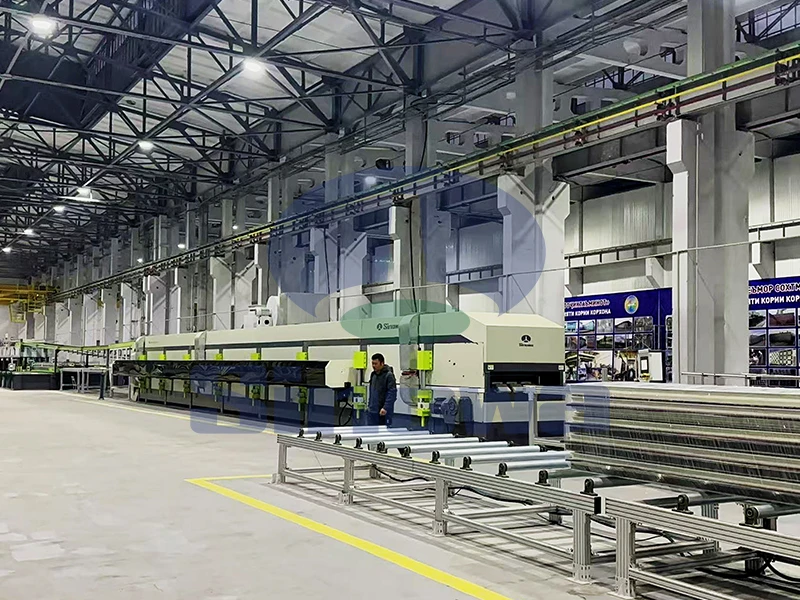
The PU sandwich panel forming line is a continuous automated production system designed for manufacturing rigid polyurethane insulated sandwich panels. It realizes the compounding of surface skins and foamed PU core materials through coordinated mechanical conveying, high-pressure foaming, continuous curing, shaping and cutting. The core working principle relies on the in-situ chemical foaming reaction of polyurethane raw materials. After two-component PU raw materials are fully mixed under high pressure, they are evenly poured between the upper and lower facing materials. With the set temperature and pressure environment inside the double-belt conveyor, the mixed liquid expands rapidly, foams and solidifies into a compact, low-density insulation core. The foaming core forms a firm bonding structure with the upper and lower skins synchronously, and the integrated composite panel is continuously formed without secondary adhesive treatment. The whole forming process runs continuously, avoiding the discontinuity and unstable bonding quality of batch production.
Main Components of the Whole Machine
The PU sandwich panel forming production line consists of multiple functional units connected in sequence, and each unit matches the production rhythm to ensure stable continuous operation.
Unwinding unit: It is used to place and release coiled metal or non-metal facing materials, equipped with tension adjustment and deviation correction devices to keep the surface material flat and aligned during feeding.
Surface material pre-treatment unit: It completes surface cleaning, embossing, grooving and preheating of the facing materials, which helps improve the bonding strength between the skins and PU foam core.
High-pressure PU foaming and pouring unit: This unit stores, meters and mixes polyol and isocyanate raw materials, and evenly sprays the mixed foaming material on the lower facing material through a movable pouring head.
Double-belt continuous laminating and curing unit: As the core forming section, it provides constant pressure and temperature support. The upper and lower circulating steel belts clamp the materials to control the thickness of the sandwich panel and maintain a stable curing environment for PU foaming.
Edge sealing and trimming unit: It shapes the two side edges of the panel, removes excess foaming materials and forms regular panel side profiles.
Continuous cutting unit: It cuts the continuously formed long panel into finished products of preset length by flying saw cutting without stopping the production line.
Finished product conveying and stacking unit: It transports the cut panels out of the forming area and automatically stacks the qualified panels for packaging.
Auxiliary heating and circulating unit: It provides stable heat source for the curing section and maintains the temperature balance required for the foaming reaction.
Production Process Flow
The production of PU sandwich panels follows a continuous closed-loop process. After the facing coils are installed on the unwinding rack, the surface materials are pulled forward at a constant speed. After pre-treatment and preheating, the lower facing material enters the pouring station, where the metered PU mixed material is evenly distributed on its surface. Then the upper facing material is closed and covered, and the composite enters the double-belt laminating section for pressurization, heat preservation and foaming curing. After the PU core is fully solidified and bonded with the skins, the semi-finished panel passes through edge trimming to standardize the width dimension. Subsequently, the continuous strip panel is cut to the required length by the flying saw cutter. The cut finished panels are inspected on the conveying table, and qualified products are transported to the stacking area for stacking.
Loading and unwinding of upper and lower facing materials
Surface cleaning, forming and preheating of facing materials
Proportional metering and high-pressure mixing of PU raw materials
Uniform pouring of PU mixture onto the lower facing sheet
Covering with upper facing material and entering double-belt laminating section
Constant-pressure foaming, thermal curing and composite forming
Edge trimming and edge shaping of the continuous panel
Flying saw fixed-length cutting
On-line inspection of finished panels
Conveying, stacking and packaging of finished products
Available Panel Types and Application Scenarios
This forming line can produce multiple types of PU sandwich panels by changing the types of facing materials and adjusting process parameters. Common products include metal-faced PU sandwich panels, color steel PU panels, aluminum-faced PU panels, and composite panels with fiber cement or non-metal decorative skins. It can also produce panels with different core thicknesses and surface textures according to requirements, as well as panels with built-in tongue-and-groove structures for easy assembly. These panels are widely adopted in many fields that require thermal insulation, sound insulation and weather resistance. They serve as wall and roof enclosures for prefabricated buildings, clean rooms and cold storage warehouses. They are also used for thermal insulation enclosures of mobile modular houses, agricultural planting greenhouses and industrial workshop partitions. In addition, such panels can be applied to the inner and outer decorative insulation layers of buildings, as well as the compartment and thermal insulation components of special transport vehicles.
Metal skin PU sandwich panels: prefabricated workshop roofs and walls, modular housing enclosure
Color steel PU sandwich panels: cold storage, constant temperature warehouse, fresh-keeping storage thermal insulation structure
Aluminum skin PU sandwich panels: clean workshop, dust-free laboratory enclosure system
Non-metal decorative skin PU panels: building interior insulation and decorative integration wall
Tongue-and-groove type PU sandwich panels: quick-assembly temporary buildings and container houses
Equipment Advantages and Characteristics
The PU sandwich panel forming manufacturing line realizes fully continuous production, which greatly improves production efficiency compared with intermittent foaming equipment. The high-pressure foaming system ensures accurate proportioning of raw materials, so the density and thermal insulation performance of the PU core are uniform across the whole panel. The double-belt laminating structure can precisely control the panel thickness and flatness, reducing the deformation rate of finished panels. The whole line has flexible adjustability; production parameters such as panel thickness, width and length can be adjusted within a certain range to meet diversified order demands. The bonding between the PU core and facing materials is completed in one step during foaming, which has stable bonding performance and avoids the risk of degumming caused by secondary glue application. The equipment runs with low material waste and can effectively control the consumption of polyurethane raw materials. The modular unit layout facilitates daily maintenance and component replacement.
Continuous automatic forming, high production capacity and stable production rhythm
Precise raw material metering and uniform foaming, consistent insulation performance of core material
Double-belt constant pressure forming, high flatness and accurate thickness tolerance of panels
Wide adjustment range of product specifications, supporting customized panel size production
One-step foaming composite molding, reliable adhesion between core and facing skins
Optimized raw material utilization, low production waste and good economic benefit
Modular unit layout, convenient routine maintenance and quick replacement of wearing parts
Low noise operation and good on-site working environment
Control System and Quality Control
The PU sandwich panel line adopts a centralized programmable control system. The touch human-machine interface is used to set and display key parameters including line speed, raw material ratio, pouring flow, curing temperature, cutting length and tension value of facing materials. The system supports real-time monitoring of the running status of each unit, and will trigger alarm and protective stop when abnormal parameters such as raw material shortage, material deviation and over-temperature occur. Multiple sets of sensors are distributed in the foaming, laminating and cutting sections to feed back data to the main controller dynamically.
For product quality control, on-line detection items cover the surface flatness of panels, overall thickness, edge dimension and bonding state. Operators can sample the finished panels regularly to check the foaming compactness of the core layer and thermal insulation effect. All production parameter records can be stored for traceability, which helps to adjust the process in time when quality fluctuation appears. The linkage control between each unit prevents the mismatch of feeding speed and foaming speed, effectively reducing defective products such as hollow foaming, poor bonding and uneven thickness.
Installation, Matching and After-sales Service
Before PU sandwich panel machine installation, the site needs to be leveled and reserved with reasonable space for material feeding, equipment layout and finished product turnover. Corresponding power supply, compressed air pipeline and raw material storage area should be configured to match the operation requirements of the production line. The equipment is assembled by connecting each functional unit in sequence, and the alignment, tension, temperature and speed of each station are calibrated one by one after mechanical assembly. Then no-load test and simulated material test run are carried out to verify the coordination of the whole line.
After the PU sandwich panel equipment is delivered, technical support covers on-site installation guidance, equipment commissioning and operation training for on-site operators. The training content includes normal startup and shutdown procedures, parameter setting, routine inspection points and common fault judgment methods. Long-term after-sales support provides remote technical consultation for operation problems. Spare parts supply channel is available for vulnerable components of the production line. Technical personnel can guide the replacement and maintenance of parts remotely. Regular follow-up service is provided to assist users in optimizing production processes according to their product types, so as to keep the equipment running in good condition for a long time.
Keyword: PU Sandwich Panel Forming Line, PU Sandwich Panel Forming Production Line, PU Sandwich Panel Forming Manufacturing Line