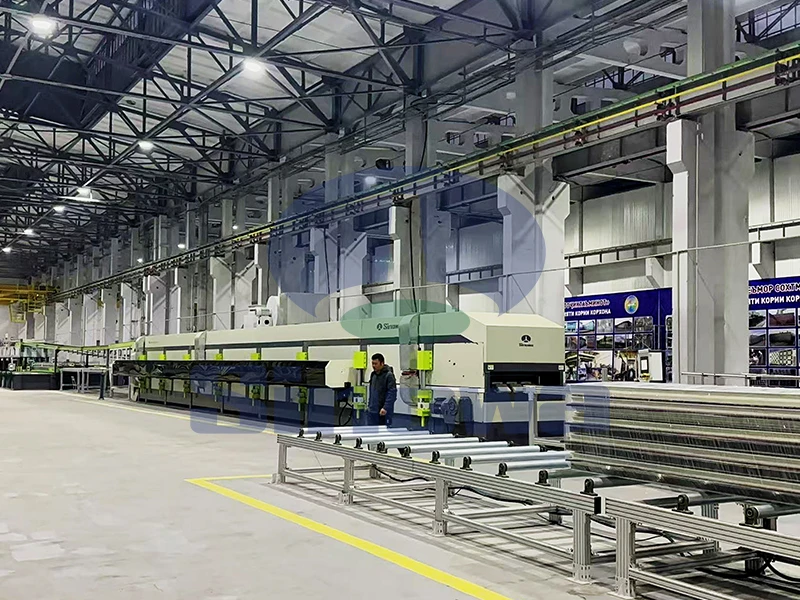
A PU sandwich panel plant is a complete set of continuous production equipment specially developed for manufacturing polyurethane composite sandwich panels. It takes polyurethane as the core foaming and insulating core material, combines different surface facings through continuous mixing, foaming, laminating and curing procedures, and forms integrated sandwich panels with stable structure. This production line can realize automated continuous forming instead of manual single-piece manufacturing, which greatly improves the consistency of finished panels. The whole production process is controlled in a closed and sequential working mode to ensure that the foaming reaction of polyurethane proceeds under stable temperature and pressure conditions, so that the core layer forms uniform and compact foam tissue, and the core material is firmly bonded with upper and lower surface sheets.
Main Components of the Whole Plant
The PU sandwich panel making plant consists of multiple functional units connected in sequence, and each unit cooperates with each other to complete the continuous production of panels. Every component is designed for long-time continuous operation and convenient maintenance.
Unwinding unit: Used for placing and steadily releasing different surface raw sheets, equipped with tension adjustment devices to avoid wrinkling and deviation of facings during conveying.
Surface sheet pretreatment unit: Finishes cleaning, guiding and preheating of the surface materials to enhance the bonding effect between facings and polyurethane foam.
Polyurethane metering and mixing unit: Accurately conveys polyether polyol and isocyanate raw materials according to the set proportion, and realizes uniform mixing of raw materials inside the mixing head.
Foaming and laminating forming unit: The mixed PU material is evenly poured on the lower surface sheet, and then covered with the upper sheet. The composite material enters the curing section for foaming and bonding under the constraint of the forming mold.
Continuous curing unit: Provides a constant temperature environment for the foaming core layer to complete chemical crosslinking reaction, so that the core material reaches the required hardness and bonding strength.
Traction unit: Pulls the composite slab forward at a stable and adjustable speed, matching the foaming reaction rate of polyurethane.
Cutting unit: Cuts the continuous slab into finished panels of preset length through flying cutting without stopping the production line.
Output and stacking unit: Conveys the cut panels out of the line and arranges the finished products neatly for subsequent packing.
Production Technological Process
The production of PU sandwich panels is a continuous and cyclic technological flow. Raw materials enter the line from the unwinding station and go through a series of physical transportation and chemical reaction steps before becoming qualified finished panels. The running speed of the whole line can be adjusted according to the thickness of panels and formula of PU raw materials.
Loading of surface raw materials: Install the coil facings on the unwinding rack and adjust the tension system to keep the surface sheets flat.
Surface material preprocessing: The surface sheets pass through the guide roller and preheating area to remove surface impurities and reach the suitable bonding temperature.
Raw material proportioning and mixing: The PU two-component raw materials are pumped to the mixing head with precise flow control and fully mixed.
Pouring and distribution: The mixed liquid PU material is evenly poured onto the lower surface sheet and spread to the required width.
Composite lamination: The upper surface sheet is covered on the PU liquid layer, and the composite enters the forming mold to control the panel thickness.
Foaming and curing: Inside the curing channel, the PU mixture foams and expands, fills the cavity between two surface sheets, and completes curing and bonding.
Continuous traction conveying: The cured composite slab is pulled forward at a constant speed.
Fixed-length cutting: The flying saw cuts the continuous slab into finished panels of specified length.
Output, inspection and stacking: Finished panels are transported out of the line, inspected visually and stacked orderly.
Available Panel Types and Application Scenarios
This PU sandwich panel production plant can produce a variety of sandwich panels by changing the types of surface facings and adjusting the formula of the polyurethane core layer. Different finished panels have different mechanical performance and thermal insulation performance to adapt to diverse usage environments.
PU sandwich panels with metal facings: Featuring high structural strength and good surface flatness, they are widely used for wall and roof enclosure of prefabricated buildings, workshops, warehouses and cold storage buildings.
PU sandwich panels with non-metal facings: Light in weight and with good sound insulation performance, they are suitable for interior partition of clean rooms, temporary office spaces and exhibition booths.
Fire-retardant modified PU sandwich panels: Adopting special core material formula, they are applied in places with higher requirements for fire safety of building enclosure.
Ultra-thick thermal insulation PU sandwich panels: With low thermal conductivity, they are the preferred enclosure material for low-temperature storage facilities and constant-temperature workshops.
Advantages and Characteristics of the Equipment
The PU sandwich panel production line adopts continuous forming design, which has obvious advantages compared with intermittent production equipment. Its structural design focuses on stable operation, flexible adjustment and low operation cost.
High production efficiency: It supports uninterrupted continuous production, and the output is much higher than that of batch-type panel making equipment.
High flexibility of product adjustment: Panel thickness, production speed and raw material formula can be adjusted conveniently to produce multiple specifications of panels on one line.
Stable bonding quality: The closed foaming environment and accurate raw material proportioning ensure consistent bonding strength between core layer and surface sheets for each batch of products.
Low heat conductivity of finished panels: The polyurethane core formed by this equipment has fine and uniform foam pores, bringing excellent thermal insulation effect.
Compact layout of the whole line: It occupies a reasonable workshop area and is convenient for workshop layout and daily management.
Low waste rate: The metering and pouring system can precisely control the consumption of PU raw materials and reduce unnecessary raw material waste.
Simple operation logic: The operation flow is standardized, and operators can master the production operation after systematic training.
Control System and Quality Control
The whole PU sandwich panel manufacturing plant is equipped with an integrated control system, which centrally manages the parameters of each unit on the production line. Operators can view and adjust key production parameters on the human-machine interaction interface. The system can realize interlock protection among all stations. If abnormal parameters appear in any unit, the system will send prompt signals to avoid large batches of defective products.
In terms of quality control, the production line monitors raw material flow, line speed, curing temperature and panel thickness in real time. Sampling inspection is carried out regularly on the finished panels to check the surface appearance, core foaming uniformity and bonding state. All production parameter records can be stored for traceability of finished product quality.
Installation, Matching and After-sales Service
Before installation, the site layout plan of the production line will be confirmed according to the workshop condition, including the requirement of ground bearing, power supply and ventilation configuration. Professional technical personnel guide the on-site assembly, alignment and connection of each unit of the plant. After mechanical installation, pipeline inspection, electrical debugging and trial production will be carried out step by step until the whole line runs stably. Supporting items include auxiliary tools for daily maintenance and spare parts for vulnerable components.
For after-sales service, technical support is provided remotely to solve common operation faults. On-site service can be arranged when it is necessary to repair and adjust key units. Regular technical guidance is available to help users carry out daily maintenance, prolong the service life of the plant and keep the sandwich panel line in stable running condition.
Keyword: PU Sandwich Panel Plant, PU Sandwich Panel Making Plant, PU Sandwich Panel Production Plant, PU Sandwich Panel Manufacturing Plant