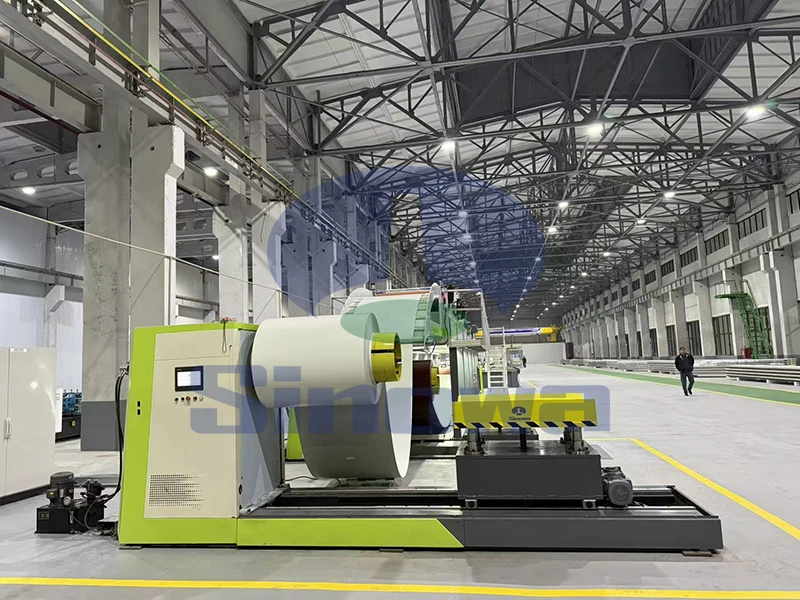
The PU sandwich panel production system is a continuous automated manufacturing line designed to produce composite sandwich panels with rigid polyurethane foam as the core material. It integrates raw material feeding, foaming, laminating, shaping, curing, cutting and conveying into one coordinated production process. Under controlled temperature and pressure conditions, liquid polyurethane components undergo chemical reaction to form closed-cell foam, which bonds firmly with two surface layers. This production mode realizes continuous forming of integrated panels, ensuring stable bonding performance, uniform foam density and consistent panel dimension across finished products.
Main Components of the Whole Machine
The complete PU sandwich panel manufacturing system consists of multiple functional units that work synchronously during operation. Each unit undertakes an independent production task while keeping pace with the overall line speed to avoid quality defects caused by mismatched running parameters.
Raw material feeding and metering unit: It stores, stirs and precisely meters polyol and isocyanate raw materials, and delivers mixed liquid materials to the foaming area at a stable flow rate.
Surface layer unwinding and pre-treatment unit: It releases metal sheets or other facing materials, and completes surface cleaning, guiding and preheating before lamination.
Continuous foaming and mixing unit: It mixes two polyurethane raw materials evenly and evenly distributes the reaction liquid between the upper and lower facing layers.
Double-belt laminating and forming unit: It adopts upper and lower circulating steel belts to apply constant pressure, control panel thickness and complete the preliminary curing of PU foam core.
Heating and curing unit: It provides a constant temperature environment to promote sufficient foaming and curing of polyurethane materials, so that the core material reaches the expected structural strength.
Fixed-length cutting unit: It cuts continuous long panels into specified sizes according to preset length signals without damaging the surface and core layer.
Finished product conveying and stacking unit: It transports cut panels out of the production line and completes automatic stacking for subsequent packaging and handling.
Auxiliary pneumatic and hydraulic unit: It provides power for clamping, adjustment and tensioning actions of each mechanical structure.
Production Process Flow
The production of PU sandwich panels follows a continuous and sequential workflow. Every parameter in each step will directly affect the flatness, thermal insulation performance and bonding strength of final panels.
Facing material unwinding: Upper and lower surface materials are unwound steadily, and the tension is adjusted to prevent wrinkles and deviation during conveying.
Raw material mixing and pouring: Polyurethane raw materials are proportioned and mixed, then poured uniformly on the lower facing material.
Lamination and foaming: The upper facing material covers the mixed liquid, and the material enters the double-belt pressing section. The polyurethane mixture expands and foams under pressure.
Constant-pressure forming: The circulating steel belts maintain fixed thickness and pressure, restricting the foaming range to form a flat sandwich structure.
Thermal curing: The semi-finished panel passes through the curing tunnel for sufficient chemical curing to stabilize the foam structure.
Length detection and cutting: The system detects the running length of the panel and triggers the cutting device to cut panels to the required specification.
Finished product output and stacking: Qualified panels are conveyed out and stacked neatly, ready for packaging.
Available Panel Types and Application Scenarios
This production system can produce multiple types of PU sandwich panels by replacing different surface facing materials and adjusting formula and process parameters. Different panel configurations correspond to different usage environments and functional requirements.
Metal-faced PU sandwich panels: With color coated steel, galvanized steel or aluminum sheets as two sides, they feature high mechanical strength and good weather resistance. They are widely used for exterior wall cladding, roof enclosure, partition wall of industrial workshops, cold storage enclosures and clean room enclosures.
Flexible sheet-faced PU sandwich panels: With waterproof membrane or composite fabric as surface layers, they are lightweight and easy to bend. They are suitable for temporary enclosure structures, mobile facility linings and special thermal insulation covering projects.
Non-metal hard board-faced PU sandwich panels: With cement fiber boards or calcium silicate boards as facings, they have favorable surface rigidity. They are commonly adopted for interior partition walls and thermal insulation structures with special surface requirements.
Composite functional PU sandwich panels: Produced with modified PU formulas, these panels obtain enhanced performance. They are applied in temperature-controlled storage spaces and facilities requiring noise reduction together with thermal insulation.
Equipment Advantages and Characteristics
The PU sandwich panel production line adopts continuous forming technology, which stands out compared with intermittent panel production equipment in production efficiency and product consistency. Its structural design is oriented to long-time stable operation and convenient parameter adjustment.
High continuous production efficiency: The line can run continuously for a long time to realize uninterrupted panel forming, greatly improving output capacity.
Stable product consistency: Closed-loop control of material flow, pressure and temperature reduces differences in foam density, thickness and bonding effect among panels.
Flexible parameter adjustment: Operators can adjust line speed, raw material ratio and forming pressure to produce panels with different thickness and density.
Good adaptability of raw materials: It supports matching different surface materials and polyurethane formulas to meet diversified panel production demands.
Low material waste rate: Precise metering and uniform pouring reduce excess raw material consumption in the foaming process.
Compact and reasonable layout: The arrangement of each functional unit saves workshop space and facilitates daily inspection and maintenance.
Control System and Quality Control
The PU sandwich panel line is driven by an integrated automatic control system. It collects real-time data from sensors installed on each station and synchronously controls motors, metering pumps, heating modules and cutting actuators. Operators can view running data and modify production parameters through the human-machine interface. Key monitored parameters include raw material flow ratio, line running speed, forming pressure, curing temperature and panel cutting length.
For quality control, real-time monitoring is carried out during the whole production process. Abnormal signals such as raw material flow deviation, material deviation and temperature fluctuation will trigger alarm prompts. Sampling inspection is conducted on finished panels to check surface appearance, bonding condition, core uniformity and dimension accuracy. Unqualified products can be isolated at the output section to avoid mixing into qualified finished goods. The stored production data can be traced for parameter review when quality problems occur.
Installation Guidance and After-sales Service
Before PU sandwich panel machine installation, the site foundation needs to be leveled and reserved with matched power supply and ventilation conditions according to the layout drawing of the production line. Technicians will guide the positioning, alignment and connection of each unit on site, and complete the pipeline connection of raw material circuits, pneumatic circuits and electrical circuits. After mechanical assembly, step-by-step single-unit test and whole-line linkage test will be carried out, followed by trial production to optimize running parameters.
The supporting after-sales service covers operation training for on-site staff, including equipment operation, parameter adjustment, daily lubrication and common fault judgment. Long-term technical consultation is available for production adjustment demands. Spare parts supply service is provided for wearing components of the line. Remote technical support can be offered to assist troubleshooting when the equipment encounters abnormal operation. Regular maintenance reminders are provided to help users extend the service life of the production system and maintain stable production status.
Keyword: PU Sandwich Panel Production System, PU Sandwich Panel Manufacturing System, PU Sandwich Panel Making System