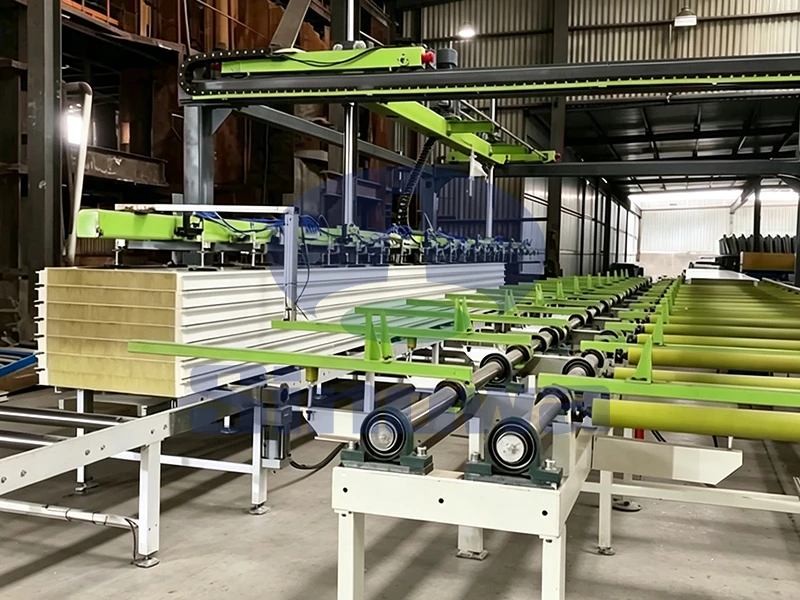
A rock wool insulation panel production line is a set of continuous industrial equipment designed to convert natural rock raw materials into finished rock wool panels with stable thermal insulation, sound absorption and fire-resistant performance. It relies on high-temperature melting, fiber forming and subsequent composite forming processes to turn bulk rock feedstock into flat, uniform boards that can be directly used for thermal and acoustic management. The whole system runs in a coordinated continuous mode, where each functional unit is linked sequentially to avoid intermittent production interruption and ensure consistent product morphology.
Working Principle
The core working principle of the rock wool sandwich panel production line is high-temperature fiberization and curing forming. Basalt and other mineral raw materials are fed into a melting furnace and heated to a molten state at extremely high temperature. The flowing molten mineral liquid is then thrown into fine fibers through centrifugal spinning. A small amount of binder is sprayed evenly onto the newly formed rock wool fibers to bond loose fibers together. After spreading and pre-forming, the fiber mat enters a curing oven under controlled temperature to trigger the curing reaction of the binder. The cured wool mat is cooled, trimmed and cut into specified sizes, and can be compounded with facing materials according to demand. Through the whole process, disordered loose rock wool fibers are fixed into rigid or semi-rigid panel structures with stable shape and physical performance.
Main Components of the Whole Machine
The production line consists of multiple interconnected functional sections, and each part undertakes an independent production task while matching the running speed of adjacent units.
Raw material feeding and batching unit: Conveys and proportionally mixes mineral raw materials, and stably sends materials into the melting furnace.
High-temperature melting and fiber spinning unit: Includes melting furnace, centrifugal spinning machine and binder spraying device, which completes melting, fiber formation and binder addition.
Wool collecting and laying unit: Collects rock wool fibers and lays them into uniform fiber mats with controllable thickness and density.
Pre-pressing and shaping unit: Pre-compresses the loose fiber mat to preliminarily fix the thickness and reduce internal gaps.
Curing oven unit: Provides constant temperature environment for binder curing to form stable rock wool substrate.
Cooling and conveying unit: Gradually reduces the temperature of cured rock wool boards to facilitate subsequent processing.
Edge trimming and cross-cutting unit: Trims irregular edges and cuts continuous rock wool belts into panels of required dimensions.
Facing composite unit (optional): Attaches surface facing materials on one or both sides of rock wool boards.
Finished product stacking unit: Automatically stacks finished rock wool panels for convenient transfer and packaging.
Production Process Flow
The production of rock wool insulation panels follows a continuous sequential flow. Raw materials are proportioned and transported to the melting furnace for high-temperature melting. Molten mineral liquid is centrifuged into fine rock wool fibers, and adhesive is sprayed synchronously during fiber formation. The fibers fall onto the collecting conveyor to form a layered wool mat. The wool mat is pre-pressed to adjust density and thickness, then delivered into the curing oven for heat curing. After curing, the rock wool substrate is conveyed to the cooling section for temperature reduction. The continuous rock wool belt is trimmed on both sides and cut to preset lengths. If composite panels are required, facing materials are laminated before cutting. Finally, finished panels are stacked and packaged.
Raw material batching and feeding
High-temperature melting of mineral materials
Centrifugal fiber spinning and binder spraying
Fiber collection and wool mat laying
Pre-pressing and thickness adjustment
Thermal curing in curing oven
Conveying and cooling of rock wool substrate
Edge trimming and fixed-length cutting
Surface facing composite (optional)
Finished product stacking and packaging
Available Panel Types and Application Scenarios
This rockwool sandwich panel line can produce multiple types of rock wool insulation panels by adjusting process parameters and adding composite structures. It can manufacture ordinary bare rock wool boards, single-sided faced rock wool panels and double-sided faced rock wool panels. By adjusting the laying speed and pressing pressure, products with different bulk densities and thicknesses can be obtained to meet different functional requirements.
Ordinary bare rock wool insulation panels: Mainly used for hidden thermal insulation layers where no decorative surface is required.
Single-sided composite rock wool panels: Equipped with one layer of facing material, convenient for direct installation and surface protection.
Double-sided composite rock wool panels: Covered with facing materials on both sides, with better moisture resistance and integrity.
Special-density rock wool panels: Customized density for sound absorption or load-bearing matching needs.
These rock wool panels are widely used in many fields. They serve as building envelope insulation for exterior walls, roof structures and partition walls of buildings. They are applied in industrial equipment and pipeline thermal insulation to reduce energy loss of high-temperature facilities. They are used in ventilation and air duct systems for heat preservation and noise reduction. They can also be arranged in indoor spaces as sound-absorbing components to improve acoustic environment. In addition, they are suitable for cold storage and low-temperature warehouse insulation systems to stabilize internal temperature.
Advantages and Characteristics of the Equipment
This rock wool sandwich panel machine adopts continuous continuous layout design to realize automatic connection of each working section, which effectively reduces manual intervention in the production process. The spinning and laying system can adjust the uniformity of fiber distribution, so that the density of finished panels keeps consistent in the whole board surface. The curing oven adopts balanced temperature control design, which makes the binder curing reaction uniform and avoids local performance difference of rock wool boards. The line has strong parameter adjustability, and users can switch products of different thicknesses, densities and composite forms within a certain range. The conveying system runs smoothly with low vibration, which helps reduce the damage rate of semi-finished rock wool mats. The structural layout reserves expansion space, so the facing composite unit and other auxiliary devices can be added according to later production needs.
Continuous automatic production reduces labor intensity and improves production efficiency.
Adjustable process parameters support diversified product specification switching.
Uniform fiber laying and stable curing ensure stable physical performance of finished panels.
Smooth conveying structure reduces deformation and breakage rate of semi-finished fiber mats.
Modular design allows flexible addition of optional functional units.
Reasonable heat distribution of curing unit helps control energy consumption in the curing stage.
Control System and Quality Control
The whole rock wool board production line is equipped with an integrated control system. Operators can set and modify key parameters such as feeding speed, spinning rotating speed, binder flow rate, laying frequency, curing temperature and conveying speed on the operation interface. The system can realize interlock protection among each unit; when abnormal conditions occur in a single section, relevant front and rear equipment will respond correspondingly to prevent mass defective products. Real-time running data of each station can be displayed on the interface for operators to monitor the production state.
Quality control runs through the whole production process. Sampling inspection is carried out regularly on the semi-finished wool mat to check thickness uniformity. After curing, the substrate is inspected for surface integrity and bonding condition. For cut finished panels, dimension precision and surface flatness are checked. For composite products, the bonding firmness between rock wool core and facing layer is verified. All inspection records can be tracked according to production batches, which helps trace abnormal quality problems and adjust process parameters in time.
Installation Support and After-sales Service
For the installation of the rock wool insulation panel production line, technical support is provided for site layout planning before equipment arrival. Guidance on foundation construction, space arrangement and reserved channel design is offered according to the overall size and heat dissipation requirements of each unit. After the equipment arrives, technicians guide the positioning, assembly, pipeline connection and wiring work of each module. Commissioning work is carried out step by step: single machine test runs first, then linkage test of the whole line, and trial production is arranged until stable qualified products are produced. Operation training is provided for on-site operators, covering normal startup and shutdown, parameter adjustment, daily inspection and common fault judgment.
The after-sales service system provides long-term technical consultation support after rockwool panel manufacturing equipment delivery. Guidance on daily maintenance and wearing parts replacement is available. When equipment failures occur, technical support is provided for fault analysis and troubleshooting. Upgrade guidance for process adjustment and auxiliary module retrofitting can be provided in the later period according to the user’s production demand change. Regular follow-up communication is arranged to collect equipment operation feedback and give suggestions for maintenance and production optimization.
Keyword: Rock Wool Insulation Panel Production Line, Rock Wool Panel Production Line, Rock Wool Board Production Line