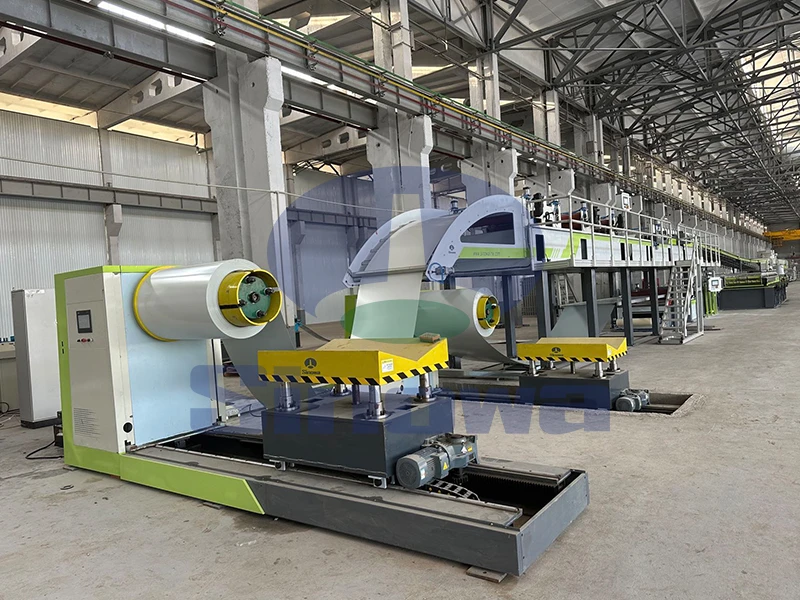
A sandwich panel fabrication machine is a continuous production system engineered to combine different core insulating materials with metal or non-metal facing sheets into integrated composite panels. It supports the processing of polyurethane, PIR, phenolic foam, rock wool, mineral wool and glass wool cores, adapting to both foam in-situ foaming and prefabricated rigid insulation core feeding modes. The machine completes material feeding, forming, bonding, curing, cutting and stacking in a coordinated workflow, delivering finished panels with stable structural performance and consistent thermal insulation property. It is designed for flexible switching among multiple core materials, which greatly expands the application scope of end products.
Working Principle
The sandwich panel fabrication machinery operates based on the composite bonding principle of facing skins and insulating cores. For foam-type cores including polyurethane, PIR and phenolic, raw chemical components are proportionally mixed and injected between two moving facing sheets; the mixture expands and cures under controlled temperature and pressure inside the forming section to form a continuous foam core tightly adhered to the facings. For fibrous insulation cores such as rock wool, mineral wool and glass wool, pre-cut core strips are continuously arranged and positioned between upper and lower facings. Adhesive is applied as required, and the whole assembly passes through the pressing and curing zone to achieve reliable bonding between skins and cores. Continuous linear movement synchronizes all stations, so the semi-finished composite strip is cut to preset lengths automatically after curing, forming individual sandwich panels.
Main Components of the Whole Machine
The complete sandwich panel fabrication line consists of interconnected functional units, and each part works synchronously under unified coordination.
Facing sheet unwinding unit: It holds and releases coil materials for upper and lower surface skins, equipped with deviation correction devices to keep sheets running on the correct track.
Surface sheet pre-treatment unit: It carries out leveling, embossing and cleaning to improve surface adhesion for subsequent bonding.
Core material feeding unit: Dual-structure design for foam raw material metering and injection system and fibrous core automatic arranging and conveying mechanism.
Glue application system: It applies uniform adhesive layers on contact surfaces for fibrous core composite processes.
Continuous forming and pressing unit: It provides constant pressure and temperature environment to shape the composite structure and complete curing.
Traction unit: It drives the whole composite strip forward at a stable and adjustable speed.
Cutting unit: Flying saw cutting device that cuts panels to required length without stopping the continuous line.
Output and stacking unit: It conveys finished panels, aligns them and stacks them neatly.
Auxiliary pneumatic and hydraulic system: It supplies power for clamping, pressing and adjusting actions of all stations.
Production Process Flow
The production follows a continuous, sequential process, and parameters can be adjusted when switching between different core materials.
Load facing coils onto unwinding racks and thread upper and lower sheets through each station, activate the deviation correction system.
Start pre-treatment of facing sheets to ensure flat and clean bonding surfaces.
Select the corresponding production mode: start chemical raw material metering and injection for foam cores, or feed and arrange rock wool, mineral wool or glass wool core strips.
Apply adhesive if required for fibrous core production.
Send the assembled facings and core materials into the forming pressing section for shaping, thermal insulation curing and bonding.
The traction system pulls the continuous composite strip forward at the set line speed.
The flying saw cuts the continuous strip into panels of specified length automatically according to preset data.
Finished panels are conveyed out, aligned and stacked on the output platform.
Conduct visual and sampling inspection before the panels are transferred for packaging.
Available Panel Types and Application Scenarios
This fabrication line can manufacture multiple categories of sandwich panels with different core materials, and each type matches its own usage scenarios depending on thermal, fire and acoustic performance.
Polyurethane sandwich panels: Lightweight and excellent in thermal insulation, widely used for cold storage enclosures, temporary prefabricated buildings and interior partition systems.
PIR sandwich panels: Maintain low thermal conductivity at relatively high temperatures, suitable for industrial workshop enclosures, clean rooms and logistics warehouse roofing and wall systems.
Phenolic sandwich panels: Feature low smoke emission when exposed to heat, commonly adopted for underground spaces, public building partition walls and ventilation duct insulation covers.
Rock wool sandwich panels: Good high-temperature resistance and sound absorption performance, applied in factory fire compartment walls, power plant auxiliary buildings and exterior wall cladding.
Mineral wool sandwich panels: Stable fibrous structure with acoustic insulation capacity, used for gymnasiums, auditoriums and noise-isolation partition structures.
Glass wool sandwich panels: Lightweight fibrous insulation, suitable for ventilation enclosure systems and low-load roof insulation projects.
Equipment Advantages and Characteristics
The multi-core compatible sandwich panel production line integrates versatility, stability and operational convenience.
Multi-core compatibility: One line can switch between foam cores and fibrous insulation cores, reducing the need for separate dedicated production lines.
Continuous automatic production: High continuous running efficiency, lowering manual intervention and improving production consistency.
Adjustable product specifications: Panel thickness, width and length can be modified within the design range to meet customized orders.
Good bonding quality control: Constant pressure and temperature control in forming section avoids hollowing, delamination and uneven foaming.
Simple material switching: Core material feeding stations can be quickly reconfigured when changing production recipes.
Compact and reasonable layout: The whole line occupies a controlled factory area with convenient maintenance access for key components.
Low waste rate: Synchronized tracking and flying cutting reduce leftover materials during panel cutting.
Control System and Quality Control
The whole sandwich panel fabrication plant adopts a centralized control system with interactive operation interface. Operators can set line speed, temperature, pressure, cutting length, raw material ratio and glue dosage on the operation terminal. Real-time running status of each station is displayed on the screen, and abnormal signals will trigger prompts for timely troubleshooting.
Quality control runs through the whole production process. During production, the system keeps key processing parameters within the preset range. Operators carry out regular sampling checks on panel surface flatness, bonding integrity, overall thickness and dimensional accuracy. Visual inspection is performed on every finished panel to spot surface scratches, core dislocation and edge defects. Recorded production parameters for each batch provide reference for parameter adjustment and quality tracing.
Installation, Commissioning and After-sales Service
After the sandwich panel fabrication equipment arrives at the production site, installation work starts with site survey and foundation preparation. The units are positioned and aligned in sequence according to the layout drawing, followed by connection of power, pneumatic and hydraulic pipelines. Mechanical alignment and synchronization debugging are carried out to match the running speed of every station. Then no-load test run and trial production with raw materials are conducted to optimize parameters until stable qualified panels are produced.
The supporting after-sales service covers technical guidance for daily operation, routine maintenance training for on-site operators and remote technical support for fault diagnosis. Spare parts supply channel is available for wearing components. Technical support is also provided for recipe adjustment and parameter optimization when users develop new panel products. Regular maintenance reminders help extend the service life of the whole sandwich panel line and keep stable production capacity in long-term operation.
Keyword: Sandwich Panel Fabrication Machinery, Sandwich Panel Fabrication Line, Sandwich Panel Fabrication Equipment, Sandwich Panel Fabrication Plant