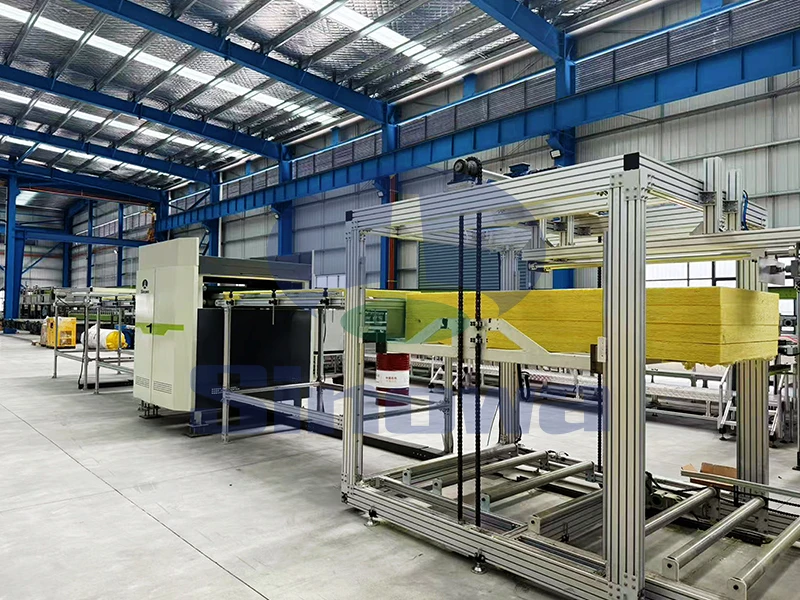
Sound insulation sandwich panel making machine is a specialized continuous production unit designed for manufacturing composite sandwich panels with outstanding sound absorption and sound insulation performance. It combines raw material feeding, core material laying, surface material compounding, pressing, shaping and cutting into one integrated production line. The finished panels produced by this equipment can effectively block the transmission of air-borne noise and reduce vibration noise, which are widely adopted in noise control construction projects. This production equipment achieves stable composite bonding between different surface sheets and sound-absorbing core materials under controlled pressure and running speed, realizing automated and continuous manufacturing of sound insulation sandwich panels.
Working Principle
The working principle of the sound insulation sandwich panel machine relies on continuous lamination and solid composite forming. After the surface base materials are unwound and guided into the production track, the sound insulation core material is evenly arranged and filled between the upper and lower surface layers. The adhesive system applies bonding materials uniformly on the contact surfaces of the core and surface layers. The composite materials then enter the pressing section, where constant pressure and matched running speed force tight fitting between each layer. After a short curing and shaping process, the integrated sandwich slab moves forward to the cutting unit. The cutting mechanism cuts the continuous slab into panels of preset dimensions. The whole process keeps synchronous matching of feeding speed, glue application amount and pressing pressure to avoid delamination, hollowing and uneven thickness, so as to guarantee the sound insulation performance and structural integrity of finished panels.
Main Components of the Whole Machine
The complete sound insulation sandwich panel production machine consists of multiple functional modules that coordinate with each other during operation. Each part undertakes an independent production task while maintaining synchronous linkage to ensure smooth running of the whole line.
Unwinding units: Used for placing and releasing coiled metal sheets or non-metal surface boards, equipped with tension adjustment devices to prevent wrinkling and deviation of surface materials.
Core material conveying and distributing device: Transport bulk or sheet-shaped sound insulation core materials, and spread the core materials evenly to control consistent thickness of the core layer.
Glue coating system: Realizes quantitative and uniform gluing on the surface of core materials or panel skins, with adjustable glue output according to production speed.
Guiding and positioning frame: Limits the horizontal position of all raw materials to prevent offset during compounding.
Continuous pressing unit: Provides stable clamping pressure for multi-layer composite materials, forming close combination of skins and core materials.
Curing and shaping section: Offers proper space for preliminary curing of adhesive to stabilize the composite structure before cutting.
Fixed-length cutting device: Cuts continuous long panels into required sizes through hydraulic or servo-driven cutting blades.
Finished product conveying and stacking frame: Transports cut panels out of the production line and supports manual or auxiliary stacking.
Protective cover and safety interlock parts: Isolate moving components and trigger pause signals under abnormal conditions for operational safety.
Production Process Flow
The production of sound insulation sandwich panels follows a fixed continuous flow. Every step is interlocked, and parameter adjustment on one working station will affect the quality of subsequent finished products. Operators need to inspect the material status at each node regularly to avoid continuous defective products.
Raw material preparation: Load coiled surface materials and sound insulation core materials onto corresponding feeding positions, check the material quality and adjust initial tension parameters.
Unwinding and material guiding: Start the unwinding mechanism; surface sheets are pulled forward along the guide track and calibrated to the central position of the production line.
Core material laying and distribution: The core material conveying system sends sound insulation filling materials to the middle layer between upper and lower skins, and flattens the core layer.
Automatic glue application: The glue coating system sprays or rolls adhesive on the bonding surfaces of core materials and skins.
Composite pressing: Multi-layer materials enter the pressing section, and continuous pressure makes each layer closely bonded.
Curing and shaping: The composite slab passes through the shaping area for adhesive setting to avoid deformation after cutting.
Fixed-length cutting: The servo cutting system executes cutting according to the preset length and width parameters.
Finished panel output and sorting: Cut sound insulation sandwich panels are conveyed out, and workers inspect appearance quality and stack qualified products.
Available Panel Types and Application Scenarios
This machine supports the production of various sound insulation sandwich panels by replacing core materials and matching different surface skins. Different combinations bring differences in sound insulation effect, weight, fire resistance and surface texture, adapting to diversified use demands.
Panel Types
Metal skin sound insulation sandwich panels: Take color steel sheets or aluminum sheets as surface layers, matched with porous sound-absorbing core materials; high structural strength and good weather resistance.
Non-metal skin sound insulation sandwich panels: Use fiber cement boards, calcium silicate boards or polymer boards as outer skins, with relatively light weight and convenient secondary processing.
Composite porous core sound insulation panels: Core materials adopt multi-layer mixed sound-absorbing fillers, designed for high noise reduction requirements.
Vibration-damping sound insulation sandwich panels: Add damping layers inside the core structure to weaken vibration-borne noise transmission.
Application Scenarios
Noise isolation walls for factory workshops and production equipment enclosures to reduce noise diffusion to surrounding areas.
Interior sound insulation partitions for entertainment venues, recording rooms and meeting rooms to block indoor cross noise.
Sound barrier structures along urban traffic roads and elevated passages to weaken traffic noise impact on nearby buildings.
Sound insulation enclosures for generators, air-conditioning units, fans and other noisy electromechanical equipment.
Acoustic decoration and noise control structures inside commercial buildings, gymnasiums and exhibition halls.
Temporary sound insulation enclosures for construction sites to lower construction noise disturbance.
Equipment Advantages and Features
The sound insulation sandwich panel manufacturing machine is developed targeting the special requirements of acoustic composite panels, which is different from ordinary thermal insulation sandwich panel production lines. It focuses more on the uniformity of core material paving and the stability of composite bonding, so as to maintain consistent acoustic performance of finished panels in mass production.
High degree of automation: Realizes continuous production from feeding to finished product cutting, reduces manual intervention and improves production efficiency.
Wide compatibility of raw materials: Can adapt to multiple surface skins and sound insulation core materials, and switch panel types by adjusting process parameters.
Precise thickness control: The pressing and distributing structure keeps stable core layer thickness, avoiding local weak sound insulation caused by uneven filling.
Adjustable running speed: Production speed can be adjusted according to order demand and material characteristics, balancing output and product quality.
Good consistency of finished panels: Continuous compounding effectively reduces the difference of sound insulation performance between different batches of panels.
Convenient operation and parameter storage: Common process parameters can be saved for quick switching when producing conventional panel specifications.
Compact and reasonable layout: The whole line occupies controllable space and is convenient for layout inside production workshops.
Control System and Quality Control
The sound insulation sandwich panel equipment adopts an integrated control system to realize centralized management of all functional units. The main control terminal displays real-time running status including line speed, glue flow, pressing pressure and cutting size. Each motor and executing component keeps synchronous signal connection; once the feeding speed of a single unit deviates from the set value, the system will send out prompt signals or pause the operation to prevent defective composite panels.
For quality control, on-site inspection covers multiple dimensions. Operators check the surface flatness of panels, whether delamination or hollowing exists at the bonding interface, and verify the dimension accuracy of cut panels. Sampling inspection on the sound insulation effect of finished products can be carried out periodically. If abnormal quality occurs, technicians can trace back the corresponding process parameters recorded by the control system, adjust glue amount, pressing pressure or core material paving thickness in a targeted way, and resume production after re-inspection reaches the qualified standard.
Installation Matching and After-sales Service
Before installation, users need to prepare a flat and load-bearing workshop foundation, reserve power supply space and enough passage for raw material turnover and finished panel storage. The sound insulation sandwich panel line shall be placed according to the production logistics direction, and auxiliary facilities such as glue supply pipelines and waste material collection devices shall be matched. During installation, each module is positioned and connected sequentially, followed by linkage debugging of all transmission, gluing, pressing and cutting parts. Trial production with raw materials will be conducted after mechanical connection to optimize process parameters until stable qualified panels are produced.
Standard after-sales support includes guidance for sound insulation sandwich panel production line installation, on-site commissioning and operation training for production staff. Technical support is available for troubleshooting of common running faults. Spare part supply channels are provided for wearing parts on the production line. Technical consultation services cover parameter adjustment when developing new panel formulas and replacing raw materials. Regular remote follow-up can be arranged to help users maintain the equipment, check the wear condition of key components and prolong the service life of the whole production line.
Keyword: Sound Insulation Sandwich Panel Machine, Sound Insulation Sandwich Panel Line, Sound Insulation Sandwich Panel Production Line