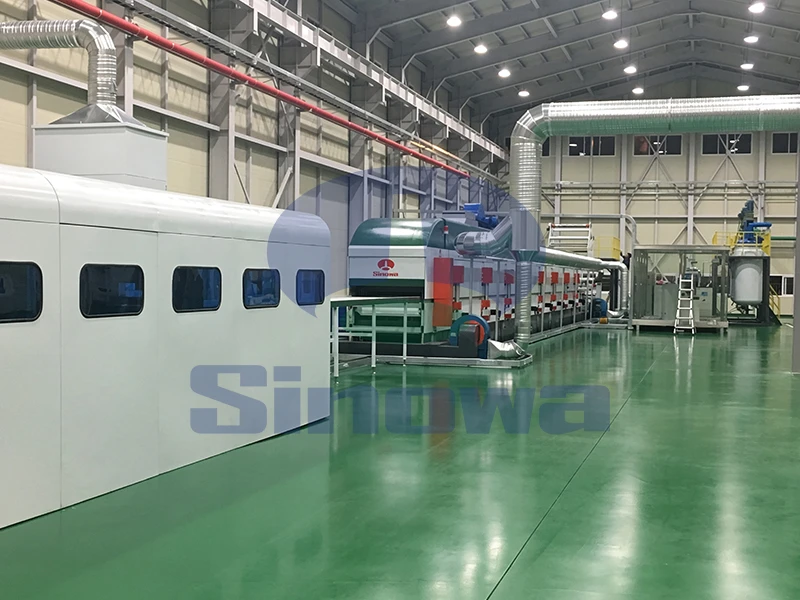
The thermal insulation sandwich panel manufacturing machine is a continuous integrated production system specially developed to produce composite insulation panels with different core materials. It can adapt to polyurethane (PU), polyisocyanurate (PIR), phenolic foam, rock wool, mineral wool and glass wool as inner core layers, combining metal or non-metal surface sheets and core insulation materials through continuous feeding, forming, pressing, curing and cutting. This type of production equipment realizes automated continuous molding instead of intermittent manual or semi-automatic fabrication, greatly stabilizing the structural integrity, thermal performance and surface flatness of finished sandwich panels. It is widely used to support the manufacturing of lightweight composite panels for building envelope, cold storage and industrial enclosure.
Working Principle
The whole thermal insulation sandwich panel machine follows the principle of continuous composite lamination and in-situ forming. Surface raw materials are unwound and conveyed forward synchronously from the upper and lower roll stands. For foam core materials such as PU, PIR and phenolic, raw chemical components are metered, mixed and sprayed evenly between the two surface layers, and chemical foaming and cross-linking reactions happen under controlled temperature and pressure inside the double-belt pressing section. For fibrous core materials including rock wool, mineral wool and glass wool, pre-cut core blocks or continuous fiber mats are automatically arranged and positioned between upper and lower facings, and adhesive is applied to bond the core and surface sheets tightly. Under constant clamping pressure and preset curing conditions, the composite structure forms a unified panel blank. After continuous traction, fixed-length cutting, edge trimming and stacking, qualified finished sandwich panels are obtained. All material feeding speed, pressing gap and curing parameters are matched to ensure consistent thickness, bonding strength and insulation performance of each panel.
Main Components of the Complete Machine
The thermal insulation sandwich panel production line consists of interconnected functional units, and each part works synchronously under unified scheduling.
Upper and lower sheet unwinding units: used to place and release coiled surface materials, equipped with tension adjustment devices to avoid wrinkling and deviation of facings.
Surface sheet pretreatment section: for surface cleaning, guiding, deviation correction and adhesive coating as required.
Core material feeding system: two optional structures, including high-pressure foaming and spraying unit for foam cores, and automatic core material conveying and arranging mechanism for rock wool, mineral wool and glass wool.
Double-belt continuous pressing machine: the core forming station, providing stable clamping pressure and temperature environment for foaming reaction or adhesive curing.
Traction unit: drives the composite panel blank to move forward at a stable line speed and coordinates the speed of all upstream stations.
Fixed-length cutting and trimming device: cuts continuous panel blanks into required dimensions and trims uneven side edges.
Panel turnover, conveying and stacking mechanism: transports finished panels and neatly stacks products for subsequent packaging.
Auxiliary pipeline and heating/cooling auxiliary system: maintains stable working temperature for foaming raw materials and pressing chamber.
Production Process Flow
The production proceeds in a continuous sequential flow, and different core materials only differ in the core feeding and forming section while sharing most downstream procedures.
Raw material preparation: load coiled surface sheets on unwinders, prepare foaming chemical raw materials or arrange bulk fibrous core materials.
Unwinding and tension control: upper and lower facings are released and guided into the production line with constant tension.
Deviation correction and surface treatment: the correction system keeps sheets centered; adhesive is coated if needed.
Core material compounding: spray mixed foaming materials between facings for PU/PIR/phenolic panels, or automatically lay rock wool, mineral wool or glass wool cores in position.
Continuous pressing and curing: the composite blank enters the double-belt press to complete foaming, cross-linking or adhesive bonding under pressure and temperature.
Continuous traction: the cured panel blank is pulled forward steadily.
Fixed-length cutting and edge trimming: panels are cut to customized lengths and edges are trimmed smoothly.
Inspection and conveying: preliminary visual inspection is carried out while panels are conveyed.
Stacking: finished panels are stacked neatly for packaging and storage.
Available Panel Types and Application Scenarios
This versatile production machine supports multiple categories of insulation sandwich panels, and each core material endows the panel with different functional properties to fit different usage demands.
PU sandwich panels: featuring low thermal conductivity and good sealing performance, suitable for cold storage, fresh-keeping warehouses and temporary clean rooms.
PIR sandwich panels: with improved high-temperature stability and thermal resistance, commonly used for building roofs, exterior walls and high-temperature workshop partitions.
Phenolic sandwich panels: with outstanding flame-retardant performance, suitable for public buildings, ventilation ducts and fire-separating enclosure structures.
Rock wool and mineral wool sandwich panels: mainly relied on for fire resistance and sound absorption, widely applied in factory walls, power plant enclosures and fire partition walls.
Glass wool sandwich panels: lightweight with good sound insulation and heat preservation, preferred for interior partition, air-conditioning duct wrapping and noise reduction projects.
These finished panels are all lightweight, easy to install and prefabricated, helping shorten construction cycles of enclosure projects. They can serve as roof panels, wall panels, partition panels and special functional panels for different industrial and civil buildings.
Equipment Advantages and Features
The integrated sandwich panel line has obvious comprehensive advantages compared with separated single-process equipment.
Wide material adaptability: one set of equipment can switch among PU, PIR, phenolic, rock wool, mineral wool and glass wool core materials by adjusting relevant units, meeting diversified production orders.
Continuous automatic operation: it reduces manual intervention in core laying, foaming, pressing and cutting links, lowering labor cost and human-caused defects.
Adjustable product specifications: panel thickness, width and production speed can be adjusted within the design range to produce customized sizes.
Stable composite quality: constant pressure and temperature control in the pressing section ensures uniform foaming density and reliable bonding between core and facings.
Compact layout design: the whole line arranges functional stations in sequence, occupying reasonable workshop space and facilitating daily operation and maintenance.
Flexible switching between foaming core and fibrous core modes, which only requires simple parameter modification and partial accessory replacement instead of major reconstruction.
Control System and Quality Control
The whole thermal insulation sandwich panel production machine adopts a centralized programmable control system. Operators set production parameters including line speed, pressing gap, foaming material ratio, spraying flow and cutting length on the human-machine interface. Real-time data of each station is displayed on the screen, and the system will trigger alarm and slow-down or stop actions when sheet deviation, material shortage or abnormal temperature occurs.
For quality control, key monitoring targets cover the thickness of finished panels, surface flatness, bonding condition between core and facings, uniformity of foaming layers and the integrity of fibrous core arrangement. Sampling checks are performed periodically during continuous production to verify composite stability. Cutting size accuracy is guaranteed by the fixed-length positioning module, and edge trimming removes loose or uneven parts to reduce defective products. Parameter records can be stored for traceability of production batches.
Installation Support and After-sales Service
Professional technical guidance is provided for on-site installation of the sandwich panel machine. Service teams assist with site layout planning, equipment foundation confirmation, unit alignment, pipeline connection and initial power-on debugging. Training sessions are offered for on-site operators, covering routine startup and shutdown, parameter adjustment, common fault judgment and daily maintenance methods.
After formal commissioning and handover, after-sales support includes remote technical consultation for operational problems and guidance for spare parts replacement. Regular maintenance reminders are provided to help users keep the sandwich panel manufacturing line in stable running condition. If abnormal working conditions appear, technical support can be arranged to analyze problems and give solutions, to minimize production downtime.
Conclusion
As a multi-functional continuous composite production solution, the thermal insulation sandwich panel manufacturing machinery can produce insulation panels with foam and fibrous cores including PU, PIR, phenolic, rock wool, mineral wool and glass wool. With automated feeding, pressing, curing and cutting procedures, it delivers stable and customizable insulation panels for various enclosure and thermal preservation projects. Flexible material switching, reliable control and complete supporting service make it a practical production facility for modern prefabricated insulation panel manufacturing.
Keyword: Thermal Insulation Sandwich Panel Machine, Thermal Insulation Sandwich Panel Line, Thermal Insulation Sandwich Panel Production Line