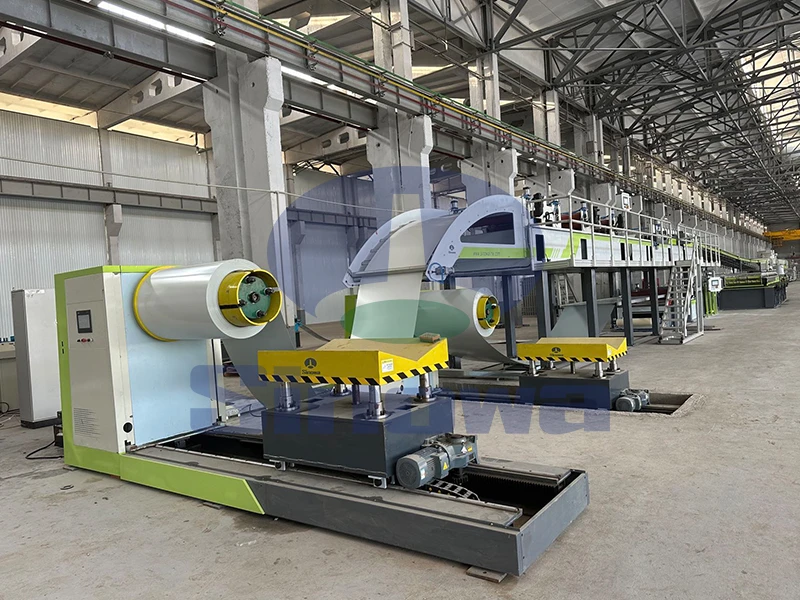
A turnkey PU sandwich panel line is an integrated, self-contained production system engineered for continuous manufacturing of polyurethane sandwich panels. The core working principle relies on the chemical reaction between polyol and isocyanate raw materials. Once blended under controlled conditions, the mixed PU foaming material expands rapidly, forms a uniform and compact foam core, and bonds firmly with two layers of surface facings. Under constant pressure, temperature and speed coordination within the forming section, the composite structure cures into a rigid, integral sandwich panel. This continuous forming method eliminates separate adhesive gluing procedures, delivers stable bonding strength between the foam core and facings, and supports uninterrupted long-run panel production.
Main Components of the Whole Machine
The complete sandwich panel production line is assembled by interconnected functional units, and every single section matches production speed to guarantee synchronized operation.
Raw material feeding and metering unit: Stores polyol, isocyanate and auxiliary additives, and precisely meters and conveys each component to the mixing head.
Continuous mixing and foaming unit: Mixes multiple liquid raw materials evenly at a preset ratio and sprays the foaming mixture onto the lower facing sheet.
Unwinding unit for surface facings: Holds and steadily releases upper and lower metal or non-metal facing rolls, with functions for sheet alignment and tension adjustment.
Double-belt forming and curing unit: Consists of upper and lower circulating conveyor belts, which apply stable clamping pressure and maintain curing temperature for foam shaping and solidification.
Side trimming unit: Trims the panel edges to reach consistent panel width and remove uneven foam overflow.
Flying saw cutting unit: Cures continuous long panels into customized finished lengths according to preset parameters without halting line operation.
Panel stacking and conveying unit: Transports cut panels away from the cutting station and neatly stacks finished products.
Waste collection unit: Collects edge trimmings and production scraps generated during trimming.
Production Process Flow
The whole manufacturing workflow runs in a continuous loop, and each procedure links sequentially to ensure consistent panel quality.
Preparation: Load facing rolls onto unwinders, fill raw material tanks, set production parameters including line speed, material ratio, forming temperature and target panel thickness.
Facing unwinding and alignment: Upper and lower facings are unwound synchronously, guided and corrected to avoid lateral deviation.
Raw material mixing and spraying: Metered PU components flow into the mixing head, get fully blended, and are evenly sprayed over the moving lower facing.
Foaming and composite forming: The upper facing closes over the foaming mixture; the assembly enters the double-belt press, where foam expands, bonds with facings and cures under pressure and heat.
Edge trimming: Both sides of the continuous panel are trimmed to achieve uniform width.
Length cutting: The flying saw tracks the moving panel and cuts it to the required finished size.
Output and stacking: Finished panels are conveyed out and stacked automatically for packaging and delivery.
Waste disposal: Trimmed scraps are collected for subsequent handling.
Produced Panel Types and Application Scenarios
This turnkey line supports the production of multiple categories of PU sandwich panels by switching facing materials and adjusting foam formulation.
Metal-faced PU sandwich panels: Using coated steel, aluminum alloy as facings; widely used for exterior wall cladding, roof enclosure, partition walls of industrial workshops, warehouses, logistics parks and cold storage buildings.
Non-metal-faced PU sandwich panels: With fiber cement board, magnesium oxide board or decorative polymer sheets as surface layers; suitable for interior partition systems, cleanroom enclosures, temporary prefabricated housing and noise reduction structures.
Special functional PU sandwich panels: Modified foam formulas can produce panels with enhanced thermal insulation or flame-retardant performance, for cold chain facilities, fresh-keeping warehouses and special enclosed spaces.
Thin decorative PU composite panels: Lightweight thin panels for interior decoration, suspended ceilings and modular decorative walls.
Advantages and Characteristics of the Equipment
This integrated PU sandwich panel production line brings obvious operational and product advantages compared with separate discrete machines.
High integration as a turnkey solution: All functional sections are matched for synchronized running, requiring less manual coordination between individual machines.
Stable continuous production capacity: Supports long-time non-stop operation, with steady output and lower fluctuation on panel thickness and density.
Flexible parameter adjustment: Operators can modify panel width, thickness, production speed and material formula to make different panel specifications on the same line.
Excellent foaming uniformity: Precision metering and high-efficiency mixing reduce foam voids, guarantee consistent thermal insulation performance across the whole panel.
Low labor demand: Automated unwinding, cutting and stacking reduce repetitive manual work and lower labor intensity.
Compact overall layout: Reasonable arrangement of each station saves factory floor space and facilitates routine maintenance.
Low material waste: Accurate metering and trimming control cut raw material consumption and reduce scrap rate.
Control System and Quality Control
The turnkey PU sandwich panel manufacturing line adopts a centralized human-machine interaction control system. Operators input target specifications on the touchscreen, and the system automatically adjusts raw material proportion, conveyor speed, forming temperature and cutting length. Real-time data of running status, material flow and temperature are displayed on the interface, and abnormal conditions will trigger automatic alarms to stop feeding or remind on-site staff.
For quality control, online monitoring tracks panel thickness, surface flatness and foam filling status during forming. Random sampling inspection is carried out on finished panels to check bonding integrity, core density and surface appearance. Deviations from preset standards can be corrected promptly by tuning control parameters before large batches of defective products are produced. All production parameter records can be stored for production traceability.
Installation, Commissioning and After-sales Service
After turnkey PU sandwich panel equipment arrives at the user's workshop, professional technical teams carry out on-site installation, including mechanical assembly, pipeline connection, electrical wiring and safety checking. The commissioning phase covers single-unit test run, whole-line linkage test, formula debugging and trial panel production until stable qualified panels are obtained.
Training service is provided for on-site operators, covering normal startup, parameter setting, routine shutdown, daily inspection and simple troubleshooting. After formal handover, sustained after-sales support includes remote technical guidance for operational faults, supply of spare parts and periodic follow-up checks. Technical consultation is available when users plan to adjust product types or upgrade production parameters in later operation. Regular maintenance guidance is offered to extend the service life of the whole sandwich panel line and keep long-term stable production performance.
Keyword: Turnkey PU Sandwich Panel Line, Turnkey PU Sandwich Panel Machinery, Turnkey PU Sandwich Panel Production Line