Working Principle
The turnkey sandwich panel plant adopts a continuous composite forming principle. Two layers of metal or non-metal face sheets are unwound and conveyed synchronously along the production line. The insulation core material is conveyed or foamed in-situ between the upper and lower face sheets. For foam-type cores such as polyurethane, PIR and phenolic, mixed chemical raw materials are sprayed and foamed to fill the gap between face sheets and form a bonded insulation layer. For fibrous cores including rock wool, mineral wool and glass wool, pre-formed core strips are arranged and positioned automatically, and adhesive is applied to achieve firm bonding with face sheets. Under the effect of constant pressure and controlled temperature in the curing section, the composite structure is solidified into an integrated panel. The continuous slab is then cut into specified lengths and stacked automatically to obtain finished sandwich panels.
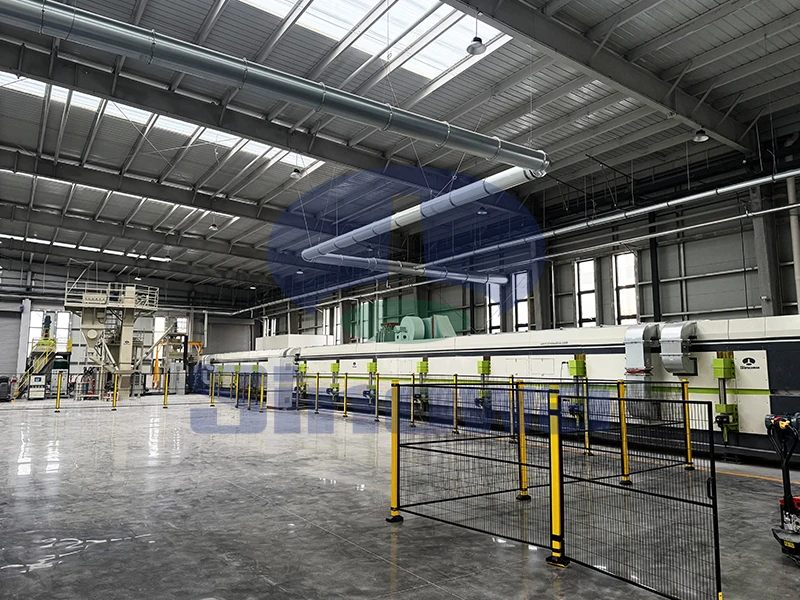
Main Components of the Whole Plant
The complete turnkey sandwich panel plant consists of multiple interconnected functional units, as listed below:
Face sheet unwinding unit: Supports multiple coils of surface materials, equipped with deviation correction and tension control to keep flat feeding.
Surface pretreatment unit: Cleans and coats adhesive or primer on the inner side of face sheets as needed.
Core material feeding and metering unit: Includes chemical raw material metering and spraying system for foam cores, and automatic arrangement and conveying system for fibrous insulation cores.
Double-belt laminating and curing unit: Provides constant clamping pressure and stable thermal environment for composite bonding and curing.
Continuous traction unit: Drives the composite slab to move forward at a set and adjustable line speed.
Cutting unit: Performs fixed-length cutting of continuous panels after curing.
Edge trimming unit: Trims panel edges to guarantee uniform panel width.
Automatic stacking unit: Collects and arranges finished panels neatly.
Central power and transmission unit: Supplies power and synchronizes the movement of all sections.
Protective and safety isolation structure: Covers moving parts and high-temperature areas for operational safety.
Production Process Flow
The production follows a standardized continuous workflow, which is described as follows: Raw material preparation is the first step, where face sheet coils and insulation core materials are loaded onto corresponding feeding positions, and formula parameters for core materials are set on the control terminal. Face sheets are unwound, tension-adjusted and pretreated before entering the laminating area. The insulation core is then delivered into the space between the upper and lower face sheets; foaming materials are sprayed and expand, while fibrous cores are aligned and glued. The composite material enters the double-belt curing section to complete bonding and shape setting under pressure and heat. The continuous slab is pulled forward steadily, and excess edge parts are trimmed. The slab is cut into required lengths by the flying saw cutting device. Finished panels are transported to the stacking area, sorted and stacked, ready for packaging and outbound. The step-by-step flow is shown in the list:
Loading of face sheet coils and insulation core raw materials
Unwinding, tension regulation and surface pretreatment of face sheets
Core material feeding, metering, spraying or positioning arrangement
Lamination of face sheets and insulation core inside the double-belt press
Thermal curing and solidification of the composite slab
Edge trimming to control panel width
Fixed-length cutting of continuous slab
Conveying and automatic stacking of finished sandwich panels
Manual inspection and temporary storage of finished products
Available Panel Types and Application Scenarios
Supported sandwich panels are classified by their core insulation materials, and each type fits different usage environments. Polyurethane core sandwich panels feature low thermal conductivity and good structural integrity. PIR core panels enhance thermal stability compared with regular polyurethane materials. Phenolic core panels balance insulation performance and fire resistance. Rock wool and mineral wool core panels are typical fibrous insulation composite boards with outstanding fire performance. Glass wool core panels are lightweight and have excellent sound absorption effects. All these panels can be produced with different face sheet options to adapt to indoor and outdoor use. The panel types and typical applications are listed below:
Polyurethane sandwich panel: Cold storage enclosures, clean room partitions, temporary buildings, roof and wall cladding with high insulation demand
PIR sandwich panel: Low-temperature cold storage, logistics warehouse envelopes, building exterior wall insulation systems
Phenolic sandwich panel: Ventilation duct boards, industrial plant partitions, public building interior insulation structures
Rock wool sandwich panel: Factory fire compartment walls, power plant enclosures, high-temperature workshop wall and roof panels
Mineral wool sandwich panel: Commercial building fire separation walls, data center enclosure panels
Glass wool sandwich panel: Sound insulation walls, indoor partition systems, acoustic treatment structures for venues
Advantages and Characteristics of the Equipment
This turnkey sandwich panel production plant realizes multi-material compatibility in one production line, avoiding the need to purchase separate lines for different core materials. Continuous production greatly improves output efficiency compared with intermittent batch production methods. The synchronization of each functional unit ensures consistent panel thickness, bonding quality and surface flatness. The line speed and formula parameters can be adjusted conveniently to switch between different panel specifications. The mechanical structure is designed for long-cycle continuous operation, with easy access for routine maintenance. The layout of the whole line can be adjusted according to the customer’s workshop space. Key advantages and characteristics are listed:
Multi-core-material compatibility, supporting flexible production of foam and fibrous insulation sandwich panels
Fully continuous automatic workflow, reducing manual intervention and improving production efficiency
Precise synchronization between all units, stable dimensional accuracy of finished panels
Adjustable production speed and process parameters for diversified product specifications
Robust mechanical structure, suitable for long-time continuous operation
Modular unit design, convenient for maintenance and partial upgrade
Compact or extendable layout scheme to match different workshop dimensions
Control System and Quality Control
The turnkey sandwich panel making plant is equipped with a centralized control system. Operators set production parameters on the human-machine interface, including line speed, core material feeding ratio, curing temperature, cutting length and pressure value. The system realizes interlocking control of each unit; abnormal signals such as material blockage, deviation and over-temperature will trigger alarm and protective stop. Real-time running data can be displayed on the interface for operators to monitor the whole production state.
Quality control runs through the whole production process. Tension and deviation correction systems prevent wrinkling and offset of face sheets. The metering system controls the dosage of chemical raw materials to keep stable foam density. Temperature and pressure inside the curing section are kept within the set range to guarantee bonding strength. After cutting, finished panels are checked for thickness, appearance, edge quality and flatness. Unqualified products can be separated at the stacking section. Parameter records can be stored for production traceability.
Supporting Installation and After-sales Service
After the turnkey sandwich panel manufacturing plant arrives at the production site, installation work includes foundation alignment, unit positioning, pipeline connection, cable wiring and inter-unit calibration. Technicians complete mechanical debugging, single-unit test run and full-line linkage test run step by step. Operators receive on-site training covering equipment operation, parameter adjustment, daily inspection and simple troubleshooting.
The after-sales service scope includes long-term technical consultation for production problems. Guidance on routine maintenance plans and wearing parts replacement is provided. Remote assistance is available for common control and process faults. When on-site support is needed, service personnel can be arranged to the site for inspection and repair. Technical support is also offered for process adjustment when customers develop new panel specifications.
Keyword: Turnkey Sandwich Panel Plant, Turnkey Sandwich Panel Making Plant, Turnkey Sandwich Panel Production Plant, Turnkey Sandwich Panel Manufacturing Plant