Can A PU Sandwich Panel Machine Produce Cold Room Insulated Panels?
Publication Date: Nov 26, 2026
Yes. Adjust raw materials & machine settings to produce rigid PU foam core panels with tongue-and-groove joints. Ideal for cold storage walls and roofs, delivering steady insulation.
Yes, a PU sandwich panel machine is fully capable of manufacturing insulated panels specially used for cold rooms. With proper raw material configuration and parameter adjustment during the production process, the equipment can continuously form composite panels that meet the thermal insulation, sealing and structural requirements of cold storage applications.
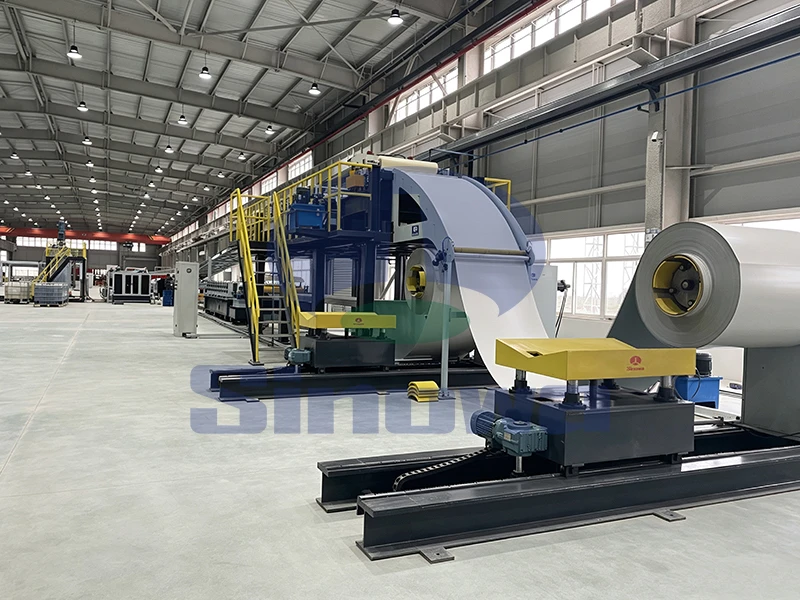
Basic Structure of Cold Room PU Insulated Panels
Cold room insulated panels are typical composite sandwich structures. Two outer layers are metal facing sheets, while the core material is rigid polyurethane foam. The PU core serves as the main thermal barrier, and the outer sheets provide mechanical protection, surface rigidity and moisture resistance. The whole panel is formed in one continuous molding process inside the sandwich panel machine, with strong bonding strength between the foam core and surface layers, avoiding delamination under long-term low-temperature working conditions.
Key Production Adjustments for Cold Room Panels
Although the same machine platform is used to make general PU sandwich panels, several production settings need to be optimized for cold room products. The formula of the PU foaming material is adjusted to achieve low thermal conductivity and stable performance at sustained low temperatures. The foaming density is controlled within a suitable range to balance insulation performance and structural strength. Besides, the forming speed, curing temperature and pressure of the machine are fine-tuned to ensure uniform foaming inside the core without voids or uneven density. Some structural features such as interlocking tongue-and-groove joints can also be shaped during molding, which helps tight assembly between panels and reduces cold leakage after installation.
Performance Advantages of Machine-Made Cold Room Panels
Panels produced by the PU sandwich panel machine have consistent thickness and stable insulation performance across the whole batch. Continuous production helps maintain consistent bonding quality, which is critical for cold rooms that need to run stably for years. The finished panels can resist moisture penetration effectively, preventing the insulation core from absorbing water and losing thermal resistance. Compared with on-site foaming methods, factory-molded panels have more stable overall quality and simpler on-site assembly procedures.
Application Scope of the Output Panels
The panels produced by this sandwich panel line can be applied to different types of cold storage spaces, including medium and low-temperature cold rooms, freezing rooms, fresh-keeping warehouses and temperature-controlled storage areas. They can be used for both wall enclosures and roof structures of cold rooms. It should be noted that the final applicability still depends on matching the panel specifications with the actual temperature demand and installation design of the cold room project.
Limitations to Note
The PU sandwich panel production line can only complete the molding of the insulated panel itself. It cannot add additional surface anti-corrosion coatings or special surface treatments that require separate processing steps. If special surface functions are required for specific cold room environments, follow-up processing procedures will be needed after the panels come out of the production line. Also, improper raw material matching or parameter misoperation will lead to defects such as poor foaming, weak adhesion and unstable insulation effect, even if the machine itself supports cold room panel production.
Tags: pu sandwich panel machine, pu sandwich panel machine manufacturer, pu sandwich panel machine supplier, china pu sandwich panel machine, pu sandwich panel machine for sale
Sinowa Sandwich Panel Lines
Sandwich Panel Machine For Sale
- PUR Sandwich Panel Production Line
- PIR Sandwich Panel Production Line
- PUF Sandwich Panel Production Line
- Rock Wool Sandwich Panel Production Line
- Glass Wool Sandwich Panel Production Line
- Mineral Wool Sandwich Panel Production Line
- Color Steel Sandwich Panel Production Line
- Thermal Insulation Sandwich Panel Production Line
- Cold Storage Sandwich Panel Production Line
- PU/PIR/Rockwool Insulation Sandwich Panel Machines
- PU/PIR/Rockwool Sandwich Panel Production Equipment
- PU/PIR/Rockwool Sandwich Panel Making Machinery