How Does A PU Sandwich Panel Machine Produce Insulated Building Panels?
Publication Date: Oct 7, 2026
How a PU sandwich panel machine produces insulated building panels: shape metal skins, inject PU foam, press & cure, cut & stack continuous foam-insulated wall/roof panels for construction & cold storage.
A PU sandwich panel machine continuously combines two outer metal facings and a liquid polyurethane foaming mixture in a controlled production line to form rigid, insulated building panels. The equipment feeds the surface materials steadily, injects the mixed PU raw materials between the upper and lower sheets, lets the chemical blend expand and cure inside a constrained forming channel, and finally cuts the solid integrated composite boards to preset lengths. The finished panels gain structural rigidity from the outer skins and thermal insulation performance from the closed-cell PU foam core bonded tightly to both layers.
Raw Material Preparation and Feeding
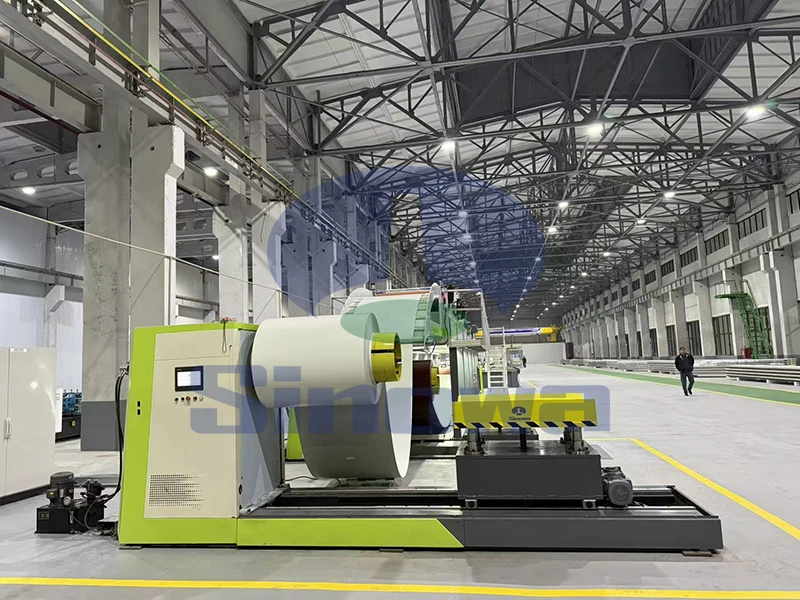
Before the forming process starts, two types of materials are prepared separately: the surface facings and the polyurethane chemical components. Coiled metal sheets are loaded onto uncoilers, which release the sheets at a consistent speed. The sheets pass through leveling and guiding structures to maintain flatness and alignment. On the foaming side, two liquid PU components are stored in separate tanks and delivered to a high-pressure mixing head. The two chemicals are kept isolated until injection to avoid premature reaction and solidification.
Surface Treatment and Preheating
The moving metal facings go through simple surface treatment to remove dust and oil residues. Clean surfaces ensure strong adhesive bonding between the metal and PU foam. Controlled preheating is applied to the facings as they move forward. Proper temperature adjustment stabilizes the foaming reaction rate and prevents uneven expansion or poor adhesion caused by cold panel surfaces. Both upper and lower facings move synchronously into the next working section.
High-Pressure Mixing and Foam Injection
When the two metal sheets form an open cavity, the mixing head sprays the uniformly blended PU liquid mixture into the space between them. The mixing head works at stable pressure to guarantee even mixing of the chemical ingredients. Once discharged, the liquid mixture begins an exothermic chemical reaction immediately. It expands rapidly to fill the whole gap between the upper and lower facings without leaving voids or weak spots. The expansion speed is matched with the running speed of the sheet materials.
Continuous Forming and Curing
The filled assembly enters a long double-belt conveyor, which acts as a closed forming mold. The upper and lower belts apply constant pressure and maintain the set thickness of the panel. Within this channel, the PU foam continues to expand, cross-link, and cure into a hard closed-cell core. The whole composite stays pressed until the foam completes curing and forms a firm bond with both outer facings. This continuous forming method ensures consistent thickness, density and flatness along the whole length of the semi-finished board.
Traction and Length Cutting
After curing, the continuous long panel is pulled forward by traction devices that keep the production speed synchronized with the front sections. A flying saw cutting unit moves together with the running panel during cutting, so the production line does not need to stop. The cutting tool trims the continuous board into individual panels according to the preset length requirement. The cut edges are neat, and the foam core and metal layers stay tightly combined without delamination.
Final Output and Post Inspection
Cut insulated panels are conveyed to the output rack for stacking. Operators carry out visual checks to verify surface condition, edge quality and overall appearance. Panels with defects such as uneven foam, separation between layers or surface scratches are sorted out. Qualified PU sandwich panels can then be packaged for transportation and used for building enclosure systems, roof structures and partition walls.
Core Advantages of This Production Process
This continuous production mode realizes high output and stable product consistency. The direct bonding formed during PU foaming eliminates the need for extra adhesive layers. The closed-cell foam core delivers reliable thermal insulation, while the outer metal skins offer mechanical protection and load-bearing capacity. The whole production process can adjust panel thickness and foam density by modifying machine parameters to meet different application demands of insulated building panels.
Tags: pu sandwich panel machine, pu sandwich panel machine manufacturer, pu sandwich panel machine supplier, china pu sandwich panel machine, pu sandwich panel machine for sale
Sinowa Sandwich Panel Lines
Sandwich Panel Machine For Sale
- PUR Sandwich Panel Production Line
- PIR Sandwich Panel Production Line
- PUF Sandwich Panel Production Line
- Rock Wool Sandwich Panel Production Line
- Glass Wool Sandwich Panel Production Line
- Mineral Wool Sandwich Panel Production Line
- Color Steel Sandwich Panel Production Line
- Thermal Insulation Sandwich Panel Production Line
- Cold Storage Sandwich Panel Production Line
- PU/PIR/Rockwool Insulation Sandwich Panel Machines
- PU/PIR/Rockwool Sandwich Panel Production Equipment
- PU/PIR/Rockwool Sandwich Panel Making Machinery