How To Adjust The Panel Flatness Of A Continuous PU Sandwich Panel Line?
Publication Date: Oct 15, 2026
Learn practical ways to adjust panel flatness on continuous PU sandwich panel production lines to fix warping and uneven surfaces effectively.
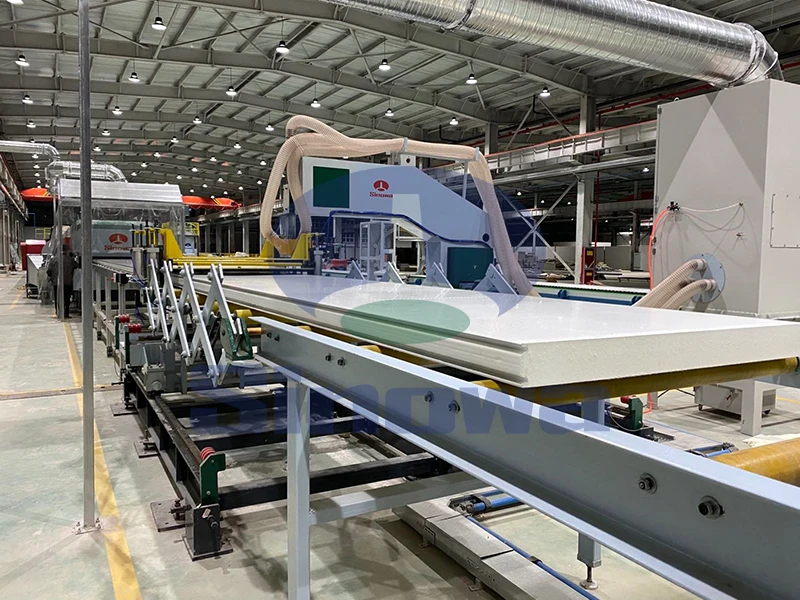
Before adjusting the panel flatness of a continuous PU sandwich panel line, operators should first inspect the whole running equipment to check for abnormal vibration and uneven clearance between upper and lower forming rollers. Observe the real-time state of the raw material feeding, including the surface tension of face sheets and the uniformity of PU material output, because unstable feeding is one of the common causes of uneven finished panels. Any deviation in sheet tension will lead to one side being pulled tighter than the other, resulting in curved panels after foaming and curing. Operators need to make minor adjustments to the tension control device to keep both upper and lower face sheets fed steadily and synchronously, avoiding excessive tension difference on left and right sides.
Then focus on the adjustment of forming roller gaps. The gap between each pair of rollers must be consistent horizontally. If one side gap is larger, the panel will have thickness deviation and poor flatness. Fine-tune the roller adjustment screws slowly instead of making big one-time changes. After each slight adjustment, run a short section of panel and check its surface condition. It is necessary to ensure all forming rollers are parallel to each other, and worn roller surfaces should be maintained in time, as partial wear will leave indentations and distortion on the panel surface.
The PU foaming and distribution state also has a direct impact on panel flatness. Uneven material distribution will cause inconsistent foaming pressure inside the panel, making the finished product bend to the side with less foam. Check the material distribution device to ensure the PU mixture spreads evenly across the full width of the face sheet. Adjust the flow rate and spreading range properly, avoid local accumulation or shortage of raw materials. Keep the mixing state stable so that the foaming reaction proceeds uniformly across the whole panel width during continuous production.
Temperature control in the curing section cannot be ignored. Too high, too low or uneven temperature distribution will change the curing speed of PU foam. Areas with faster curing will shrink differently from slower parts, leading to panel warpage. Monitor the temperature inside the curing channel along the width direction, adjust the heating components to balance temperature. Do not make sudden large changes to the curing temperature, and maintain stable operating temperature for continuous running to ensure consistent shrinkage of the foam core after curing.
Running speed matching is another key point. Mismatch between feeding speed, foaming speed and curing line speed will generate internal stress inside the sandwich panel. When the line speed fluctuates frequently, the foaming structure cannot form stably, and residual stress will deform the panel after it exits the production line. Keep the line speed stable within a reasonable range, reduce frequent speed up and down. When changing production specifications, adjust the speed gradually and cooperate with other parameter settings to adapt to the new production condition.
Check the alignment of the guiding equipment along the line. Deviated face sheet guiding will cause lateral offset during material advancing, resulting in asymmetric stress on the panel. Adjust the guide wheels and limit components to keep the face sheet moving along the central axis of the production line. The guiding parts should not apply extra squeezing force on the sheet, only maintain correct position, so that the sheet can go into the forming area smoothly without lateral pulling force.
Pay attention to the support condition of the panel in the post-curing section. After the panel leaves the forming rollers, it still has incomplete curing and is easy to deform under uneven support. Ensure the supporting rollers are arranged evenly and keep the panel horizontal in this section. Avoid local suspended areas or excessive supporting pressure. Proper support can reduce bending deformation before the foam core is fully hardened.
Inspect the finished panels continuously during production. Take samples regularly to check flatness from multiple directions. Record the deformation direction and degree, then trace back to the corresponding process parameters. If the panel bends toward the top face sheet, adjust the relevant tension or temperature parameters correspondingly; if it bends sideways, focus on roller parallelism and material spreading uniformity. Make iterative small adjustments rather than modifying multiple parameters at once, which makes it hard to locate the root cause.
Regular equipment maintenance helps sustain stable panel flatness for long-term operation. Lubricate movable parts of rollers and tension devices on schedule to prevent jamming. Check for loose connecting parts that may cause position drift during continuous running. Timely maintain or replace damaged components to avoid gradual deterioration of panel quality caused by aging equipment. Good daily maintenance reduces frequent large adjustments during formal production.
When all adjustments are completed, continue production and track panel quality for a period of time. Some flatness defects may appear after the panel cools completely, so finished products should be rechecked after natural cooling. Fine-tune parameters slightly according to the cooling state. Only when flatness remains stable in continuous batches can the adjustment work be confirmed finished. Stable process parameters and standardized operation habits are the foundation to keep good flatness of PU sandwich panels in long-time continuous production.
Tags: continuous pu sandwich panel line, continuous pu sandwich panel line manufacturer, continuous pu sandwich panel line supplier, china continuous pu sandwich panel line, continuous pu sandwich panel line for sale