How To Solve Panel Warping Issues Of A Polyurethane Sandwich Panel Production Line?
Publication Date: Nov 27, 2026
Solve polyurethane sandwich panel warping on production lines by balancing temperature gradient, belt pressure, foam injection & line speed. Stabilize raw material mixing, optimize curing and slow cooling to reduce uneven internal stress.
Panel warping in polyurethane sandwich panel production can be mitigated by synchronizing core material feeding, controlling the temperature gradient across the panel cross-section, adjusting the continuous line speed and foaming injection volume evenly, balancing upper and lower belt pressure, stabilizing raw material mixing ratio and reaction rate, and carrying out proper post-curing and cooling treatment after forming. Deviations in any of these links will create uneven internal stress inside the panel, which gradually releases and causes bending or distortion.
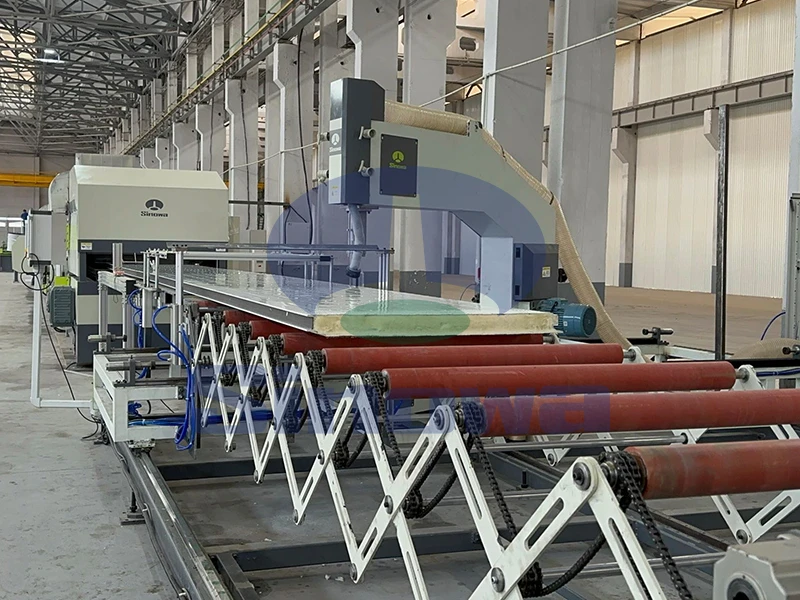
Main Root Causes of Sandwich Panel Warping
Uneven heat distribution is one of the most common triggers. The foaming reaction of polyurethane generates heat continuously. If the heat dissipation speed of the upper and lower surface layers is inconsistent, the expansion and shrinkage degree of the foam core will differ on both sides, building up asymmetric internal stress. Besides, inconsistent feeding tension of the face sheets will pull the panel to one side during continuous forming. Fluctuations in the proportion of isocyanate and polyether raw materials change the foaming density and curing speed locally. Local overfilling or insufficient injection of polyurethane raw materials also leads to uneven core thickness and density distribution. Unmatched running speed between the foaming station and the double-belt conveyor can disrupt the stable expansion process of the foam. In addition, rapid cooling right after forming prevents the uniform release of internal stress, and the finished panel will warp after stacking.
Targeted Adjustment Measures for the Production Line
First, optimize the raw material mixing and foaming system. Keep the mixing ratio of polyurethane components stable and maintain consistent raw material temperature before injection. Adjust the injection position and spread the material evenly across the panel width to avoid concentrated foaming in partial areas. Fine-tune the output of the foaming head according to the actual expansion state of the foam, ensuring the core forms uniform density without local over-expansion.
Second, balance the pressure and running state of the double conveyor belts. Calibrate the clearance between the upper and lower belts to guarantee consistent panel thickness along the whole width. Keep the tension of upper and lower face sheets matched to avoid one-sided pulling force. Check the parallelism of the belts regularly to prevent offset extrusion during the foaming and curing stage.
Third, optimize the temperature control of the curing section. Set a reasonable temperature curve for the curing tunnel, and reduce the temperature difference between the top and bottom of the panel. Avoid excessive heating on a single side. Extend the holding time properly when the reaction speed is slow, so the polyurethane foam completes cross-linking uniformly and reduces residual stress.
Fourth, improve the cooling and post-processing workflow. Do not transfer freshly formed panels to a low-temperature environment for fast cooling. Arrange a slow cooling area after the curing section to let internal stress release gradually. Control the stacking mode of finished panels; avoid excessive stacking weight or one-sided stress during storage.
Daily Monitoring and Preventive Management
Set up regular sampling inspection of finished panels to track the warping trend. Record production parameters including raw material temperature, mixing ratio, polyurethane sandwich panel line speed, curing temperature and belt pressure. Once warping appears, compare parameter records to locate the abnormal link quickly. Keep the production environment ventilation and temperature relatively stable, as drastic ambient temperature changes will interfere with the foaming reaction. Regularly maintain the foaming equipment and conveyor system to avoid jitter, unstable feeding or uneven material spraying caused by mechanical wear.
Conclusion
Panel warping is essentially a problem of unbalanced internal stress formed in the foaming and forming process of polyurethane sandwich panels. Stable raw material reaction, balanced mechanical extrusion force and reasonable temperature control throughout the PU sandwich panel production line are the core solutions. By combining real-time parameter adjustment, standardized curing cooling and routine equipment maintenance, the warping risk can be effectively controlled, and the flatness consistency of finished sandwich panels can be improved sustainably.
Tags: polyurethane sandwich panel production line, polyurethane sandwich panel production line manufacturer, polyurethane sandwich panel production line supplier, china polyurethane sandwich panel production line, polyurethane sandwich panel production line for sale
Sinowa Sandwich Panel Lines
Sandwich Panel Machine For Sale
- PUR Sandwich Panel Production Line
- PIR Sandwich Panel Production Line
- PUF Sandwich Panel Production Line
- Rock Wool Sandwich Panel Production Line
- Glass Wool Sandwich Panel Production Line
- Mineral Wool Sandwich Panel Production Line
- Color Steel Sandwich Panel Production Line
- Thermal Insulation Sandwich Panel Production Line
- Cold Storage Sandwich Panel Production Line
- PU/PIR/Rockwool Insulation Sandwich Panel Machines
- PU/PIR/Rockwool Sandwich Panel Production Equipment
- PU/PIR/Rockwool Sandwich Panel Making Machinery