How To Solve Unstable Foam Rising In PU Sandwich Panel Machine Production?
Publication Date: Nov 25, 2026
Fix unstable foam rising in PU sandwich panel production. Adjust feed ratio, mixing, temp & line speed. Check foaming head, raw materials and additives for consistent foam expansion.
Unstable foam rising during PU sandwich panel production can be improved by synchronizing raw material feeding ratios, controlling the mixing speed and pressure of the foaming head, stabilizing the preheating temperature of substrates and raw materials, adjusting the conveying speed of the panel line, eliminating air leakage inside the mixing chamber, and checking the activity consistency of polyol and isocyanate materials; fine-tuning the dosage of foam stabilizer and catalyst according to the on-site ambient temperature can also effectively restrain abnormal expansion such as too fast foaming, slow rising and partial collapse.
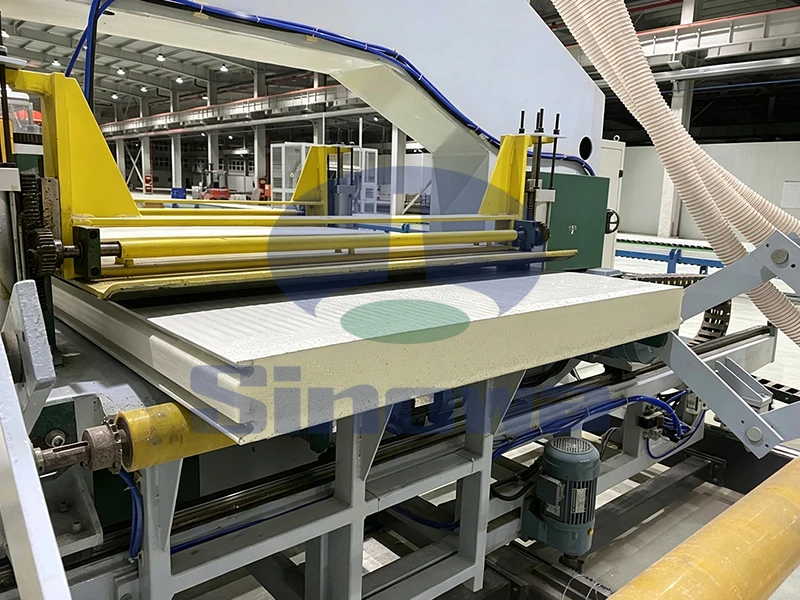
Main Causes of Unstable Foam Rising
The fluctuation of raw material matching is the most common inducement. Even tiny deviation between polyol and isocyanate will break the balance of foaming reaction. If the feeding pump has unstable output or the pipeline has blockage and backflow, the actual proportion entering the mixing area will keep changing. Besides, inconsistent chemical activity of raw material batches will lead to different reaction rates, which makes some foam rise rapidly while some cannot expand sufficiently.
Mixing conditions of the foaming system also exert a critical influence. Insufficient mixing speed or uneven mixing cannot disperse additives and main materials uniformly, forming local high-concentration or low-concentration areas. Excessive mixing may introduce excessive trapped air, resulting in loose foam structure and irregular rising curve. Pressure fluctuation inside the mixing head and foaming channel will change the nucleation state of bubbles directly, causing uneven expansion of foam on the upper and lower layers of the sandwich panel.
Temperature factors cannot be ignored. Raw materials with unstable storage temperature have variable viscosity, which affects the flow rate and reaction initiation speed. If the steel or aluminum substrate temperature changes frequently before foaming, the heat transfer condition of the foaming layer will differ greatly. Low ambient temperature slows down the catalytic reaction, while over-high temperature accelerates the reaction sharply, both disrupting the normal foam rising cycle.
Unmatched line running status is another key factor. When the conveyor speed fluctuates, the residence time of the foaming material in the molding section changes. If the material is cured before it finishes rising, the foam will be compacted and insufficiently expanded. If the conveying speed is too slow, the fully expanded foam will be squeezed and deformed. Poor sealing of the mold and side baffle will cause foam leakage and local pressure loss, bringing unstable rising performance.
Step-by-Step Adjustment and Optimization Methods
First, calibrate the feeding system regularly. Verify the delivery accuracy of each raw material pump, clean blocked filters and pipelines, and stabilize the back pressure of feeding pipelines. Keep the raw material storage and circulation temperature within a fixed range to reduce viscosity drift. Avoid mixing raw materials from different batches without testing their foaming performance.
Second, optimize the mixing head parameters. Set a stable mixing speed suitable for the formula, and keep the mixing chamber sealed to prevent air infiltration. Check the wear of mixing rotor and liner regularly; worn components will cause poor mixing effect. Maintain stable working pressure of the foaming head to guarantee consistent bubble nucleation.
Third, build a stable temperature control system. Install temperature keeping devices for raw material tanks and conveying pipelines. Preheat the panel substrate evenly before foaming to reduce the temperature difference between the substrate and foaming materials. Isolate the production area from direct air flow such as fans and air outlets to avoid local cold spots on the board surface.
Fourth, match the conveyor speed with the foaming reaction cycle. Confirm the time required for the foam to complete rising and initial curing, then set the PU sandwich panel machine speed steadily and reduce frequent speed adjustment. Check the clearance and sealing performance of side baffles and forming molds to prevent material leakage and pressure loss.
Fifth, fine-tune auxiliary additives properly. Increase or decrease the content of foam stabilizer and catalyst in a small range according to the actual foaming state. The foam stabilizer helps form uniform and stable bubble walls, while the catalyst controls the reaction rate. Each adjustment should be in small increments, and continuous trial production is needed to observe the foam rising effect, avoiding large-scale formula modification at one time.
Daily Maintenance and Preventive Measures
Carry out routine inspection of the whole foaming system before startup every day. Check whether the feeding pipeline has air bubbles, whether the pressure gauge reading is stable, and whether the mixing head has residual cured material that affects mixing. Clean residual PU material in the mixing chamber after shutdown to prevent hardened deposits from damaging mixing uniformity in the next production run.
Keep continuous production parameters record. Note down raw material batch number, material temperature, mixing parameters, PU sandwich panel line speed and corresponding foam rising condition. When unstable foaming reappears, the historical records can help quickly locate the abnormal point, instead of blind parameter adjustment.
Avoid frequent formula switching in a short production window. Each new formula needs a period of parameter adaptation. If formula switching is necessary, fully clean the whole feeding and mixing pipeline to eliminate the residue of the previous formula which may interfere with the new foaming reaction.
Conclusion
Stable foam rising relies on the coordinated control of raw materials, mixing equipment, temperature and line operation. Most unstable foaming problems are not caused by a single factor, but the superposition of tiny fluctuations in multiple links. Through standardized calibration, stable temperature control, reasonable parameter matching and regular equipment maintenance, the foam rising state can stay consistent, and the surface flatness, core density and structural uniformity of finished PU sandwich panels can be guaranteed continuously.
Tags: pu sandwich panel production machine, pu sandwich panel production machine manufacturer, pu sandwich panel production machine supplier, china pu sandwich panel production machine, pu sandwich panel production machine for sale
Sinowa Sandwich Panel Lines
Sandwich Panel Machine For Sale
- PUR Sandwich Panel Production Line
- PIR Sandwich Panel Production Line
- PUF Sandwich Panel Production Line
- Rock Wool Sandwich Panel Production Line
- Glass Wool Sandwich Panel Production Line
- Mineral Wool Sandwich Panel Production Line
- Color Steel Sandwich Panel Production Line
- Thermal Insulation Sandwich Panel Production Line
- Cold Storage Sandwich Panel Production Line
- PU/PIR/Rockwool Insulation Sandwich Panel Machines
- PU/PIR/Rockwool Sandwich Panel Production Equipment
- PU/PIR/Rockwool Sandwich Panel Making Machinery