What Causes Side Leakage During PU Sandwich Panel Making Machine Operation?
Publication Date: Nov 25, 2026
Issues include unstable raw material feeding, poor mixing, incorrect forming clearance, worn side seals, mismatched foaming parameters and inadequate maintenance.
Side leakage in the running process of the PU sandwich panel making machine mainly arises from mismatched material feeding status, unstable foaming reaction parameters, unreasonable clearance of guide and pressing structures, and abnormal sealing conditions on both sides of the production line. When the liquid PU raw materials flow out beyond the edge of the face sheet before complete curing, side leakage occurs, which will contaminate equipment, damage panel edge quality and interrupt continuous production.
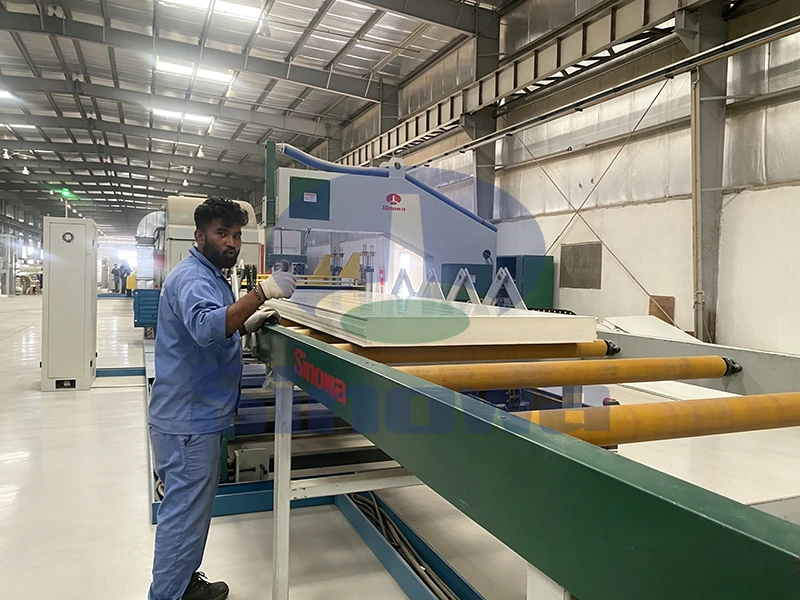
Unstable Raw Material Feeding and Mixing Conditions
The matching flow rate of polyol and isocyanate components is the foundation of normal PU foaming. If the feeding pressure of two raw material pipelines fluctuates obviously, or the mixing effect inside the mixing head becomes poor, the foaming speed and expansion ratio of the mixed material will lose consistency. Too fast foaming expansion pushes the mixture to spread sideways along the surface of the face material, while too slow reaction makes the low-viscosity liquid PU flow outward from the panel edge under the extrusion of the pressing belt. In addition, impurities in raw materials, uneven material temperature and blocked partial feeding channels will also change the fluidity of the mixture and induce overflow at the side edges.
Improper Clearance and Alignment of Forming and Pressing Parts
The upper and lower pressing belts and side limiting baffles form the shaping space for PU foaming. If the side baffles are offset, deformed or loosely installed, the effective width of the forming cavity will deviate from the set size. Excessive side clearance provides space for uncured PU mixture to squeeze out. Meanwhile, inconsistent gap between the front and rear sections of the pressing belt will lead to uneven extrusion force on the foaming layer. Local excessive pressure forces the liquid foam to escape from the weaker side edge position. The deflection of the upper and lower face sheets during conveying is another common factor; once the face sheet shifts sideways, it cannot block the foaming material as designed.
Abnormal Sealing and Auxiliary Edge Protection Structures
Side sealing components are used to restrict the flow range of liquid PU. Long-time friction and extrusion will wear the sealing strips, leading to gaps or local failure of sealing. Dry, hardened or deformed sealing materials lose their elastic sealing ability and can no longer closely fit with the face sheet and baffles. If the edge guiding accessories are not adjusted synchronously when switching to panels of different widths, the sealing position cannot match the edge of the face material. Even tiny gaps at the sealing position allow low-viscosity PU liquid to seep out gradually before foaming is finished.
Deviation of Foaming Environment and Curing Parameters
The reaction rate of PU foam is sensitive to ambient temperature and the surface temperature of the face sheet. Low ambient temperature slows down the curing reaction, extending the flowing time of the liquid mixture and increasing the risk of side overflow. High temperature accelerates foaming sharply, and the rapidly expanding foam generates large internal pressure to break through the limit of the side barriers. Unstable running speed of the whole PU sandwich panel production line also breaks the balance: faster conveying speed shortens the reaction time inside the forming section, while slower speed makes the foam stay too long and expand excessively.
Improper Daily Operation and Maintenance
Irregular inspection and cleaning work will accumulate cured PU residues on baffles, sealing parts and pressing belts. These hard residues change the local clearance and scratch the sealing strips, forming hidden channels for leakage. Operators may also set inappropriate raw material injection amount according to experience. Excessive injection volume brings more foaming materials than the cavity can hold, and redundant foam will overflow from both sides. In addition, sudden start-stop of the unit will cause instantaneous impact on the material flow, which easily triggers short-term side leakage.
Impacts and Basic Control Ideas
Side leakage not only reduces the finished product yield and increases material waste, but also brings extra cleaning workload. Long-term leakage will corrode equipment surfaces and affect the operation precision of moving parts. To reduce this fault, operators need to stabilize raw material parameters, regularly check the straightness and clearance of limiting baffles and sealing parts, keep the conveying of face sheets centered, and match the feeding volume, PU sandwich panel line speed and foaming reaction state dynamically according to the actual production situation. Timely replacement of worn sealing accessories and regular removal of foam residues can effectively maintain stable running conditions of the machine.
Tags: pu sandwich panel making machine, pu sandwich panel making machine manufacturer, pu sandwich panel making machine supplier, china pu sandwich panel making machine, pu sandwich panel making machine for sale
Sinowa Sandwich Panel Lines
Sandwich Panel Machine For Sale
- PUR Sandwich Panel Production Line
- PIR Sandwich Panel Production Line
- PUF Sandwich Panel Production Line
- Rock Wool Sandwich Panel Production Line
- Glass Wool Sandwich Panel Production Line
- Mineral Wool Sandwich Panel Production Line
- Color Steel Sandwich Panel Production Line
- Thermal Insulation Sandwich Panel Production Line
- Cold Storage Sandwich Panel Production Line
- PU/PIR/Rockwool Insulation Sandwich Panel Machines
- PU/PIR/Rockwool Sandwich Panel Production Equipment
- PU/PIR/Rockwool Sandwich Panel Making Machinery