What Is The Working Principle Of A PU Sandwich Panel Production Line?
Publication Date: Oct 7, 2026
A PU sandwich panel production line operates on continuous integrated composite molding principles, combining automatic material feeding, precise polyurethane foaming, constant-pressure lamination, thermal curing, and fixed-size cutting to fabricate high-performance insulated sandwich panels. It synchronizes physical shaping and chemical cross-linking processes to bond durable surface substrates with lightweight foam cores steadily, delivering uniform, structurally stable panels with consistent thermal insulation and mechanical properties throughout automated continuous production.
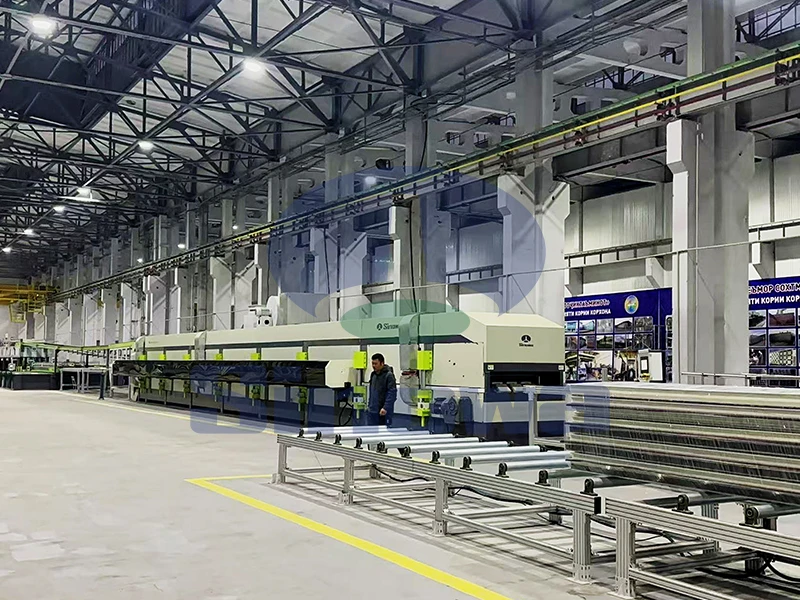
The entire production workflow starts with the automatic feeding and tension control of upper and lower surface substrates, which form the outer protective layers of PU sandwich panels. Flexible coiled substrates are loaded onto uncoiling devices that release materials at a stable, synchronized speed, eliminating uneven feeding, wrinkling, or stretching issues during operation. Equipped with intelligent tension adjustment structures, the system maintains consistent material flatness and linear movement throughout the feeding phase. This stable material supply lays a solid foundation for subsequent composite processing, ensuring the overall flatness and dimensional accuracy of finished panels while avoiding structural deviations caused by irregular substrate positioning in later procedures.
Following substrate feeding, the critical surface pretreatment process optimizes the bonding condition between outer substrates and internal PU foam cores. This stage mainly includes surface cleaning, impurity removal, and preheating treatment to eliminate dust, oil stains, and residual particles attached to the substrate surface. These contaminants would otherwise weaken the adhesion between metal or non-metal substrates and polyurethane materials, leading to delamination and reduced panel durability. Moderate preheating further activates the substrate surface molecular activity, enabling the liquid PU material to spread and attach more uniformly during subsequent pouring, greatly enhancing the overall composite tightness and structural integrity of the sandwich panel.
Raw material preparation and filtration for polyurethane foam constitute the core pre-work of foaming molding. Polyurethane production relies on two main chemical components, which are stored in independent sealed tanks with constant temperature maintenance to ensure stable chemical activity. Before mixing, all raw materials pass through multi-stage fine filtration devices to remove tiny impurities and precipitates generated during storage and transportation. This filtration process prevents foreign particles from creating hollow pores or weak structural points inside the foam core. Meanwhile, the system precisely adjusts the raw material proportion through automated metering units, laying the groundwork for uniform foaming and stable core density in subsequent processes.
High-pressure dynamic mixing and continuous pouring are the key links that determine the internal quality of PU foam cores. The filtered and proportioned polyurethane components are transported to a high-speed mixing head, where high-pressure swirling fusion achieves instantaneous and homogeneous mixing of different chemical materials. Unlike traditional low-speed mixing methods, this high-pressure mixing mode avoids uneven component distribution and incomplete chemical reactions. The uniformly mixed liquid PU material is continuously and evenly poured between the upper and lower pretreated substrates, with the pouring range and flow rate precisely matched to the running speed of the substrate conveyor system to ensure full coverage of the composite gap without material accumulation or missing pouring.
In-line lamination and preliminary shaping realize the initial composite molding of sandwich panel structures. After PU liquid pouring, the upper and lower substrate layers with intermediate liquid foam immediately enter the laminating unit, which adopts a double-layer flat conveyor structure to clamp the composite materials stably. The unit maintains stable and uniform mechanical pressure throughout the operation, compressing the overall thickness of the composite structure to the preset panel specification. This constant pressure constraint limits the free expansion range of the foaming material, preventing excessive foam expansion from causing uneven panel thickness or surface bulging. At the same time, the synchronous operation of upper and lower conveyor belts ensures no relative displacement between substrates and foam materials, effectively avoiding internal layer dislocation.
Thermal gradient curing promotes complete chemical cross-linking and stable shaping of polyurethane foam. The initially laminated semi-finished panels enter a long constant-temperature curing channel with a scientific gradient temperature distribution. The channel temperature rises gently from the inlet to the middle section and maintains a stable constant temperature in the later section, which solves the problem of inconsistent internal and external curing speeds. Gradient heating prevents rapid surface curing from forming a dense outer film that locks internal gas, avoiding hollow pores and loose structures inside the foam. Under continuous constant-temperature conditions, the polyurethane liquid completes full foaming, gas discharge, and molecular cross-linking reactions, gradually forming a dense, elastic, and high-strength foam core structure with stable physical properties.
Continuous traction and speed synchronization ensure the overall consistency of the entire production line. The entire production process from feeding, pouring, lamination to curing relies on a unified traction speed control system to realize linkage operation. The traction device stably pulls the semi-finished panels forward at a constant speed, matching the working rhythm of each functional unit. If the speed is too fast, the PU material will fail to fully foam and cure, resulting in insufficient core strength; if the speed is too slow, excessive foaming will cause structural redundancy and dimensional deviation. The intelligent speed synchronization system eliminates rhythm conflicts between different processing sections, ensuring continuous and uninterrupted production and consistent product quality across the entire batch.
Fixed-length cutting and edge trimming realize the final sizing of finished panels. After completing curing and stable shaping, the continuous integrated composite board is transported to the cutting unit, which automatically identifies and cuts the board according to preset length parameters. The high-precision cutting tool ensures flat and smooth cutting sections without burrs or deformation. Subsequent edge trimming processes remove tiny uneven edges and residual foam materials on the panel periphery, standardizing the overall dimensions of each panel. This automated sizing process replaces manual measurement and cutting, effectively improving dimensional accuracy and production efficiency while ensuring the interchangeability and assembly consistency of finished panels in subsequent application scenarios.
Post-processing inspection and automatic stacking complete the final production link of PU sandwich panels. After sizing, each finished panel undergoes real-time online inspection to check for surface flatness, internal compactness, bonding integrity, and dimensional compliance. Unqualified products are automatically screened out through the system’s intelligent judgment program to avoid defective products entering the finished product stack. Qualified panels are then transported to the stacking unit, which realizes automatic layer-by-layer stacking and neat arrangement. This automated post-processing process not only reduces manual intervention and labor costs but also protects finished panels from secondary damage, ensuring the integrity and uniformity of delivered products.
The core working principle of the entire PU sandwich panel production line lies in the perfect coordination of mechanical transmission, chemical reaction, and intelligent control technology. It transforms discrete manual processing procedures into a continuous, automated closed-loop production system, realizing organic integration of substrate shaping, PU foaming composite, thermal curing molding, and precise sizing. By strictly controlling raw material proportion, foaming pressure, curing temperature, and operating speed, the line stably produces sandwich panels with excellent thermal insulation, mechanical strength, and structural durability, meeting the standardized production demands of various insulation and building enclosure scenarios.
Tags: pu sandwich panel production line, pu sandwich panel production line manufacturer, pu sandwich panel production line supplier, china pu sandwich panel production line, pu sandwich panel production line for sale