What Is The Maximum Production Speed Of A Standard PU Sandwich Panel Line?
Publication Date: Oct 8, 2026
Standard PU sandwich panel production lines feature adjustable operational speeds, with typical maximum production speeds ranging from 6 to 8 meters per minute for conventional continuous models, while optimized configurations can reach up to 10 meters per minute under stable working conditions. This speed benchmark defines the core production capacity of standard automated lines, balancing manufacturing efficiency, panel forming quality, and operational stability for mainstream architectural and insulation panel production. Multiple factors including panel thickness, material formulas, and line operational settings directly influence the actual maximum achievable speed in practical industrial production.
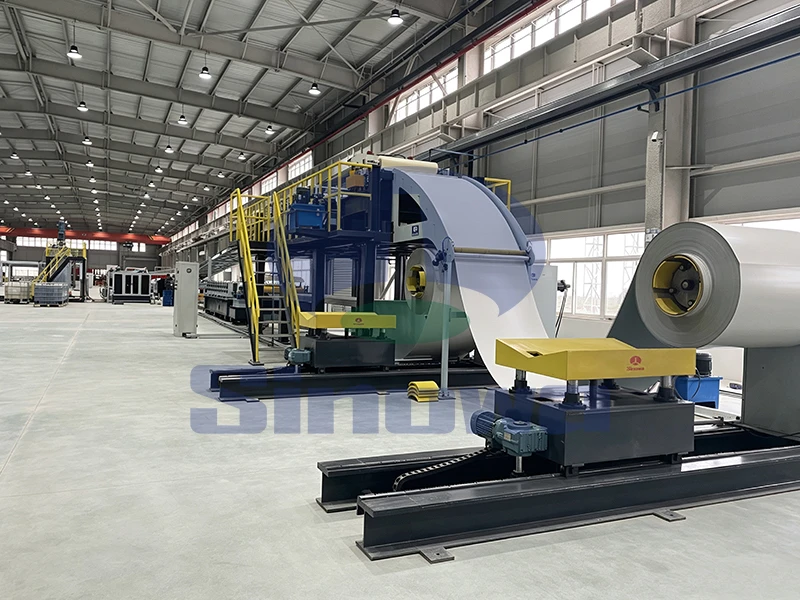
To understand the maximum production speed of a standard PU sandwich panel line, it is essential to first distinguish between standard continuous production lines and semi-automatic intermittent production equipment, as their speed parameters vary significantly. Standard industrial-grade PU sandwich panel lines refer to fully continuous automated production systems that integrate material feeding, foaming, laminating, curing, cutting, and output into one uninterrupted workflow. Unlike semi-automatic lines that rely on manual auxiliary operations and intermittent processing, standard continuous lines maintain steady linear operation, which lays the foundation for stable high-speed production. The maximum speed data recognized in the industry is exclusively targeted at this fully continuous standard configuration, excluding modified customized lines or low-efficiency semi-automatic equipment that cannot support long-term continuous high-speed operation.
The core maximum production speed range of standard PU sandwich panel lines is anchored at 6 to 8 meters per minute for daily mass production scenarios, which is the most widely adopted and verified parameter in mainstream industrial applications. This speed range is not an extreme transient value but a sustainable maximum operational speed that can be maintained for long-hour continuous production without compromising panel quality. When running at this maximum speed, the line can produce a complete finished PU sandwich panel with intact surface lamination and qualified core foaming structure every minute, covering conventional panel thickness specifications commonly used in the construction industry. For basic standard panels with a thickness of 50mm, the line can stably sustain the upper limit of 8 meters per minute, achieving efficient batch output while ensuring uniform foaming density and tight bonding between the surface sheet and PU core layer.
Under optimized parameter tuning and standardized operating environments, a standard PU sandwich panel line can reach a peak instantaneous production speed of 10 meters per minute, which is the absolute maximum speed limit for most unmodified standard models. This peak speed is only achievable under strict production condition control, including stable raw material temperature, consistent PU foaming formula proportion, and precise mechanical parameter calibration. Unlike the sustainable 6 to 8 meters per minute speed, the 10 meters per minute peak state is not suitable for long-term continuous operation. Sustained operation at this extreme speed may lead to insufficient curing time for the PU core, incomplete bonding of the panel layers, or slight deviations in panel dimensional accuracy, so it is only used for short-term high-output demand with subsequent quality inspection screening.
Panel thickness is one of the most critical factors that restrict the maximum production speed of standard PU sandwich panel lines. Thinner PU sandwich panels with a thickness of 20mm to 50mm impose lower requirements on foaming curing time and structural forming cycle, allowing the line to operate steadily at the maximum sustainable speed of 8 meters per minute. As panel thickness increases to 100mm or even 150mm, the PU core requires longer foaming, filling, and high-temperature curing time to ensure internal compactness and no hollow gaps. In this case, the actual operable maximum speed of the standard line will drop significantly, usually decreasing to 4 to 6 meters per minute to reserve sufficient time for core material molding. This speed adjustment is an automatic matching mechanism of the automated line to guarantee fundamental product quality.
PU material formula and foaming performance also play a decisive role in determining the effective maximum production speed of standard sandwich panel lines. Different PU raw material ratios lead to variations in foaming reaction speed, curing efficiency, and fluidity, which directly adapt to different line operating speeds. Conventional universal PU formulas with moderate reaction rates match the standard line’s maximum sustainable speed of 8 meters per minute perfectly, realizing synchronous coordination between mechanical operation and chemical foaming reactions. If using high-activity fast-curing PU formulas, the line can appropriately approach the 10 meters per minute peak speed due to shortened curing cycles. In contrast, low-activity formulas with slow curing reactions require reduced line speed to avoid unformed core layers and defective bonding, lowering the practical maximum production limit.
Mechanical configuration and operational precision of standard PU sandwich panel lines ensure the stability of maximum production speed during long-term operation. Standard lines are equipped with synchronized servo control systems, constant-temperature curing tunnels, and precise roller pressing structures, which unify the operating rhythm of each production link. The servo feeding system maintains consistent linear transmission speed for surface steel sheets and core materials, avoiding speed deviation caused by mechanical jitter. The constant-temperature curing tunnel provides a stable thermal environment for PU foaming and solidification, ensuring that the foaming process keeps pace with the line’s operating speed. These standardized mechanical configurations prevent quality anomalies when the line runs at high speed, enabling the equipment to stably exert its rated maximum production capacity.
Daily actual output derived from the maximum production speed intuitively reflects the production capacity of standard PU sandwich panel lines. Calculated based on the sustainable maximum speed of 8 meters per minute, a standard line operating for an 8-hour working day can produce approximately 3,840 linear meters of qualified PU sandwich panels. Converted by conventional panel width specifications, the daily output can reach more than 4,000 square meters of finished panels. Even when considering necessary equipment inspection, material replacement, and short downtime adjustments, the effective daily output still maintains a high level, fully meeting the mass production needs of conventional construction insulation projects. The peak speed of 10 meters per minute can further improve short-term output efficiency for urgent order production.
It is important to distinguish standard PU sandwich panel lines from upgraded high-speed customized lines to avoid misjudging conventional speed parameters. Some enhanced production lines with extended curing tunnels, upgraded foaming injection systems, and optimized servo synchronization structures can achieve speeds exceeding 10 meters per minute, but these belong to non-standard customized equipment rather than conventional standard models. Standard lines focus on balanced performance of cost stability, quality consistency, and operational durability, so their maximum speed is limited within a stable and controllable range. Custom high-speed lines sacrifice part of equipment universality and increase operational costs for extreme speed, which is not included in the parameter definition of standard industrial production lines.
Reasonable speed control is key to balancing the maximum production efficiency and product quality of standard PU sandwich panel lines. Although the equipment has a clear maximum speed limit, long-term full-speed operation is not the optimal production strategy. Most manufacturers adjust the operating speed dynamically according to panel specifications, material batches, and order requirements, using 5 to 7 meters per minute as the conventional daily operating speed and reserving the maximum speed state for peak production cycles. This flexible speed control mode not only gives full play to the line’s maximum production potential but also effectively reduces equipment wear and product defect rates, prolonging the service life of the standard production line while maintaining stable production quality.
In summary, the maximum production speed of a standard PU sandwich panel line forms a clear and practical industrial parameter system, with 6 to 8 meters per minute as the sustainable long-term maximum operating speed and 10 meters per minute as the instantaneous peak speed limit. Multiple factors including panel thickness, material characteristics, and mechanical operation status jointly determine the actual effective maximum speed in production. This speed range accurately defines the production capacity boundary of standard continuous PU sandwich panel lines, providing a reliable efficiency reference for industrial mass production, and highlights the equipment’s core advantages of high efficiency, stability, and strong universality in the field of insulation panel manufacturing.
Tags: pu sandwich panel line, pu sandwich panel line manufacturer, pu sandwich panel line supplier, china pu sandwich panel line, pu sandwich panel line for sale