What Are The Main Components Of A Complete PU Sandwich Panel Production Line?
Publication Date: Oct 9, 2026
A complete PU sandwich panel production line is a fully automated, modular manufacturing system designed for continuous, high-efficiency production of durable, insulated polyurethane sandwich panels. Composed of interconnected mechanical, processing, and control components, the line covers every production stage from raw material feeding and surface substrate processing to PU foaming, composite molding, curing, precision cutting, and finished product stacking, ensuring consistent panel structure, stable thermal insulation performance, and unified product quality for construction and industrial insulation applications.
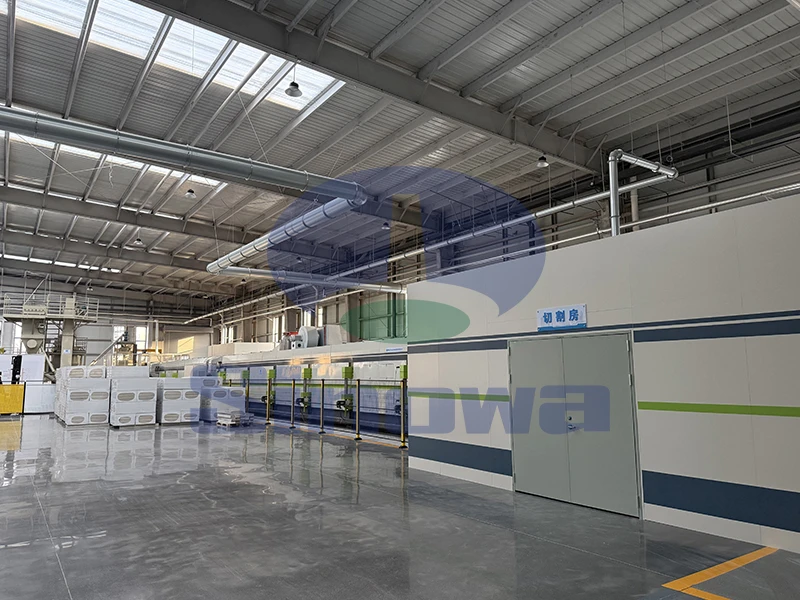
The raw material unwinding and feeding system serves as the starting module of the entire PU sandwich panel production line, undertaking the task of stably supplying surface substrates for subsequent processing. This system is mainly responsible for unwinding coiled metal or non-metal sheet materials, maintaining continuous and tension-balanced material output to avoid sheet deviation, wrinkling, or uneven feeding during high-speed production. Equipped with automatic tension adjustment and material buffering structures, it can adapt to different thicknesses and hardness of surface materials, ensuring the flatness and integrity of substrates before entering the forming process. Stable operation of this front-end system eliminates intermittent production shutdowns caused by material supply failures, laying a solid foundation for the full continuous operation of the entire production line and guaranteeing the uniformity of the base materials for subsequent composite processing.
Surface substrate pretreatment equipment is an essential intermediate component that optimizes substrate conditions to enhance the bonding quality between surface sheets and PU foam cores. After unwinding, the sheet materials will go through multi-step pretreatment processes, including surface cleaning, dust removal, and micro-heat treatment to remove surface impurities, oil stains, and moisture that may affect adhesion. The preheating function in this module effectively improves the surface activity of substrates, enabling the liquid PU raw materials to bond more tightly with the sheet surface during the later foaming and composite stage. This pretreatment process avoids poor bonding, delamination, or hollowing between the panel surface and core layer, greatly improving the overall structural firmness and service durability of finished PU sandwich panels while maintaining the stability of continuous production cycles.
The roll forming system is responsible for shaping flat surface substrates into standardized profile structures that meet sandwich panel design requirements. Through sets of precision arranged forming rollers, the system conducts gradual cold bending and rolling processing on flat sheets, realizing consistent molding of panel edge folds, rib structures, and overall plate shapes. The roller spacing and forming parameters are adjustable to adapt to different panel specifications, ensuring the dimensional accuracy and structural consistency of each processed substrate. During operation, the system maintains synchronous running speed with the front feeding and rear processing modules to prevent material stretching or deformation. Uniformly formed substrates provide precise structural support for the subsequent compounding with PU foam cores, ensuring the neat appearance and stable mechanical properties of finished sandwich panels.
The high-pressure PU foaming and mixing system is the core functional component that determines the thermal insulation and structural performance of sandwich panels. This system precisely transports multiple liquid polyurethane raw materials through independent sealed pipelines, and completes high-speed uniform mixing in a closed mixing chamber via professional dynamic mixing technology. It can accurately control the raw material ratio, mixing speed, and injection flow according to production demands, ensuring that the PU raw materials fully react and foam evenly. The well-mixed foaming materials are evenly injected between the upper and lower surface substrates, forming a dense and uniform foam core layer after foaming and curing. Stable foaming and mixing effects avoid uneven core density, bubble cavities, or insufficient foaming, directly optimizing the heat insulation, sound insulation, and compression resistance of finished panels.
The double crawler composite molding system is a key component for integrating surface substrates and PU foam cores into an integral panel structure. Consisting of upper and lower synchronous crawler conveyor structures, the system clamps and conveys the compounded substrates and foaming materials stably, while applying uniform and constant pressure during the conveying process. This continuous pressure maintaining state ensures that the liquid PU foam fully fills the gap between the upper and lower sheets, closely fits with the pretreated substrates, and forms a flat and integral composite structure. The crawler runs at a constant synchronous speed to match the foaming reaction rate, avoiding material displacement or uneven pressure distribution. This module realizes the preliminary integral molding of sandwich panels and effectively prevents core layer separation and surface unevenness.
The constant temperature curing system supports the complete reaction and solidification of PU foam cores after composite molding, which is crucial for stabilizing panel performance. By providing a closed and temperature-balanced curing environment, the system maintains a suitable constant temperature range to promote thorough chemical reactions of polyurethane raw materials, enabling the foam core to complete shaping, solidification, and structural stabilization. Reasonable temperature control avoids incomplete foaming reaction caused by low temperature or foam aging and performance degradation caused by excessive temperature. The continuous curing process ensures that the internal structure of the PU core is dense and stable, with consistent hardness and elasticity throughout the panel. Fully cured panels can maintain stable mechanical and thermal insulation properties in long-term use, avoiding later deformation and performance attenuation.
The precision cutting and trimming system undertakes the final shaping processing of continuously cured integrated sandwich panels. Equipped with automatic tracking and fixed-length cutting functions, the system can accurately cut continuous long panels into standard finished sizes according to preset parameters, while trimming redundant edge materials to ensure neat panel edges and consistent overall dimensions. The cutting equipment operates synchronously with the front-end production speed, realizing non-stop continuous cutting and avoiding production efficiency loss caused by intermittent shutdowns. The high-precision cutting and trimming process effectively eliminates dimensional errors and edge burrs, ensuring the uniformity and aesthetic appearance of finished panels. This module also guarantees the assembly consistency of panels in subsequent construction and installation scenarios.
The panel cooling and shaping auxiliary system assists in completing the final structural stabilization of cut sandwich panels. After high-temperature curing and cutting, the panels retain residual internal temperature, which may cause slight thermal deformation if directly stacked. The cooling system adopts uniform air cooling or natural balanced cooling modes to gradually reduce the panel temperature to room temperature, eliminating internal thermal stress and fixing the overall panel shape. Slow and balanced cooling avoids local shrinkage deformation or surface wrinkles caused by rapid temperature difference. This auxiliary process further optimizes the flatness and structural stability of finished panels, ensuring that the products maintain stable dimensional accuracy and flat appearance in subsequent transportation, stacking, and use.
The automatic finished product conveying and stacking system realizes the automatic collection and arrangement of qualified finished PU sandwich panels. After cooling and shaping, the panels are stably transported to the stacking area through the roller conveying device, and the automatic stacking equipment neatly arranges the panels in fixed specifications and layers. This system replaces manual handling and stacking, effectively improving production efficiency while avoiding panel surface scratches, collisions, and stacking irregularities caused by manual operation. The orderly stacked finished products are convenient for subsequent packaging, transportation, and storage, realizing the seamless connection from production completion to product delivery. This terminal module completes the full closed-loop operation of the entire production line.
The intelligent central control system is the brain of the entire PU sandwich panel production line, realizing unified scheduling and synchronous control of all functional modules. The system integrates parameter setting, speed adjustment, operation monitoring, and fault diagnosis functions, allowing operators to uniformly configure production parameters such as feeding speed, foaming ratio, curing temperature, and cutting size through the central control interface. It realizes precise synchronous linkage of each equipment unit, avoiding asynchronous operation between front and rear processes that affects product quality. In addition, the system can monitor the real-time operating state of each component, timely identify abnormal operation problems, and ensure the stable, efficient, and safe continuous operation of the entire production line, realizing intelligent and automated whole-process production management.
Tags: pu sandwich panel production line, pu sandwich panel production line manufacturer, pu sandwich panel production line supplier, china pu sandwich panel production line, pu sandwich panel production line for sale