What Panel Thickness Can A Conventional PU Sandwich Panel Production Line Manufacture?
Publication Date: Oct 8, 2026
Conventional PU sandwich panel production lines support standardized panel thickness ranges from 30mm to 200mm, covering most construction, insulation, and industrial enclosure needs, with adjustable mechanical configurations enabling flexible thickness customization for diverse application scenarios.
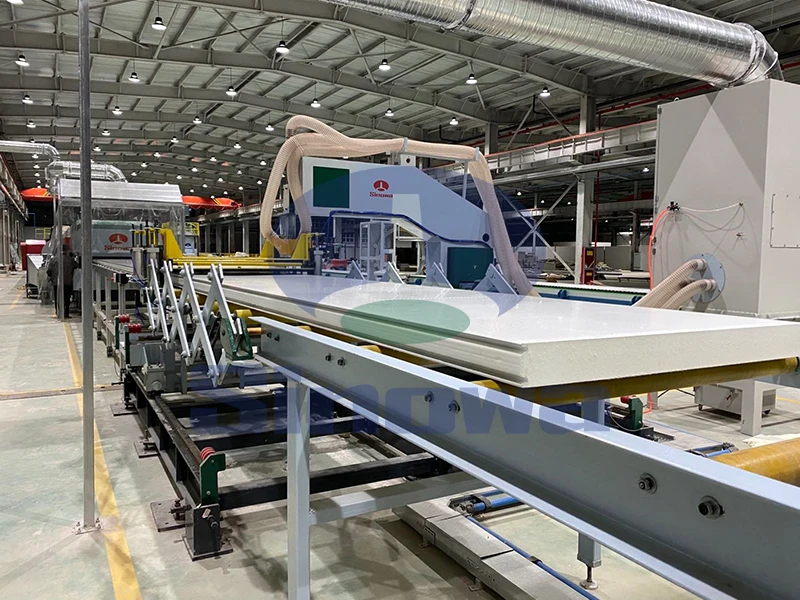
The core thickness manufacturing range of conventional continuous PU sandwich panel production lines forms the foundational parameter for industrial production, with 30mm marking the minimum viable thickness for stable mass production. This thin-panel specification is engineered for lightweight building components, including interior partition walls, decorative wall claddings, and temporary structural enclosures that prioritize space-saving design and basic thermal insulation performance. Producing panels thinner than 30mm on conventional lines poses significant technical challenges, such as uneven PU foam filling, inconsistent core density, and easy surface layer deformation during the continuous pressing and curing process. Conventional production equipment lacks the precision pressure and flow control systems required for ultra-thin panel molding, making 30mm the practical lower limit for reliable, defect-free batch production in standard operating conditions.
Moving upward from the minimum threshold, conventional PU sandwich panel lines excel at producing medium-thickness panels ranging from 50mm to 100mm, which represent the most widely used specifications in the construction industry. Panels in this thickness bracket strike an optimal balance between structural rigidity, thermal insulation efficiency, and cost-effectiveness, making them ideal for exterior building walls, factory roofing, and ordinary warehouse enclosure systems. The mechanical structure of conventional production lines, including double conveyor pressing systems and fixed mold height adjustments, is perfectly calibrated to stabilize foam expansion and bonding for medium-thickness cores. During production, the PU foaming reaction and curing time can be fully matched to the line’s standard operating speed, ensuring uniform core density, tight adhesion between metal surface layers and PU cores, and consistent flatness across every finished panel in mass production.
For low-temperature insulation and high-performance enclosure projects, conventional PU sandwich panel production lines can stably manufacture thick panels spanning 120mm to 200mm, the upper thickness limit for standard continuous production models. Panels within this range are primarily applied in cold storage facilities, constant-temperature workshops, and industrial buildings requiring ultra-high thermal insulation and strong structural load-bearing capacity. Producing thick PU panels demands coordinated adjustments of multiple line parameters, including increased PU material injection volume, extended thermal curing time, and optimized conveyor running speed to avoid incomplete foam curing or internal voids. Conventional production lines are pre-configured with adaptive adjustment functions for these parameters, enabling stable production of thick panels without additional major equipment modifications, though the overall production efficiency will moderately decrease compared with medium-thickness panel manufacturing.
The thickness adjustment mechanism of conventional PU sandwich panel production lines relies heavily on the height of the side sealing blocks and upper-lower conveyor gap calibration, which directly defines the effective production thickness range. All conventional standard lines adopt mechanical gap adjustment structures that support stepless fine-tuning within the 30mm to 200mm range, allowing operators to accurately set target thicknesses according to project requirements. Each thickness parameter corresponds to a matched set of process settings, including PU foam material flow rate, foaming pressure, and heating tunnel temperature gradient. This mechanical and procedural matching design ensures that whether producing thin, medium, or thick panels, the finished products maintain unified structural stability and insulation performance, avoiding quality fluctuations caused by thickness changes in conventional production modes.
It is critical to distinguish the thickness capacity differences between continuous conventional PU sandwich panel lines and discontinuous batch production equipment, as their manufacturing limits vary significantly. Conventional continuous lines focus on efficient mass production of panels within 30mm to 200mm, with stable product consistency and high output efficiency suitable for large-scale engineering orders. In contrast, discontinuous production equipment can produce thicker panels beyond 200mm but suffers from lower production efficiency and less uniform product quality, making it unsuitable for conventional standardized mass production. For most regular construction and industrial insulation projects, the 30mm to 200mm thickness range of conventional continuous lines fully meets engineering demands, eliminating the need for inefficient customized batch production processes.
Different panel application scenarios further refine the mainstream thickness specifications produced by conventional PU sandwich panel lines, forming standardized production habits in the industry. Thin panels of 30mm and 50mm are predominantly used for interior decoration and non-load-bearing partition structures, where lightweight and space utilization are the primary considerations. Medium-thickness 75mm and 100mm panels serve as the mainstream choice for civil building exterior walls and ordinary industrial plant roofing, balancing wind resistance, pressure resistance, and basic insulation needs. Thick panels of 150mm and 200mm are dedicated to cold chain and low-temperature industrial environments, where ultra-low thermal conductivity and excellent heat preservation performance are essential. Conventional production lines can seamlessly switch between these common specifications to adapt to diverse market and engineering requirements.
The production line operating speed is closely correlated with panel thickness, a key operational rule for conventional PU sandwich panel manufacturing. Conventional lines run at a relatively fast speed when producing thin panels from 30mm to 50mm, as the thin PU core cures quickly and requires less foaming and molding time. As panel thickness increases to 100mm and above, operators must reduce the line running speed appropriately to ensure sufficient time for PU foam full expansion, uniform filling, and complete thermal curing. Excessively fast operating speeds for thick panels will lead to incomplete core curing, internal hollowing, and weak bonding between layers, while overly slow speeds for thin panels may cause foam over-expansion and surface bulging. Conventional lines are designed with built-in speed-thickness matching logic to standardize this operational adjustment.
The surface material specifications matched with conventional production lines also indirectly affect the stability of different thickness panel production. Conventional lines are compatible with common metal surface sheets with fixed thickness ranges, and the matching between surface sheet rigidity and PU core thickness ensures product molding quality. For thin PU panels, thin surface sheets are adopted to avoid overall structural stiffness excess and surface stress deformation; for thick PU panels, relatively thicker surface sheets are used to enhance the overall structural strength of finished panels. This supporting material matching mechanism enables conventional production lines to maintain stable molding quality throughout the entire 30mm to 200mm thickness range, ensuring that panels of different thicknesses meet daily service and structural use requirements.
Many users confuse the maximum production thickness of conventional standard lines with customized modified lines, leading to misunderstanding of equipment performance. Ordinary unmodified conventional PU sandwich panel production lines cannot stably produce panels thicker than 200mm, as exceeding this limit will exceed the adaptive range of the conveyor gap, foaming system, and curing tunnel structure. Producing ultra-thick panels requires professional equipment modification, including replacing height-adjustable sealing structures, upgrading high-flow foaming systems, and extending constant-temperature curing zones, which falls beyond the scope of conventional production line capabilities. Therefore, in conventional standardized production scenarios, 200mm remains the reliable upper thickness limit for mass-produced qualified PU sandwich panels.
In summary, the mature and stable manufacturing thickness range of conventional PU sandwich panel production lines is firmly fixed at 30mm to 200mm, covering almost all conventional application fields of PU sandwich panels. With flexible mechanical adjustment and standardized process parameter matching, these lines can efficiently and stably produce thin, medium, and thick panels for interior decoration, exterior building enclosure, and low-temperature insulation projects respectively. This fixed thickness production envelope not only defines the core performance boundary of conventional production equipment but also provides a reliable parameter basis for industrial standardized production and engineering specification design, maintaining high product consistency and production efficiency in daily industrial operation.
Tags: pu sandwich panel production line, pu sandwich panel production line manufacturer, pu sandwich panel production line supplier, china pu sandwich panel production line, pu sandwich panel production line for sale