How To Solve Uneven Foaming Problems Of A Continuous PU Sandwich Panel Line?
Publication Date: Oct 12, 2026
Solve uneven foaming issues on continuous PU sandwich panel production lines with practical process adjustment, equipment maintenance, raw material control, and environmental optimization methods to stabilize foam density, eliminate surface defects, and improve panel overall consistency and production yield.
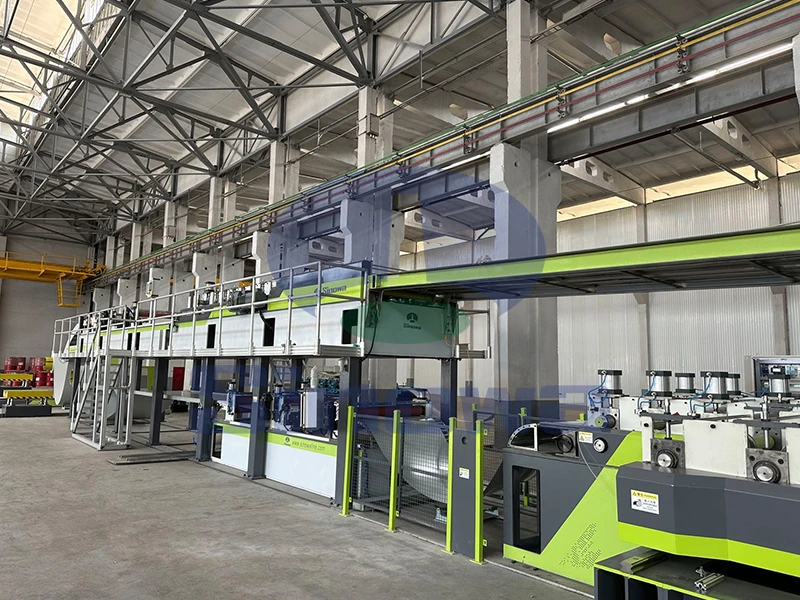
Uneven foaming is one of the most prevalent quality defects in continuous PU sandwich panel production, manifesting as inconsistent foam density, irregular cell structures, wavy surfaces, and local insufficient or excessive foaming. This problem directly undermines the thermal insulation performance, structural stability, and surface flatness of finished panels, and often leads to high product rejection rates and unstable continuous production. The core causes mainly cover inaccurate raw material proportioning, unstable reaction temperature, inadequate material mixing, abnormal line operating parameters, and unregulated production environments. Targeted troubleshooting and systematic optimization of each production link can effectively eliminate uneven foaming defects and maintain stable production quality.
Inaccurate raw material ratio is the primary cause of uneven PU foam formation in continuous production. PU foaming relies on the precise chemical reaction between polyol and isocyanate, and any deviation in the proportion of core materials or auxiliary additives will disrupt the foaming balance. Excessive isocyanate leads to overly fast local curing and dense foam areas, while insufficient dosage causes incomplete reaction and sparse bubble structures. Irregular addition of catalysts, blowing agents, and surfactants also results in inconsistent reaction speed and bubble stability across different production sections. It is essential to calibrate the automatic metering system of the production line regularly to ensure stable and accurate feeding of all raw material components, and fine-tune the auxiliary agent dosage according to real-time foaming conditions to maintain a balanced foaming reaction state.
Unstable temperature conditions of raw materials and production environment severely affect foam uniformity. PU foaming reaction is highly temperature-sensitive, and material temperature fluctuations will directly change reaction activity and foaming speed. Low polyol and isocyanate temperatures slow down the reaction, leading to delayed bubble expansion and uneven cell growth, while excessively high temperatures cause rapid, uncontrolled local reactions and partial foam shrinkage. Meanwhile, large fluctuations in workshop ambient temperature disrupt the consistency of continuous foaming. It is necessary to keep raw material storage and delivery temperatures within a stable range and maintain a constant workshop ambient temperature to ensure each batch of materials undergoes consistent reaction progress during continuous pouring and foaming.
Insufficient or uneven material mixing in the mixing head easily triggers regional foaming differences. The continuous production line relies on high-speed mixing equipment to blend raw materials evenly, and long-term operation will cause residue accumulation, nozzle blockage, and mixing head wear. These faults lead to incomplete mixing of polyol, isocyanate and auxiliary materials, forming local material concentration differences. Insufficiently mixed material areas produce sparse or broken bubbles, while fully mixed areas form dense and uniform foam. Regular disassembly and cleaning of the mixing head, inspection of mixing blade integrity, and adjustment of mixing speed and shearing strength can ensure uniform material blending and eliminate foaming differences caused by mixing defects.
Mismatched production line operating speed and foaming reaction time is a key factor in dynamic foaming unevenness. Continuous PU sandwich panel production features synchronous progress of material pouring, bubble expansion, and curing molding. If the line speed is too fast, the foam fails to complete uniform expansion before lamination, resulting in local hollow and insufficient filling; if the speed is too slow, excessive foam expansion causes partial overflow and dense compression deformation. The cream time and curing time of PU foam have fixed reaction rules, and production speed must be adjusted dynamically according to the actual foaming reaction progress. Matching reasonable line speed with foam reaction rhythm can avoid foaming defects caused by asynchronous production and reaction cycles.
Abnormal pendulum pouring operation leads to uneven material distribution and subsequent foaming inconsistency. The pendulum pouring system undertakes the task of uniform material spreading on the base plate, and pendulum swing deviation, unstable swing frequency, or inconsistent moving speed will cause uneven material accumulation on the panel surface. Local excessive material accumulation leads to over-foaming and high density, while insufficient material coverage results in under-foaming and sparse foam layers. Regularly calibrate the pendulum swing trajectory, adjust swing frequency and amplitude, and check the stability of the pouring delivery system to ensure uniform material coverage on the entire panel width, laying a foundation for consistent integral foaming.
Unstable feeding pressure of raw materials disrupts continuous foaming stability. The raw material delivery system of the production line requires stable pressure to ensure consistent material flow per unit time. Fluctuations in delivery pressure cause instantaneous changes in material output during continuous pouring, leading to alternating dense and sparse foam areas. Low and unstable pressure results in slow material outflow and intermittent feeding, while excessive pressure causes instantaneous material surges and local over-feeding. Daily inspection of pressure pipeline tightness, regular calibration of pressure control valves, and elimination of pipeline blockage and air leakage can maintain stable feeding pressure and uniform material output throughout production.
Improper selection and dosage of foam auxiliary additives aggravate foaming unevenness. Surfactants, catalysts, and blowing agents play key roles in stabilizing bubble structures and controlling reaction speed. Unreasonable surfactant dosage causes unstable bubble film strength, leading to local bubble rupture and inconsistent cell size. Mismatched gel and blowing catalyst ratios uncouple the foaming expansion and curing processes, resulting in uneven foam shrinkage and molding differences. It is necessary to select matched auxiliary agent formulas according to production conditions, control accurate additive dosages, and avoid foaming disorder caused by auxiliary agent failure or excessive dosage.
Abnormal lamination pressure of the laminating machine affects final foam molding uniformity. After foam expansion, the panel enters the laminating stage for composite molding, and uneven belt pressure of the laminator will compress the foam layer inconsistently. Excessive local pressure squeezes foam cells to deform and densify, while insufficient pressure leads to incomplete foam bonding and loose internal structures, forming obvious foaming and density differences on the same panel. Regularly check the flatness and pressure uniformity of the laminator belt, adjust the overall and local pressure parameters, and ensure uniform stress on the panel during lamination to protect the formed uniform foam structure.
Residual moisture and impurity interference in raw materials cause local foaming defects. Excessive moisture in polyol raw materials will trigger side reactions during foaming, generating extra gas and causing local bubble enlargement and hollow defects. Impurities mixed in raw materials or residual dirt in delivery pipelines will hinder uniform material mixing and bubble growth, forming irregular foaming dead zones. Strictly control raw material storage conditions to avoid moisture absorption, filter raw materials before feeding, and regularly clean material delivery pipelines and storage tanks to eliminate impurity and moisture interference on foaming consistency.
Lack of regular production process monitoring and parameter optimization leads to recurring uneven foaming problems. Continuous PU sandwich panel production is a dynamic and systematic process, and minor changes in equipment status, raw material batches, and workshop environment will affect foaming effects. Many uneven foaming issues are caused by long-term unchanged process parameters and neglected minor equipment abnormalities. Establish a real-time foaming state monitoring mechanism, observe foam cell uniformity, surface flatness and density changes during production, and record process parameters. Conduct regular parameter optimization and equipment inspection to adjust production conditions timely according to actual production status, realizing long-term stable and uniform PU foaming production.
Tags: continuous pu sandwich panel line, continuous pu sandwich panel line manufacturer, continuous pu sandwich panel line supplier, china continuous pu sandwich panel line, continuous pu sandwich panel line for sale