How Many Operators Are Required To Run A Full PU Sandwich Panel Line?
Publication Date: Oct 8, 2026
Operating a full PU sandwich panel production line demands a well-structured team of skilled operators, with staffing levels primarily determined by line automation degree, production speed, and operational workflow. A standard fully continuous PU sandwich panel line typically requires 4 to 6 professional operators per working shift to cover material handling, equipment monitoring, production adjustment, quality control, and post-production processing, while semi-automatic configurations may need slightly fewer staff. Understanding the exact operator allocation helps manufacturers optimize labor efficiency, maintain stable production output, and avoid operational gaps in daily panel manufacturing.
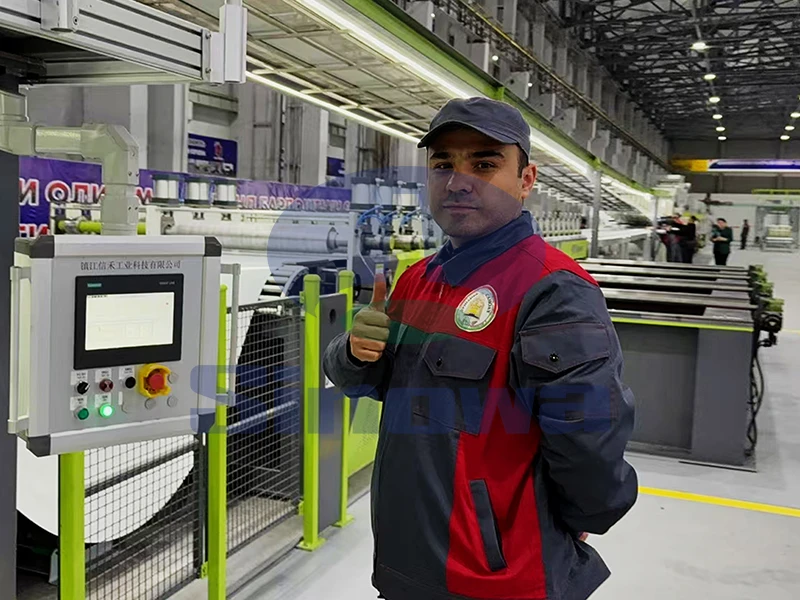
The total number of operators for a full PU sandwich panel line is not fixed and varies most significantly based on the line’s automation level, which defines manual intervention needs across every production stage. Highly automated continuous lines integrate unified control systems, automatic conveying, and intelligent parameter adjustment, minimizing repetitive manual work and reducing reliance on large labor teams. In contrast, semi-automatic lines with partial manual feeding, trimming, and stacking functions require more on-site staff to assist mechanical operations. Even within fully automated models, high-speed production configurations targeting large daily output will need an additional operator to monitor real-time line status, ensuring no delays or quality inconsistencies during peak operation hours.
A core production operator serves as the central role for daily line operation, acting as the primary controller of the entire PU sandwich panel manufacturing system. This professional is responsible for powering on the equipment, initializing production parameters, calibrating PU foaming ratios, and coordinating the synchronous operation of all linked machines. During production, they continuously monitor the central control interface to track foaming temperature, panel forming speed, and material feeding stability, making minor real-time adjustments to maintain production uniformity. This operator also conducts pre-production equipment inspections to check for system errors or mechanical abnormalities, laying a solid foundation for smooth daily production and preventing unexpected line shutdowns.
Material handling operators are essential auxiliary staff for a full PU sandwich panel line, focusing on raw material preparation and feeding management to sustain uninterrupted production. Their core duties include organizing metal coil raw materials, ensuring smooth uncoiling of upper and lower panel substrates, and checking the flatness and integrity of surface materials before they enter the forming stage. They also manage auxiliary materials such as protective films and edge sealing accessories, replenishing supplies in a timely manner to avoid material shortages that halt production. For standard production lines, one to two dedicated material handling operators are usually needed to match the line’s operating rhythm and maintain consistent feeding efficiency throughout the shift.
On-line quality inspection operators play a critical role in guaranteeing finished PU sandwich panel quality and reducing defective product rates during continuous production. Working alongside the running production line, they conduct real-time sampling and visual inspections of semi-finished and finished panels, checking key indicators including surface flatness, foaming density uniformity, edge sealing integrity, and overall dimensional accuracy. Once subtle quality deviations are detected, they immediately communicate with the core control operator to adjust production parameters, avoiding mass defective product generation. This role is indispensable for formal production lines, as continuous high-speed operation may lead to minor mechanical or parameter fluctuations that require manual quality supervision.
Finishing and stacking operators take charge of the final production stage, covering panel cutting, trimming, sorting, and orderly stacking of finished PU sandwich panels. After the continuous forming and curing process, panels are cut into standard sizes by automatic cutting equipment, and minor edge burrs or irregular parts need manual trimming to meet finished product standards. These operators also classify panels according to specifications and quality levels, stack qualified products neatly on pallets, and separate defective products for rework or disposal. One dedicated finishing operator is generally required for regular-speed lines, while high-output lines may need an additional staff member to accelerate post-production processing.
Line supervision and coordination personnel serve as the on-site management role for the PU sandwich panel production line, responsible for overall operational scheduling and problem handling during shifts. This staff member oversees the work status of all on-site operators, ensures each production process follows standardized operating procedures, and coordinates handover work between different operational positions. They also record daily production data, including output volume, equipment operation duration, and minor fault records, to support production statistics and process optimization. In medium and large-scale production configurations, a dedicated supervisor effectively unifies team operations and improves overall production coordination efficiency.
Daily equipment auxiliary maintenance is another key responsibility that requires dedicated staffing or designated operator coverage for a full PU sandwich panel line. Although modern lines feature automated operation, regular on-site maintenance is still needed to clean residual PU foam, lubricate transmission components, and check the tightness of mechanical parts during production gaps. This work prevents equipment jams, reduces mechanical wear, and extends the service life of production devices. Most production teams arrange one operator to take charge of routine on-site maintenance during each shift, while complex professional maintenance can be arranged during off-production hours by specialized technical personnel.
Production shift arrangement directly affects the total operator demand for long-term stable operation of the PU sandwich panel line. Most manufacturing factories adopt multi-shift working modes to maximize equipment utilization and achieve continuous annual production. Each independent shift needs a complete set of operational staff covering control, material handling, quality inspection, and finishing work. For enterprises running two or three shifts daily, the total number of on-the-job operators will multiply based on single-shift staffing, while reserving a small number of backup staff to cover leave and emergency work substitutions, ensuring zero gaps in line operation.
Low-capacity and trial-production PU sandwich panel lines can adopt simplified operator allocation schemes to save labor costs. For small-batch production with low operating speed and intermittent working hours, some operational roles can be merged, with skilled operators undertaking multiple tasks such as parameter adjustment, simple quality inspection, and basic material arrangement. In this scenario, a full line can run stably with only 3 to 4 operators per shift, which is sufficient to meet low-volume production demands. This flexible staffing mode is highly suitable for small-scale manufacturers or new production lines in the trial operation stage.
In summary, the operator configuration of a full PU sandwich panel line is a flexible system matched with production scale and automation level. Standard fully automatic continuous lines rely on a 4–6 person single-shift team to achieve efficient, stable, and high-quality production, covering all core and auxiliary operational links. Reasonable operator allocation not only ensures the normal operation of all production processes but also optimizes labor resource utilization, helping manufacturers balance production efficiency and operational cost in long-term panel manufacturing.
Tags: pu sandwich panel line, pu sandwich panel line manufacturer, pu sandwich panel line supplier, china pu sandwich panel line, pu sandwich panel line for sale