What Common Faults Occur Frequently On A Polyurethane Sandwich Panel Production Line?
Publication Date: Oct 9, 2026
Polyurethane sandwich panel production lines often encounter recurring mechanical, material, and process faults that compromise panel quality, disrupt continuous production, and increase operational downtime. These frequent issues primarily include inconsistent panel thickness, weak interlayer adhesion, uneven foam density, filling voids, surface defects, transmission system instability, raw material pipeline blockages, cutting inaccuracies, temperature control deviations, and foam overflow problems, all stemming from parameter mismatches, equipment wear, improper operation, and unstable material reactions. Understanding these common faults, their root causes, and performance impacts helps operators implement targeted troubleshooting and daily maintenance to stabilize production quality and improve line efficiency.
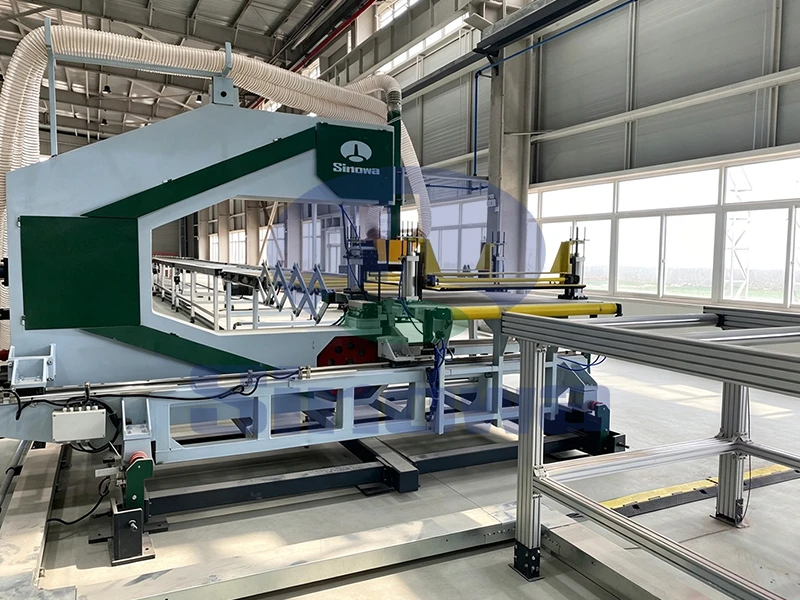
Inconsistent panel thickness ranks as one of the most prevalent faults in polyurethane sandwich panel production, affecting both the dimensional uniformity and structural performance of finished products. This defect manifests as uneven thickness across panel surfaces, inconsistent edge thickness, or gradual thickness deviation during long-duration continuous production. The core causes mainly involve unstable gaps in the pressing unit, where long-term mechanical vibration and component wear lead to subtle changes in press clearance that fail to maintain uniform compression on panel substrates. Additionally, mismatched coordination between foam injection volume and production line running speed disrupts the balanced expansion of polyurethane foam, resulting in uneven thickness distribution. Fluctuations in curing temperature also impact foam molding efficiency, causing partial over-expansion or insufficient filling. Without timely adjustment, this fault leads to large batches of unqualified products, increases material waste, and requires frequent manual thickness calibration to resume normal production.
Weak interlayer adhesion and occasional delamination are persistent quality faults troubling polyurethane sandwich panel production lines, directly undermining the structural integrity and service durability of panels. This issue appears as incomplete bonding between the metal surface sheet and the polyurethane foam core, with local separation or overall peeling easily occurring under slight external force. Improper chemical ratio of polyurethane raw materials is a primary trigger, as unbalanced proportions of polyol and isocyanate weaken the foam’s bonding activity. Meanwhile, unstable injection pressure during the foaming process results in uneven foam spreading on the substrate surface, creating weak bonding areas with insufficient contact. Surface contamination of the base sheets, including residual dust, oil stains, or moisture, also hinders effective adhesion between the foam and substrate. Long-term accumulation of this fault not only reduces product qualification rates but also leads to frequent after-sales quality issues for finished panels.
Uneven polyurethane foam density is a frequent internal quality fault in sandwich panels, which subtly impairs the thermal insulation and mechanical properties of finished products without obvious surface abnormalities. This defect features inconsistent density across different parts of the panel core, with some areas overly dense and others overly sparse, leading to unbalanced structural stress and degraded thermal insulation performance. The main causes include inaccurate calibration of the raw material metering system, where unstable feeding ratios of foaming materials cause irregular foam expansion degrees. Misalignment of the swing injection device also leads to uneven material distribution during injection, resulting in inconsistent foaming volume in different panel areas. Moreover, fluctuations in on-site ambient temperature affect the foaming reaction rate; low temperatures slow down the reaction and increase foam density, while high temperatures accelerate volatilization and create loose foam structures. Continuous production with unadjusted parameters will amplify density differences and cause batch quality inconsistencies.
Foam filling voids and hollow pockets are common structural faults in polyurethane sandwich panel production, forming invisible or visible empty spaces inside the panel core. These voids vary in size and location, often appearing at panel corners, edges, or random middle areas, severely reducing the panel’s compression resistance and overall structural stability. Insufficient raw material injection volume is the most direct cause, where inadequate material supply fails to fully fill the molding cavity during high-speed line operation. A mismatch between line speed and foam reaction cycle also contributes significantly: if the production line runs too fast, the polyurethane foam cannot complete full expansion and filling before curing, leaving residual gaps. Additionally, blocked or offset injection ports disrupt uniform material output, leading to local material shortage and hollow defects. Regular inspection of injection systems and parameter matching of speed and reaction time are essential to reduce such void faults.
Panel surface brittleness and powdering are typical surface quality faults that frequently occur in seasonal or unstable production environments, damaging the appearance quality and surface protection performance of sandwich panels. This fault is characterized by a fragile foam surface layer that easily crumbles and sheds powder when touched or rubbed, exposing internal structures and reducing surface wear resistance. Excessive moisture in the polyol raw material is a key inducing factor, as excess water triggers abnormal chemical reactions during foaming and forms unstable urea linkages that weaken surface compactness. An unreasonable isocyanate index also leads to incomplete foam curing, resulting in a loose and brittle surface structure. In addition, insufficient catalyst activity in low-temperature environments slows down the curing reaction, leaving the surface under-cured and prone to powdering. Long-term existence of this fault makes panels susceptible to corrosion and aging in subsequent use scenarios.
Transmission system instability is a common mechanical fault that induces multiple secondary quality problems in polyurethane sandwich panel production lines. The transmission system, composed of universal couplings, conveyor belts, and drive shafts, operates under long-term continuous vibration and load friction, leading to loose fixing bolts and unstable connection structures over time. This looseness causes inconsistent conveyor belt operating speed and slight jitter during operation, disrupting the uniform progress of foam injection and pressing molding. Unstable transmission also leads to uneven tension of surface base sheets, resulting in sheet deviation and wrinkling during feeding. In severe cases, sudden transmission jitter causes instantaneous material accumulation or feeding interruption, forming local thickening, indentation, or uneven foaming on panels. Regular fastening of transmission components and real-time tension calibration can effectively reduce such mechanical-induced quality faults.
Raw material pipeline blockage is a frequent operational fault that hinders stable feeding and continuous production of polyurethane sandwich panel lines. Polyurethane raw materials have specific viscosity and chemical activity, and residual materials in pipelines can undergo partial curing and precipitation after long-term intermittent production or insufficient pipeline cleaning. These precipitates gradually accumulate to form blockages, reducing pipeline flow or causing unilateral material cutoff. Pipeline blockage leads to unstable raw material supply ratios, insufficient injection volume, and discontinuous feeding, directly triggering foam density deviation, filling voids, and incomplete panel molding. In addition, local pipeline blockage causes uneven material pressure, resulting in unstable injection speed and irregular foam spreading. Regular pipeline dredging, residual material cleaning, and timed inspection of filter components are necessary routine maintenance steps to avoid this recurring fault.
Cutting system faults including inaccurate sizing and edge burrs frequently affect the finished appearance and dimensional precision of polyurethane sandwich panels. After continuous high-intensity operation, the cutting blade gradually wears and loses sharpness, leading to uneven incisions, rough section surfaces, and obvious burrs on panel edges. Meanwhile, aging or insensitive positioning sensors and signal delay of the cutting system cause inaccurate length calibration, resulting in inconsistent sizes of finished panels within the same batch. Deviations in the cutting angle of the equipment also lead to irregular panel edges, affecting subsequent assembly and installation effects. These cutting faults do not damage the internal structure of panels but reduce product finish and dimensional uniformity, requiring secondary manual trimming that lowers production efficiency and increases labor costs.
Curing temperature control deviation is a subtle but high-frequency process fault that affects the overall molding quality of polyurethane sandwich panels. The curing channel requires a stable and constant temperature environment to ensure complete and uniform foam reaction and curing, but long-term operation of heating equipment often leads to temperature drift and local temperature inconsistency in the curing area. Excessively high local temperatures cause rapid foam over-expansion, resulting in panel surface bulges and internal loose structures, while excessively low temperatures lead to slow curing, incomplete reaction, and reduced foam compactness. Temperature fluctuations also cause inconsistent curing degrees of panels produced at different time periods, forming batch quality differences. Real-time temperature monitoring and regular calibration of heating and temperature control systems are critical to eliminating this hidden process fault.
Foam overflow and edge flash faults commonly occur in the pressing and molding stage of polyurethane sandwich panel production, affecting panel appearance and dimensional standardization. This fault manifests as excess polyurethane foam extruding from panel edges, forming irregular flash and protruding residual foam. Excessive raw material injection volume is the main cause, where over-injection exceeds the cavity filling demand and generates redundant foam that overflows during pressing. Poor sealing performance of the side sealing structure of the pressing equipment also leads to gaps at panel edges, allowing foam to leak out under molding pressure. In addition, incomplete closing of the pressing unit and unstable molding pressure cause inconsistent cavity space, triggering local foam overflow. Regular inspection of sealing components and precise adjustment of injection volume can effectively control this frequent defect and improve the yield of finished panels.
Tags: polyurethane sandwich panel production line, polyurethane sandwich panel production line manufacturer, polyurethane sandwich panel production line supplier, china polyurethane sandwich panel production line, polyurethane sandwich panel production line for sale