What Surface Materials Are Compatible With PU Sandwich Panel Machine Processing?
Publication Date: Nov 23, 2026
Discover compatible surface materials for PU sandwich panel machine processing: color steel, galvanized steel, aluminum, stainless steel, cement fiber, magnesium oxide boards, aluminum foil, kraft paper & non-woven fabrics.
A wide range of rigid and flexible facing materials can be processed on PU sandwich panel machines, including color steel sheets, galvanized steel sheets, aluminum sheets, aluminum alloy sheets, stainless steel sheets, fiberglass reinforced plastic panels, cement fiber boards, magnesium oxide boards, kraft paper, aluminum foil, and non-woven fabrics. These materials can form stable composite structures with PU foam core under continuous foaming, pressing and curing processes of the equipment as long as they meet basic requirements on flatness, tensile strength and surface coating adhesion.
Basic Matching Principles for Surface Materials
The compatibility between surface materials and PU sandwich panel processing mainly depends on two core factors: surface bonding performance and thermal dimensional stability. The liquid PU raw materials will react and foam rapidly after mixing, and form adhesion with the inner side of the facing material during the curing stage. Materials with dense, clean and slightly rough inner surfaces are easier to combine tightly with the PU core layer. Materials that are too smooth or carry oil, dust and release agents on the surface will cause delamination between the panel surface and the foam core. In addition, the surface material should not produce large deformation when exposed to the heat released by PU foaming reaction, otherwise defects such as warping, wrinkling and uneven thickness of finished panels will appear.
Common Metal Surface Materials
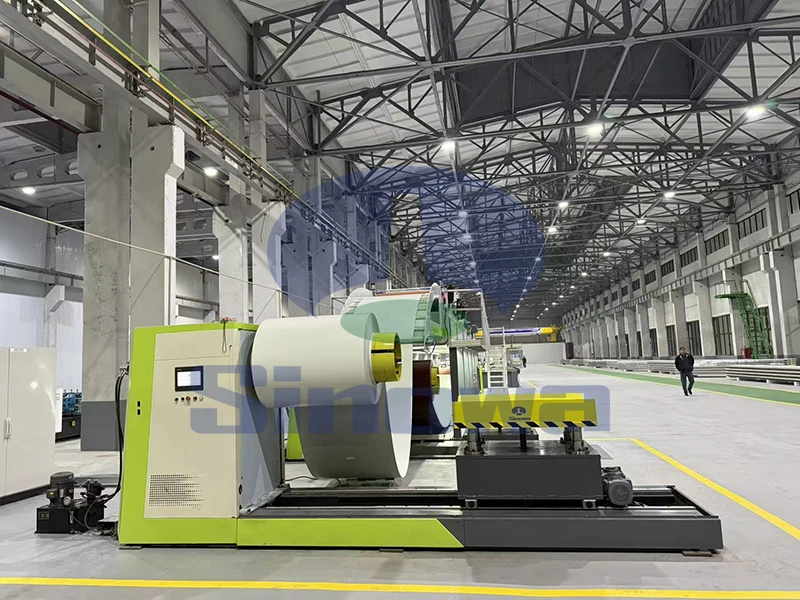
Metal facings are the most widely used type in continuous PU sandwich panel production. Color coated steel and galvanized steel have good forming performance, and can go through unwinding, leveling, embossing and bending on the machine line smoothly. Their pre-treated coating layers can maintain stable bonding with PU foam without falling off in normal processing conditions. Aluminum and aluminum alloy sheets feature lighter weight and good corrosion resistance. They need to control the surface oxide layer state before composite processing to avoid weak bonding. Stainless steel sheets have high surface density, so the processing speed and pressing pressure need to be adjusted properly to ensure uniform foam filling.
Inorganic and Composite Hard Surface Materials
Inorganic hard boards are usually supplied in sheet form instead of rolls, so they adapt to the batch feeding structure of PU sandwich panel machines. Fiberglass reinforced plastic panels have moderate hardness and good waterproof performance, and their specially treated inner surface can form a firm composite with PU core. Cement fiber boards and magnesium oxide boards have fire-resistant and rigid characteristics. It is necessary to keep the moisture content of these boards within a reasonable range before processing; excessive moisture will interfere with the foaming reaction of PU and reduce the bonding strength of the composite layer. This kind of hard facing material has poor ductility, so impact and extrusion should be avoided during conveying and pressing.
Light Flexible Surface Materials
Flexible roll materials such as aluminum foil, kraft paper and non-woven fabrics are often used for functional composite panels. Aluminum foil mainly provides vapor barrier performance. It usually needs to be compounded with a base layer to improve tensile resistance, so it will not tear under the traction of the production line. Kraft paper and non-woven fabrics have porous structures, which help the PU raw material infiltrate the surface and improve bonding. These flexible materials are generally used as single-sided or double-sided auxiliary facings, and they cannot independently provide structural rigidity for the finished sandwich panels. They are often matched with other rigid surface materials to achieve combined performance.
Material Types That Are Not Suitable for Direct Processing
Some materials cannot be directly used for PU sandwich panel machine production. Materials with highly greasy or silicone-treated release surfaces will completely prevent PU foam from sticking. Soft plastic films with poor heat resistance will melt or shrink under the heat of foaming reaction. Brittle materials that are easy to crack under slight pressure are also not suitable for the continuous pressing and traction process of the equipment. If such materials need to be used, additional surface modification or transition base layers are required, which will change the whole processing flow and parameter setting of the machine.
Key Adjustments of Processing Parameters for Different Facings
Even for compatible surface materials, the production parameters of the PU sandwich panel machine need targeted adjustment. For dense metal sheets, the foaming formula, pressing clearance and curing time can be set in a conventional interval. For water-absorbing inorganic boards, the feeding speed and material temperature should be controlled to offset the influence of surface moisture. For thin flexible materials, the traction tension needs to be reduced to prevent stretching and deformation. Reasonable parameter matching can avoid common quality problems such as empty foam, local delamination and inconsistent panel surface flatness, and give full play to the composite advantages of each surface material.
Tags: pu sandwich panel machine, pu sandwich panel machine manufacturer, pu sandwich panel machine supplier, china pu sandwich panel machine, pu sandwich panel machine for sale
Sinowa Sandwich Panel Lines
Sandwich Panel Machine For Sale
- PUR Sandwich Panel Production Line
- PIR Sandwich Panel Production Line
- PUF Sandwich Panel Production Line
- Rock Wool Sandwich Panel Production Line
- Glass Wool Sandwich Panel Production Line
- Mineral Wool Sandwich Panel Production Line
- Color Steel Sandwich Panel Production Line
- Thermal Insulation Sandwich Panel Production Line
- Cold Storage Sandwich Panel Production Line
- PU/PIR/Rockwool Insulation Sandwich Panel Machines
- PU/PIR/Rockwool Sandwich Panel Production Equipment
- PU/PIR/Rockwool Sandwich Panel Making Machinery