Can A PU Sandwich Panel Machine Integrate Rock Wool Core Panel Production?
Publication Date: Nov 20, 2026
Yes, most PU sandwich panel machines can be upgraded to produce rock wool core panels with compatible rollers, feeding and cutting systems for versatile insulated panel manufacturing.
Yes, a PU sandwich panel machine can be modified and equipped with auxiliary functional modules to realize rock wool core panel production, though it cannot switch freely between the two core materials without corresponding structural adjustment and accessory replacement. The base frame, forming conveying system and cutting mechanism of the equipment can be shared, while dedicated feeding, positioning and sealing components need to be added to adapt to the physical characteristics of rock wool.
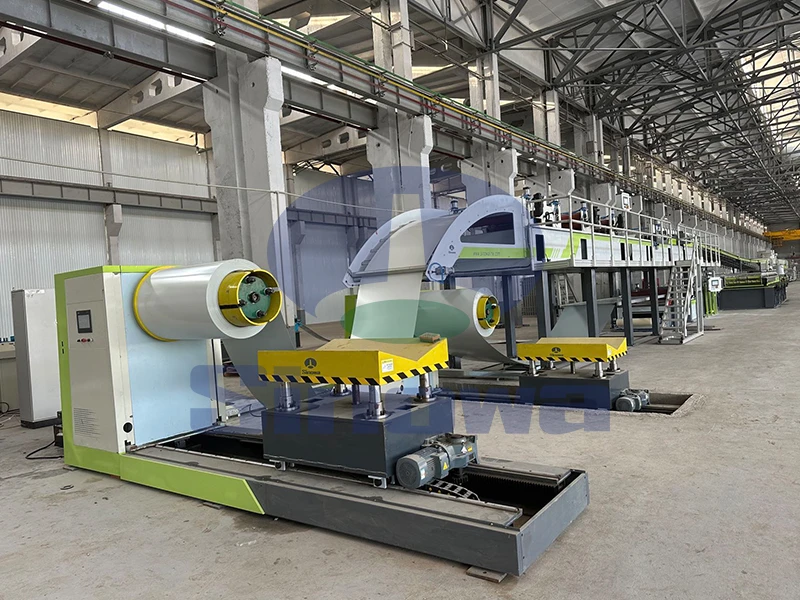
Core Differences Between PU and Rock Wool Sandwich Panel Processing
PU core material is a foaming raw material that completes curing and molding inside the panel cavity after continuous spraying. Rock wool, by contrast, is a preformed fibrous core material with rigid and porous features, which will not produce in-situ foaming reaction during production. This fundamental distinction leads to different requirements for the feeding section. PU production relies on high-pressure foaming and mixing systems, while rock wool production needs a stable unwinding, cutting and arranging device to lay rock wool strips evenly between two metal surface sheets. The original foaming spray unit will be shut down or removed when producing rock wool panels.
Necessary Modifications for Mixed Production
Several key parts need adjustment to make the PU sandwich panel machine compatible with rock wool core panels. First, a rock wool automatic feeding and centering mechanism should be installed to avoid offset and overlapping of rock wool layers during continuous transmission. Second, the pressing section requires optimized roller gaps and pressure control. Rock wool has higher compression rebound performance than cured PU foam; improper pressure will cause uneven panel thickness or broken rock wool fibers. Third, edge sealing devices are essential. Rock wool has loose fiber edges, so special glue distribution or edge wrapping structures help bond the metal sheets tightly with the rock wool core and prevent fiber shedding from panel sides.
Limitations of Integrated Production
Even after retrofitting, the PU sandwich panel machine still has obvious limitations. Switching between PU panels and rock wool panels takes extra time for part replacement, equipment cleaning and parameter recalibration. Residual PU foam left in the pipeline may contaminate rock wool fibers if cleaning is incomplete. Besides, the production speed and continuous running rhythm differ greatly for the two products. Operators need to reset running speed, pressing pressure and glue supply parameters separately for each core material. It is not suitable for frequent, rapid switching of two products in a short production cycle.
Practical Application Suggestions
This integrated solution fits PU sandwich panel production lines with diversified order demands but without ultra-high daily output for both panel types. It saves the investment of purchasing two independent production lines by sharing the main host, traction and cutting systems. Users should arrange production batches reasonably, finishing all orders of one core material before switching to the other. Regular maintenance for different functional modules is also required to keep both PU foaming systems and rock wool feeding structures in stable working condition. When the production volume of rock wool panels grows to a large proportion, a dedicated rock wool sandwich panel line will deliver better efficiency and product consistency.
Tags: pu sandwich panel machine, pu sandwich panel machine manufacturer, pu sandwich panel machine supplier, china pu sandwich panel machine, pu sandwich panel machine for sale
Sinowa Sandwich Panel Lines
Sandwich Panel Machine For Sale
- PUR Sandwich Panel Production Line
- PIR Sandwich Panel Production Line
- PUF Sandwich Panel Production Line
- Rock Wool Sandwich Panel Production Line
- Glass Wool Sandwich Panel Production Line
- Mineral Wool Sandwich Panel Production Line
- Color Steel Sandwich Panel Production Line
- Thermal Insulation Sandwich Panel Production Line
- Cold Storage Sandwich Panel Production Line
- PU/PIR/Rockwool Insulation Sandwich Panel Machines
- PU/PIR/Rockwool Sandwich Panel Production Equipment
- PU/PIR/Rockwool Sandwich Panel Making Machinery