How To Solve Panel Warping Issues In PU Sandwich Panel Machine Production?
Publication Date: Nov 20, 2026
Fix PU sandwich panel warping in production. Stabilize raw material mixing, balance curing temperature, match line speed, maintain even forming pressure, and standardize cooling & stacking to release residual stress and reduce panel bending defects.
The fundamental solution to PU sandwich panel warping during production is to balance the internal stress of the core material and the surface layers by stabilizing raw material formula parameters, controlling the temperature and speed of the continuous production line uniformly, and ensuring consistent pressure distribution throughout the foaming and curing stage; meanwhile, reasonable cooling and stacking methods after the panels exit the machine can effectively release residual stress and avoid uneven deformation caused by one-sided heat dissipation.
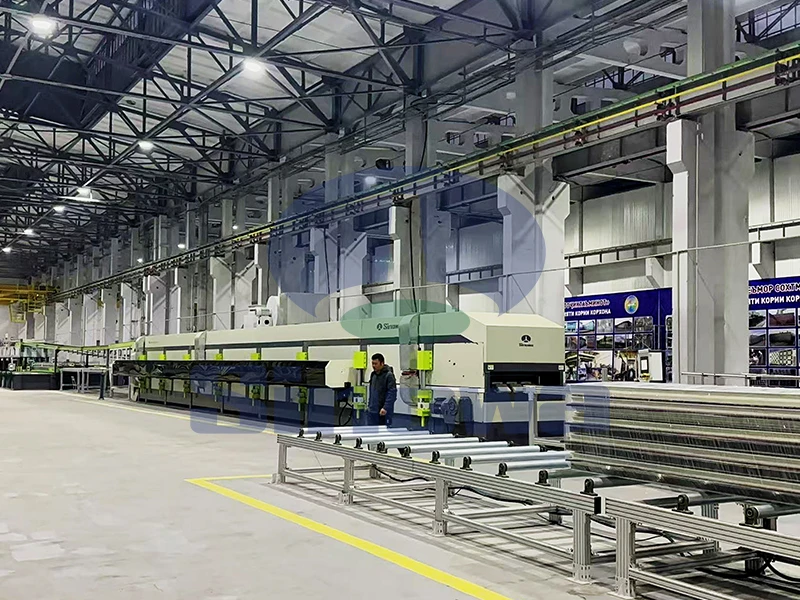
Introduction of Panel Warping Phenomenon
Panel warping is one of the most common quality defects in the continuous production of PU sandwich panels. It usually manifests as upward, downward or irregular bending of finished panels after cutting. This defect will affect the flatness of subsequent installation, reduce the fitting effect between panels, and bring extra difficulty to on-site construction. Warping is essentially the result of uneven shrinkage and stress mismatch between the PU foam core and the two surface skins. Different expansion and shrinkage rates of materials under changing temperature and curing conditions will pull the panel to bend to one side. Many production lines encounter intermittent warping problems, which are not always stable, making troubleshooting difficult.
Main Causes of Warping in Production
Unstable Raw Material Mixing and Foaming Ratio
The mixing ratio of PU raw materials directly decides the cross-linking degree and shrinkage rate of the foam core. If the proportion of components fluctuates frequently, the foaming reaction speed on the left and right sides or the upper and lower layers of the panel will be inconsistent. Fast-reacting parts complete curing earlier and shrink in advance, while slow-reacting parts continue to expand, forming uneven internal pulling force. In addition, inconsistent viscosity of raw materials will lead to poor mixing uniformity, resulting in density deviation in different areas of the foam core, which lays a hidden danger for warping.
Uneven Temperature Distribution Inside the Curing Channel
Temperature difference between the upper and lower sections of the curing oven is a major trigger for panel bending. When one side receives more heat than the other, the foam core on the hotter side cures and shrinks faster. Even a small temperature gap will accumulate stress inside the panel during continuous running. Uneven heating also leads to inconsistent foam cell structure. Parts with coarse cells have larger shrinkage space after cooling, while dense foam areas maintain stable dimensions, and the stress difference finally bends the whole panel.
Mismatched Line Speed and Curing Time
If the production line runs too fast, the PU core cannot finish sufficient cross-linking reaction inside the curing channel. After the panel is cut and exposed to the ambient air, the residual foaming reaction continues slowly. The delayed shrinkage after leaving the PU sandwich panel machine will cause gradual warping. Conversely, excessively low line speed makes the foam over-cured in local areas, producing brittle structures with large shrinkage. The coordination of line speed needs to match the reaction characteristics of the current formula rather than keeping a fixed value all the time.
Uneven Pressure from the Forming Device
The forming section provides pressure to shape the sandwich panel and control foam density. If the pressure of the upper and lower pressing belts is asymmetric, or the pressure on both sides of the panel width is different, the foam will flow unevenly in the mold cavity. The foam core forms a density gradient along the thickness or width direction. After pressure is removed, the high-density part rebounds and the low-density part shrinks, and the panel bends toward the low-density side. Loose or worn transmission parts of the pressing device will also cause periodic pressure fluctuation and regular warping of panels.
Improper Post-treatment and Stacking Operation
Many warping cases do not appear immediately after cutting but occur several hours after production. This is mostly related to improper cooling and stacking. If panels are placed in a position with one-sided air flow or direct blowing, the two surface skins cool at different speeds. Rapid cooling on one side produces fast contraction, while the other side maintains a higher temperature, and stress difference forms slowly. Stacking panels unevenly or placing heavy loads on the top of unfinished cured panels will introduce external force deformation, which becomes permanent warping after the core material is completely stabilized.
Targeted Adjustment Measures for Production
Optimize Raw Material Feeding and Mixing System
Keep the feeding flow of each PU component stable and avoid sudden flow changes. Check the mixing state regularly to ensure full and homogeneous mixing before the material flows into the space between the upper and lower skins. Fine-tune the formula to reduce the shrinkage difference after curing, and reduce the stress generated in the foaming process. Keep raw material storage temperature stable, because raw material temperature change will alter reaction activity and break the original foaming balance.
Calibrate the Temperature System of the Curing Channel
Detect the temperature of multiple points on the upper, lower, left and right positions of the curing channel. Adjust heating units to narrow the temperature difference on both sides of the panel. Keep the temperature gradient stable along the running direction of the line, so that the foaming and cross-linking process advances synchronously in the whole panel. Avoid local overheating or cold zones inside the oven, and ensure the foam core cures at a synchronized rate.
Match Line Speed with Curing Cycle
Carry out small batch tests to find the suitable line speed for the current formula. Ensure that the PU core reaches the basic curing state before exiting the forming section. When the ambient temperature changes, appropriately adjust the running speed to compensate for the change of reaction rate. After parameter adjustment, continuously track the flatness of finished panels for a period of time to confirm the stability of the effect.
Maintain Uniform Forming Pressure
Regularly inspect the pressing belt, adjusting mechanism and transmission parts of the forming machine. Correct the deviation of pressure on the upper and lower sides and the two sides of the panel width. Keep the pressure stable in the whole forming area, so that the foam spreads evenly and forms a consistent density distribution. Eliminate periodic pressure jitter caused by mechanical wear to avoid repeated warping defects at fixed intervals.
Standardize Cooling and Stacking Procedures
After the panels are cut, place them in a naturally ventilated area with uniform ambient conditions, and avoid strong one-sided wind. Do not pile panels too high before they are fully stabilized. Place supporting battens evenly under each layer of panels to ensure force is evenly distributed. Leave proper space between stacked panels for gentle and consistent heat dissipation, so that residual stress can be released slowly without deformation.
Daily Inspection and Preventive Management
Set up regular sampling inspection of panel flatness during continuous production. Record production parameters such as raw material batch, line speed, curing temperature and pressure when warping occurs, so as to quickly locate abnormal factors. Maintain the PU sandwich panel production equipment on schedule, including feeding pumps, mixing heads, heating components and pressing systems. Stable equipment operation is the premise to maintain consistent production conditions. Timely correction of tiny parameter deviations can prevent large batches of warped panels.
Conclusion
Panel warping in PU sandwich panel production is a comprehensive problem driven by material reaction, thermal condition, mechanical pressure and post-processing. It cannot be solved by adjusting a single parameter alone. Stable raw material reaction, balanced temperature field, matched production speed, uniform forming pressure and standardized post-cooling stacking work together to control internal stress. By monitoring the flatness of finished products continuously and adjusting production conditions pertinently, warping defects can be controlled within an acceptable range, and the consistent quality of sandwich panels can be maintained in long-term continuous production.
Tags: pu sandwich panel production machine, pu sandwich panel production machine manufacturer, pu sandwich panel production machine supplier, china pu sandwich panel production machine, pu sandwich panel production machine for sale
Sinowa Sandwich Panel Lines
Sandwich Panel Machine For Sale
- PUR Sandwich Panel Production Line
- PIR Sandwich Panel Production Line
- PUF Sandwich Panel Production Line
- Rock Wool Sandwich Panel Production Line
- Glass Wool Sandwich Panel Production Line
- Mineral Wool Sandwich Panel Production Line
- Color Steel Sandwich Panel Production Line
- Thermal Insulation Sandwich Panel Production Line
- Cold Storage Sandwich Panel Production Line
- PU/PIR/Rockwool Insulation Sandwich Panel Machines
- PU/PIR/Rockwool Sandwich Panel Production Equipment
- PU/PIR/Rockwool Sandwich Panel Making Machinery