What Is The Difference Between Continuous And Discontinuous PU Sandwich Panel Machines?
Publication Date: Nov 20, 2026
Learn the key differences between continuous & discontinuous PU sandwich panel machines. Compare their workflow, output, product consistency, flexibility, labor needs & best use cases for your panel production.
The core difference between continuous and discontinuous PU sandwich panel machines lies in their production workflow: continuous PU sandwich panel machines run an uninterrupted, one-line forming process for panel manufacturing, while discontinuous PU sandwich panel machines work in separate, batch-based cycles where each panel is produced individually with pauses between different processing stages. This fundamental distinction further leads to gaps in production speed, product consistency, operational flexibility, and applicable production scenarios for the two types of equipment.
Working Principle
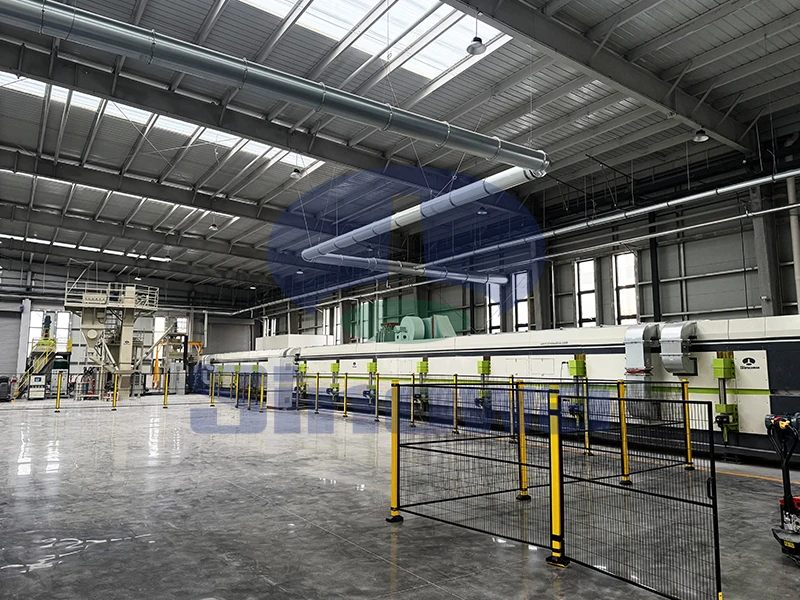
Continuous PU sandwich panel machines adopt a fully linked assembly line structure. Raw surface materials are continuously unwound, guided, and pre-treated, then PU foam raw materials are evenly mixed and poured between two surface layers. The composite materials pass through a long double-belt curing section in a steady forward movement, completing foaming, curing, shaping and trimming in sequence without stopping the main conveying system. The whole forming process proceeds nonstop.
Discontinuous PU sandwich panel machines rely on independent mould stations. Surface sheets are manually or mechanically placed into a closed mould cavity first. After PU material injection, the mould is closed for static foaming and curing. Once the curing cycle finishes, the mould opens, the finished panel is demoulded, and the equipment waits for the next round of material loading to start another production cycle. Each moulding operation is an independent unit separated by idle intervals.
Production Capacity and Efficiency
Continuous production lines feature much higher output efficiency. Once the production parameters are stabilized, the equipment can maintain long-hour stable operation, delivering panels at a fixed linear speed. It is suitable for large-volume, long-batch orders of panels with unified specifications. The interruption time in normal operation is extremely short, mainly reserved for routine inspection and raw material replacement.
Discontinuous equipment has a relatively low output. Every panel needs to go through loading, injection, curing, demoulding and cleaning repeatedly. The curing time of PU foam determines the cycle length of each product, and multiple mould stations can only partially offset this limitation. It cannot match the hourly output level of continuous lines, so it fits small-batch and intermittent production plans.
Product Consistency and Appearance Quality
Thanks to the stable continuous conveying and uniform online pouring system, continuous PU sandwich panel machines achieve consistent foam density, thickness and bonding strength along the whole length of panels. The surface flatness of finished products is more stable, and the edge trimming can be completed synchronously online, which reduces manual intervention errors. Long-length integral panels can be produced directly according to setting requirements.
For discontinuous machines, product quality is affected by the control accuracy of each single injection and the state of individual moulds. Although the closed mould helps control the thickness of panels, slight differences may exist between products from different mould cycles. The maximum length of panels is limited by the inner size of the mould, and extra processing is often required for post-trimming.
Adjustment Flexibility for Specifications
Discontinuous PU sandwich panel machines show obvious advantages in specification switching. Operators can quickly change moulds or adjust injection parameters to produce panels of different thicknesses, sizes and surface materials. Switching between different product types does not involve adjusting the whole long production line, and the trial cost for special custom-shaped panels is lower.
Continuous lines require a relatively complicated parameter adjustment process when changing panel specifications. Adjustments include pouring flow rate, belt gap, running speed and curing temperature curve. It takes a period of trial running to stabilize product quality after modification. Such equipment is more economical when producing the same specification continuously for a long time, and frequent specification replacement will cause more material waste and time loss.
Labor and Operation Requirements
A continuous PU sandwich panel production line is a highly automated integrated system. After parameter debugging is completed, only a small number of operators are needed to monitor the running status, replenish raw materials and collect finished products. The operation focus is on maintaining the stable running of the whole line.
Discontinuous equipment needs more participation in material handling, mould loading and unloading, and product demoulding. Even with auxiliary mechanical structures, the operation process contains more repetitive manual steps. Operators need to check the state of each mould frequently to avoid defects such as insufficient foaming or material leakage.
Suitable Application Scenarios
Continuous PU sandwich panel machines are preferred by manufacturers focused on mass supply of standard sandwich panels. They are the better choice when most orders are standard size panels with stable demand and long delivery cycles.
Discontinuous PU sandwich panel machines are more suitable for production with diversified customization demands. They are widely used for small-batch customized panels, special-sized components and orders with frequent changes of product types, where high output is not the primary pursuit.
Tags: continuous pu sandwich panel machine, continuous pu sandwich panel machine manufacturer, continuous pu sandwich panel machine supplier, china continuous pu sandwich panel machine, continuous pu sandwich panel machine for sale
Sinowa Sandwich Panel Lines
Sandwich Panel Machine For Sale
- PUR Sandwich Panel Production Line
- PIR Sandwich Panel Production Line
- PUF Sandwich Panel Production Line
- Rock Wool Sandwich Panel Production Line
- Glass Wool Sandwich Panel Production Line
- Mineral Wool Sandwich Panel Production Line
- Color Steel Sandwich Panel Production Line
- Thermal Insulation Sandwich Panel Production Line
- Cold Storage Sandwich Panel Production Line
- PU/PIR/Rockwool Insulation Sandwich Panel Machines
- PU/PIR/Rockwool Sandwich Panel Production Equipment
- PU/PIR/Rockwool Sandwich Panel Making Machinery