Can One PU Foaming Machine Serve Both Continuous And Discontinuous PU Sandwich Panel Line?
Publication Date: Oct 17, 2026
Yes, but it depends on the machine configuration. A single PU foaming machine **can be adapted** to serve both continuous and discontinuous PU sandwich panel production lines, yet it cannot run both processes simultaneously. You need to switch moulds, adjust the foaming mixing head, modify material feeding parameters and control programs. For high-volume mass production, separate dedicated foaming units are still recommended for stable panel quality.
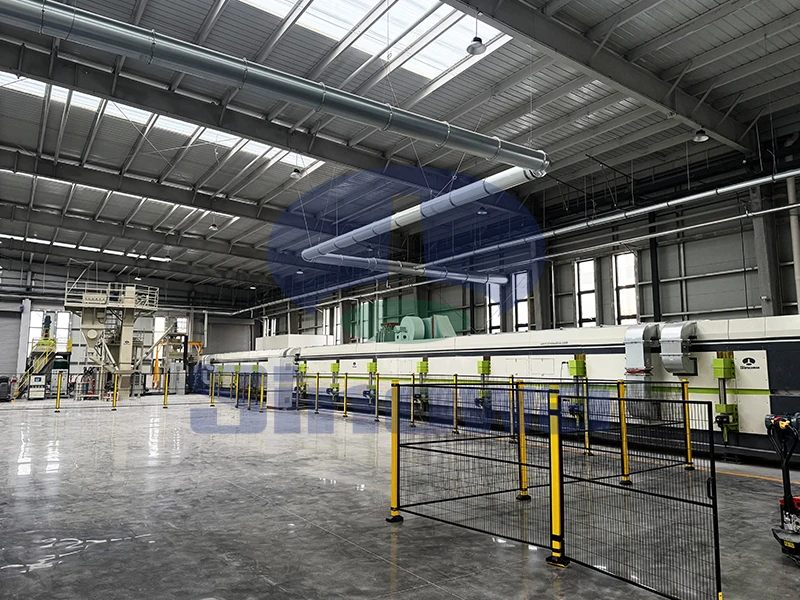
The polyurethane sandwich panel industry rests on a surprisingly simple chemical foundation: a reactive liquid mixture of polyol and isocyanate that expands and hardens into a rigid foam core bonded between two facing sheets. Yet the equipment that transforms this chemistry into finished panels has diverged into two fundamentally different production philosophies. The continuous line, built around a moving double-belt laminator, manufactures panels as an endless ribbon that is cut to length after the foam has fully risen and cured. The discontinuous, or batch, line instead operates in discrete cycles, injecting foam between facings held stationary in a large press until the panel is ready to be removed. Because these two methods impose very different demands on the metering, mixing, and dispensing systems, the question of whether a single foaming machine can credibly serve both is far more subtle than it first appears, and the answer depends on a careful weighing of chemistry, cycle dynamics, and output economics.
At the level of the metering unit itself, the two lines share far more than one might assume. Both require precise, ratio-controlled delivery of the two liquid components at elevated pressure, thorough mixing in a high-speed mixing head, and uniform dispensing across the width of the panel. The core hardware — high-pressure pumps, temperature-controlled recirculation, and high-shear mixing chambers — is essentially identical in principle, and the same machine can in fact be reconfigured to feed either process. This shared foundation is why manufacturers sometimes speak of a single high-pressure machine as a versatile asset, capable of switching between a continuous laminator and a batch press. On paper, the metering unit cares mainly about the total output rate, the chemical throughput per unit of time, and the viscosity of the components, none of which inherently binds it to one line type or the other. A machine rated for continuous operation can generally match the instantaneous flow demands of a batch cycle, and a machine sized for batch work can often be slowed or speed-adjusted for a continuous belt. The physical heart of the foaming operation, therefore, does not by itself decide the matter.
The decisive differences emerge when one looks at the dispensing pattern and the laydown geometry, because a foam that is spread as a thin, uniform film moving forward on a belt behaves very differently from one that must be shot into a closed cavity between two stationary faces. In a continuous laminator, the mixing head typically traverses back and forth across the moving substrate, laying down a series of overlapping liquid swaths that the rising foam quickly merges into a single even layer before the top facing is applied. The head is in near-constant motion, alternating across the width, and the foam must achieve a sufficiently low viscosity and fast rise profile to level itself within the brief window before the belt carries it under the top sheet. In a discontinuous press, by contrast, the operator or automated lance typically injects foam through a small opening or along a traveling lance within the cavity, and the foam expands freely until it fills the enclosed volume, exerting pressure against the platens. The temporal rhythm is completely different: a continuous line dispenses almost ceaselessly, while a batch line dispenses in short, intense bursts separated by long dwell periods. The metering unit must be able to switch between these modes without pressure drift, without component temperature loss, and without the formation of hardened residue inside the mixing head during idle phases. This is where a single machine begins to strain, because the recirculation and purge logic tuned for continuous flow may not tolerate the stop-start, shoot-and-wait cycle of batch production.
The chemical recipe itself poses an even more stubborn obstacle, because continuous and discontinuous panels are not typically made with the same formulation. Continuous laminators usually favor formulations with a moderate rise time and a cream time long enough to allow the traversing head to complete its laydown, yet short enough that the foam sets before the panel exits the heated belt section. These systems often use higher-density, self-releasing foam systems engineered for the specific thermal profile of the belt. Batch presses, on the other hand, frequently employ formulations with different reactivity, filler loading, and release-agent requirements, tuned to fill an enclosed cavity and to demold cleanly from stationary platens. If a single machine is to serve both lines, it must therefore be able to flush thoroughly between different chemical systems, hold multiple formulations ready, and switch the ratio, temperature setpoints, and dosing parameters between batches. Modern high-pressure machines can be equipped with multiple material tanks, automatic ratio control, and programmable recipe storage, so in principle one unit can hold two or three formulations and alternate between them. Yet each changeover carries real cost: purging the lines, stabilizing temperatures, and re-establishing stable ratio all consume time and material, and every switchover is a window for contamination and off-ratio shots that produce scrap.
Cycle-time compatibility is the economic crux that most often decides the question in practice. A continuous line is designed to run for hours with minimal interruption, and the economics of the operation depend on maximizing belt uptime and minimizing foam waste at the start and end of runs. If a single machine is shared with a batch press, the constant switching forces the continuous line to stop while the machine serves the batch unit, or the batch unit to wait while the continuous line takes priority. The result is that the shared machine serializes two processes that are, by nature, meant to run in parallel, and the combined output can fall well below what two dedicated machines would produce. For a facility that operates the continuous line at high utilization, the opportunity cost of sharing is usually prohibitive: every hour the belt sits idle to accommodate a batch run represents lost output that no flexibility gain can offset. Conversely, if the batch line is the dominant product and the continuous line is only an occasional, low-volume complement, sharing becomes far more sensible, because the continuous line's downtime is cheap and the batch press keeps the machine busy. The practical verdict, therefore, hinges less on technical feasibility than on whether the combined production schedule can tolerate serialization.
There is also the matter of the dispensing head itself, which is not always interchangeable between the two modes. Continuous lines often use a fixed or traversing head with a wide fan pattern and a long mix chamber optimized for sustained flow, while batch lines may use a lance that must be inserted into and withdrawn from the cavity, sometimes with a different nozzle geometry and a higher tolerance for discontinuous firing. A single metering machine can be fitted with a quick-change head, but the changeover again costs time and invites cleaning issues. Some modern systems address this with a design that supports both a traversing continuous head and a retractable batch lance, selectable by program, which genuinely allows one machine to do both. Where such a dual-configuration head exists, the technical argument for a single machine becomes quite strong, especially when the chemical systems are kept similar or the changeover frequency is low. Where the heads are not interchangeable, the operator faces repeated manual changes that undermine the very convenience a shared machine is meant to provide.
A further consideration is the pressure and flow dynamics at the interface between the machine and the line. Continuous laminators operate at a steady, high flow rate with constant backpressure, and the machine is tuned to hold that pressure precisely so that the foam output is uniform across long stretches. Batch presses, by contrast, deliver foam in a series of shots, each requiring a rapid ramp to full pressure, a steady delivery for the shot duration, and then a sharp cut-off and purge. The metering unit's control system must therefore be able to hold a stable continuous pressure curve for one process and to execute clean, repeatable shot profiles for the other. Machines with advanced digital pressure and flow control can handle both, but simpler, mechanically regulated machines may drift or produce inconsistent shots when forced out of their design operating mode. For this reason, the single-machine solution is most robust when the machine is equipped with modern electronic controls, servo-driven pumps, and recipe management, and least robust when it relies on older mechanical adjustment.
Ultimately, the answer to the question is conditional: yes, one PU foaming machine can serve both a continuous and a discontinuous sandwich panel line, but only when the formulations are compatible or the changeover cost is acceptable, when the machine is equipped with dual-mode dispensing capability and electronic recipe control, and, most importantly, when the production schedule does not penalize serialization. For a small or mid-sized producer with modest volumes on each line, a single well-specified machine can be an efficient and economical solution, avoiding the capital outlay of two separate systems while retaining the flexibility to adjust product mix. For a large-scale producer running the continuous line near full capacity, the opportunity cost of sharing is usually too high, and the cleaner choice is a dedicated machine for each process. In practice, the decision is less a matter of whether the chemistry and hardware permit it — they generally do — and more a question of whether the two lines can coexist without starving each other of uptime. Any producer weighing this choice should first map its expected product mix and shift schedule, then verify that a candidate machine can genuinely switch modes with rapid, reliable changeover and minimal waste, and finally judge whether the flexibility gained justifies the throughput lost. When those three conditions align, a single machine is not merely possible but often the smartest use of capital; when they do not, the apparent savings of a shared unit can quietly become the most expensive compromise in the plant.
Tags: continuous pu sandwich panel line, continuous pu sandwich panel line manufacturer, continuous pu sandwich panel line supplier, china continuous pu sandwich panel line, continuous pu sandwich panel line for sale