What Panel Density Range Can A Continuous Polyurethane Sandwich Panel Production Line Achieve?
Publication Date: Oct 17, 2026
Continuous polyurethane sandwich panel production line supports PU core density 30–80 kg/m³, adjustable for thermal insulation & structural PU sandwich panels. High-efficiency continuous PU panel manufacturing.
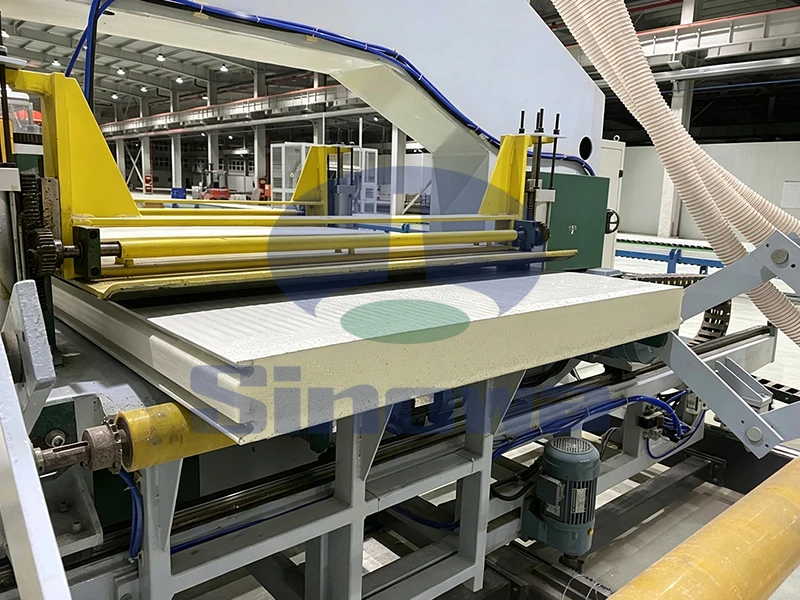
A continuous polyurethane sandwich panel production line represents one of the most advanced and efficient approaches to manufacturing insulated building panels, and its most distinctive capability lies in the range of core densities it can achieve. Density, measured as the mass of the polyurethane foam core per unit volume and typically expressed in kilograms per cubic meter, is not merely a physical property but the central design variable that governs nearly every performance characteristic of the finished panel. The continuous production process, in which raw liquid polyurethane components are mixed, applied, and foamed in an uninterrupted flow between moving metal or other facing sheets, offers a degree of control over this variable that batch and discontinuous methods simply cannot match. Understanding the density range available on such a line, the factors that determine it, and the practical trade-offs involved, is essential for anyone selecting panels for a specific application.
At the most practical level, a well-engineered continuous polyurethane sandwich panel production line can typically produce core densities ranging from roughly 30 to 120 kilograms per cubic meter, with the most commonly specified and economically important range lying between approximately 38 and 45 kilograms per cubic meter. This span is not a fixed ceiling imposed by equipment design alone, but rather the envelope within which the line can operate reliably while delivering foam of consistent quality. The lower end of the range, around 30 to 35 kilograms per cubic meter, represents foam that is lightweight and highly economical in material consumption, yet it begins to approach the structural limits where compressive strength, dimensional stability, and resistance to thermal cycling may become marginal for demanding applications. The upper portion of the range, extending toward 80 or even 120 kilograms per cubic meter, produces a denser, stronger, and more rigid core that is often used where greater load-bearing capacity or superior impact resistance is required, though at the cost of increased raw material usage and higher panel weight.
The ability to achieve this broad density range is rooted in the precise control that continuous lines exert over the core foaming chemistry and the physical conditions of the process. The density of polyurethane foam is determined fundamentally by the ratio of the blowing agent to the polyol and isocyanate components, along with the quantity of gas generated during the reaction. On a continuous line, the metering and mixing equipment can be adjusted with considerable precision, allowing the operator to vary the formulation within established parameters. Simultaneously, the line maintains strict control over temperature, pressure, and the speed at which the panels travel through the foaming zone, all of which influence how fully the foam rises and how evenly it fills the cavity between the facing sheets. Because these variables can be tuned in real time, the same physical line can be configured to produce foam at quite different densities without requiring any fundamental change to the machinery itself.
It is important to recognize, however, that the achievable density range is not uniform across the entire span, and that different portions of the range carry very different implications for process performance and product quality. At lower densities, the foam expands more aggressively and requires careful management to avoid voids, uneven cell structure, or insufficient adhesion to the facing materials. At higher densities, the reaction is faster and more exothermic, which can create challenges related to temperature control, curing uniformity, and the risk of internal stresses or surface defects. Consequently, while a line may nominally cover a wide range, each individual production run is typically optimized around a narrow target density, and attempting to shift dramatically between densities on short notice requires formulation changes, process adjustments, and a period of stabilization before output quality can be assured.
Beyond the purely technical limits, the practical density range available to a given user is also shaped by the interaction between density and the other performance requirements of the panel. Thermal insulation, the primary function of most sandwich panels, tends to be optimized at lower densities, where the foam contains a higher proportion of gas and therefore offers better thermal resistance per unit of weight. Yet this same low density may compromise mechanical strength, making the panel more vulnerable to compression, impact, or long-term creep under sustained loading. Conversely, increasing the density improves mechanical properties but adds material cost, increases panel weight, and can slightly reduce the thermal efficiency of the core. The experienced manufacturer therefore selects a density that balances these competing demands for the specific application, rather than simply seeking the maximum or minimum achievable value.
The choice of density also has a direct and significant influence on the economics of the panel, both for the producer and for the end user. Polyurethane raw materials constitute a major share of the cost of a sandwich panel, and because density directly controls how much material is consumed per cubic meter of core, even modest changes in density translate into measurable changes in cost. A panel with a core density of 40 kilograms per cubic meter, for instance, consumes roughly a third more foam material than one at 30 kilograms per cubic meter, all else being equal. This cost sensitivity means that manufacturers rarely produce panels at the extremes of the density range unless the application genuinely demands it, and it explains why the vast majority of commercial production clusters tightly around the low- to mid-density values that deliver acceptable performance at the lowest material cost.
It should also be noted that the density achieved in practice is influenced by the specific design of the line, including the type of foaming system, the pressure at which the mixed components are delivered, and the geometric configuration of the cavity being filled. Different panel thicknesses, facing materials, and edge profiles can affect how the foam distributes and cures, and thus the effective density that must be targeted to achieve uniform properties. A thicker panel, for example, allows the foam to rise more freely and may achieve a slightly lower effective density for the same formulation, while a very thin panel requires tighter control to avoid overfilling or incomplete coverage. These interactions mean that the "achievable density range" is not a single fixed number, but a capability that varies with the exact production parameters and panel specification.
Finally, the density range of a continuous line should be understood not merely as a static equipment specification, but as a strategic tool that allows a single production facility to serve a wide variety of markets and applications. The same line that produces lightweight, highly insulating panels for cold storage and building envelopes can, with appropriate adjustment, produce denser, more rigid panels for load-bearing floors, roof systems, or specialized industrial applications. This flexibility is one of the principal advantages of the continuous process, and it underscores why density control is considered a defining competence of such lines. In summary, while the typical achievable range of roughly 30 to 120 kilograms per cubic meter is broad, the practical working range is narrower, and the optimal density for any given panel is ultimately the result of a careful balance among thermal performance, mechanical strength, cost, and the specific requirements of the application.
Tags: continuous polyurethane sandwich panel production line, continuous polyurethane sandwich panel production line manufacturer, continuous polyurethane sandwich panel production line supplier, china continuous polyurethane sandwich panel production line, continuous polyurethane sandwich panel production line for sale