How Often Should Routine Maintenance Be Performed On A PU Sandwich Panel Line?
Publication Date: Oct 15, 2026
Routine maintenance for a PU sandwich panel line should follow regular schedules to cut breakdowns, preserve product quality and extend equipment service life.
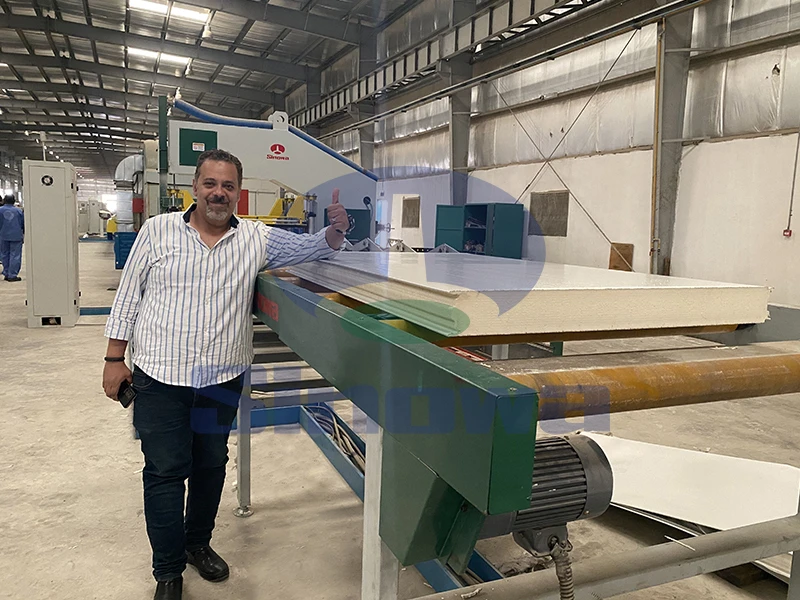
Daily maintenance for the PU sandwich panel production line focuses on quick inspections and simple cleaning work before and after each production shift. Operators need to clear residual PU foam, dust and leftover panel materials from rollers, guide rails and spraying components. They should check lubrication status of moving parts, confirm there are no oil leaks, air leaks or abnormal noises from motors and pumps. Fasteners on conveying equipment also require a visual check to prevent loose parts during continuous operation. Any minor abnormalities found in this process need to be recorded and handled in a timely manner, avoiding small faults developing into serious shutdown issues.
Weekly maintenance goes deeper than daily checks and covers more equipment components. Workers will conduct thorough cleaning of the mixing head, raw material pipelines and metering systems, removing cured PU deposits that may block material flow and affect mixing ratio accuracy. Drive chains and gear sets get supplementary lubrication, and tension of conveyor belts is adjusted to ensure stable panel transportation. Electrical cabinets and sensors are wiped to remove accumulated dust, which helps prevent signal drift and short circuit risks. All safety protection devices on the line will be tested to guarantee they respond properly when triggered.
Monthly maintenance includes comprehensive inspection and partial wear assessment of the whole production line. Technicians examine the wear degree of cutting blades, sealing strips and gaskets, replacing components that show aging or obvious abrasion. They calibrate raw material metering units to keep the mixing proportion of PU raw materials stable, which directly influences the insulation and structural performance of finished sandwich panels. Hydraulic and pneumatic systems are inspected for pressure stability, and filter elements are cleaned or replaced to reduce impurity buildup inside fluid circuits. Connections of all pipelines are rechecked to eliminate hidden leakage points.
Quarterly maintenance focuses on key core units of the PU sandwich panel line. The foaming station, laminating mechanism and cutting system will be fully disassembled for cleaning and inspection. Technicians check the alignment of upper and lower laminating rollers, adjusting parallelism to avoid uneven panel thickness and surface defects. Internal wear of mixing pumps is measured, and worn sealing parts are renewed. Cooling and heating systems are inspected to ensure temperature control precision, as temperature fluctuation can change PU foaming effect and cause inconsistent product quality. Vibration of large drive units is also detected to find potential bearing damage early.
Semi-annual maintenance involves a more systematic overhaul of mechanical and electrical systems. The whole conveying line is inspected for frame deformation, and levelness of the production platform is corrected. All bearings on rotating parts are checked, with severely worn bearings replaced and others re-lubricated. Electrical wiring inside cabinets is inspected for aging insulation and loose terminals. The whole control program and sensor feedback signals are tested comprehensively, optimizing parameter response speed to improve production stability. Waste collection auxiliary equipment also gets full cleaning and maintenance at this stage.
Annual maintenance serves as the most thorough routine overhaul for the entire PU sandwich panel production line. Every main component is completely inspected, and parts with fatigue damage are replaced in batches. The base of the equipment is checked for foundation settlement, and anchor bolts are tightened again to maintain stable operation of the whole line. The metering and foaming system undergoes full calibration, and internal pipelines are thoroughly flushed to remove stubborn residual deposits. A full load test run will be carried out after overhaul, adjusting production parameters to ensure the line can output qualified panels steadily under normal working load.
Maintenance frequency also needs proper adjustment according to actual operating conditions. If the line runs continuously for long hours every day, maintenance cycles should be shortened appropriately. Heavy dust environment and frequent raw material formula switching will accelerate component wear, so inspection and cleaning work need to be arranged more often. When the production line runs intermittently with short daily working hours, the maintenance interval can be moderately extended, but basic daily checks cannot be omitted even during idle periods.
Operational records play an important role in formulating reasonable maintenance cycles. Recording equipment operating hours, fault occurrences, component replacement history and abnormal production phenomena helps track the aging rule of each part. With complete records, maintenance work can shift from passive emergency repair to planned preventive maintenance. This method reduces unplanned downtime effectively and avoids sudden production interruption caused by unexpected equipment failures.
Good maintenance habits also require standardized operation training for on-site staff. Operators should master basic equipment inspection skills and recognize common early warning signs of faults. Maintenance personnel need to follow proper operating procedures during component disassembly, cleaning and calibration, preventing secondary damage to equipment caused by improper operation. Clear division of responsibilities between operators and maintenance staff ensures every scheduled maintenance item can be completed on time.
Adhering to the matched maintenance cycle brings multiple benefits to PU sandwich panel production. Regular upkeep keeps product surface quality, dimensional accuracy and foaming performance stable, lowering the rate of defective products. It reduces the frequency of major equipment failures and cuts the cost of large-scale repairs. A well-maintained production line can maintain stable long-term operation and extend the total service life of the whole set of equipment, supporting continuous and efficient sandwich panel manufacturing.
Tags: pu sandwich panel line, pu sandwich panel line manufacturer, pu sandwich panel line supplier, china pu sandwich panel line, pu sandwich panel line for sale