What Is The Minimum Cutting Length Of Panels For A Continuous PU Sandwich Panel Machine?
Publication Date: Oct 17, 2026
Standard continuous PU sandwich panel machines have a **minimum cutting length of 2 meters (2000mm)**. Some customized compact models can reach 1.2m (1200mm). The value depends on cutting type, line speed and machine configuration.
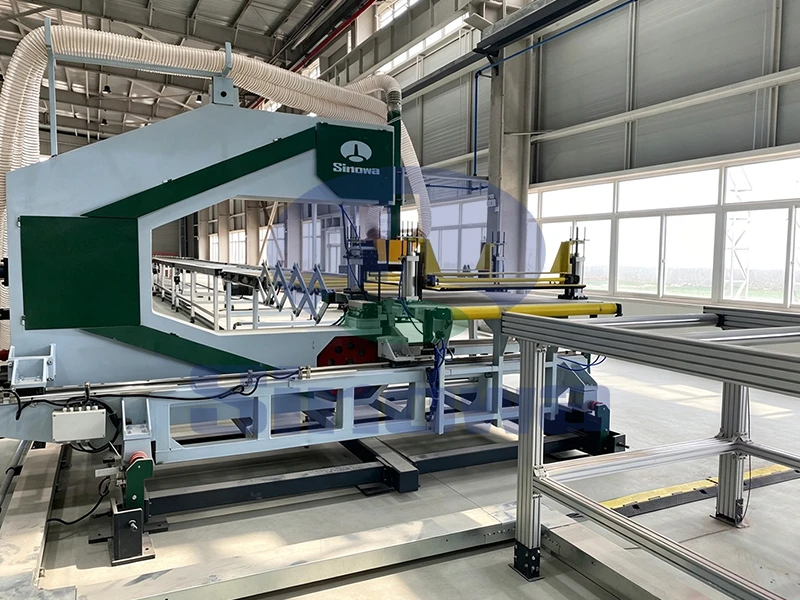
The minimum cutting length of panels on a continuous polyurethane sandwich panel production line is not a single fixed number stamped into a machine's specification sheet, but rather the practical consequence of a chain of interdependent physical and control events that unfold in the few seconds between one panel and the next. A continuous production line does not pause, breathe, or wait for a decision; the foam core is laid down, the metal facings are fed from coils, the entire composite is consolidated between the platens of the double-belt press, and it emerges from the curing zone at a steady linear speed that is dictated by the chemical kinetics of the polyurethane formulation. Against this relentless forward motion, the cross-cut saw must intercept the moving web, cut cleanly across its full width, and return to its home position before the next panel arrives. The minimum length therefore represents the shortest physical separation between two successive cuts that the system can achieve while still producing square, dimensionally stable, undamaged edges on both sides of every panel.
To understand where this lower limit comes from, it is necessary to look first at the mechanics of the cutting unit itself. The cross-cut saw on a modern continuous line is almost always a flying cut-off saw, which is to say it is mounted on a carriage that travels along rails parallel to the direction of panel travel. When a cut is commanded, the saw carriage must first accelerate from rest, match the instantaneous speed of the moving panel as precisely as possible, and only then begin the actual sawing stroke across the width of the board. During the cut, the carriage and the panel move together in perfect synchrony so that the blade leaves a cut line perpendicular to the direction of travel rather than a diagonal one. When the cut is complete, the blade retracts, the carriage decelerates and returns to its upstream home position, and the next cycle begins. Each of these phases occupies real time, and because the panel does not stop moving, that time translates directly into a physical distance along the line. The minimum cut length is essentially the distance that the web travels during one complete saw cycle, added to a margin that accounts for positioning error, control latency, and the need to leave enough material on either side of the blade path for a clean entry and exit.
The single most influential variable in this calculation is the line speed, because the sawing time is largely fixed by the mechanics of the blade and the width of the panel, while the distance consumed by the cycle scales directly with how fast the material is moving. At a given cutting frequency, doubling the production speed does not halve the achievable panel length; it sets a hard floor that rises with the feed rate. The acceleration phase is particularly demanding, because the carriage must bring a heavy motorized blade assembly from rest up to the line speed within a very short window, and the motors must do so without overshooting or oscillating. A carriage that cannot reach the required speed before the cut zone arrives will either miss the cut entirely or produce a bowed, angled edge that must be scrapped. For this reason, the practical minimum length is often quoted not as an absolute number but as a ratio or a function of the feed speed: faster lines are forced to accept longer minimum panels, while a line slowed down can, within reason, cut correspondingly shorter boards. This inverse relationship is the central engineering tension of the whole system, and it is why an operator asking for the shortest possible panel is, in effect, asking the machine to make a compromise between throughput and geometry.
Beyond the raw dynamics of the carriage, the minimum cutting length is also bounded by the behaviour of the material itself. A polyurethane sandwich panel emerges from the press with the foam core still carrying residual heat and internal stresses, and the metal facings, particularly the corrugated or profiled outer skin, have their own stiffness and springback. When the saw blade enters the panel, it compresses the foam locally and the cutting forces tend to push the material away from the blade; on a thin or short panel the unsupported area on either side of the cut may be too small to hold the board flat, leading to delamination of the facings from the foam or to ragged, compressed edges. There is also the matter of the blade's entry and exit, which are inherently imperfect: the very first and last millimetres of the stroke see reduced cutting efficiency as the blade engages and releases, and on short panels this imperfect zone becomes a proportionally larger share of the total cut length. To compensate, most lines leave a small sacrificial margin at each cut, and when panels are trimmed to final length elsewhere, that margin is removed as offcut. The minimum usable panel length must therefore be greater than the sum of the mechanical cycle time and the material's tolerance for cutting stress, and it is the larger of the two constraints that wins.
A further and often underestimated factor is the control system's reaction time and the synchronisation quality between the saw carriage and the line encoder. Modern lines measure the position of the moving web with an encoder on the belt or on a measuring wheel, and the saw's motion profile is computed in real time against that signal. Every delay in reading the encoder, computing the correction, and driving the servo adds a small error to the cut position, and this error is not negligible when panels are short and the sequence of cuts follows in quick succession. Worse, the errors do not always cancel out; they accumulate in the same direction if the line speed is fluctuating or if the foam is expanding or settling after the press. A high-quality system will re-zero itself and continuously compensate, but even the best control loop needs a certain distance between cuts to settle and to build a reliable position reference. On very short panels the saw may still be returning home when the next cut command arrives, forcing the controller either to delay the cut, which changes the panel length, or to trigger an immediate second cycle before the first has fully stabilised, which risks an out-of-square edge. This is why manufacturers advise against pushing the machine continuously at its absolute theoretical minimum; the safe operating minimum is deliberately set above the calculated limit to preserve yield and quality over the course of a long production run.
The geometry of the panels themselves imposes another set of constraints that interacts with the cutting floor. The minimum length is not independent of the panel width or thickness, because the saw stroke across a wider board takes longer, and the blade has to travel further and dissipate more energy into the cut. A line configured for very wide panels will therefore have a longer minimum cutting length than the same line set up for narrower boards, even when the speed and control system are identical. Thickness matters in a subtler way: a thick panel offers more resistance to the blade, the cut takes longer, and the carriage is under load for a greater distance, all of which pushes the minimum length upward. There is also a practical lower limit set by the handling and stacking equipment downstream of the saw. The cut panel must be conveyed away, turned, stacked, and strapped, and these machines need a certain minimum board size to grip, lift, and transport reliably. A panel too short to be handled safely by the exit conveyor will jam or fall, and no amount of saw precision can fix a problem that lives in the material-handling stage. In practice, therefore, the true minimum cutting length that a plant can exploit is often decided not by the saw itself but by the weakest link in the downstream handling chain.
There is a further economic dimension that tempers any attempt to chase the shortest possible panel, and it is worth stating plainly because it shapes how the specification should be read. Cutting panels shorter than the line's comfortable range forces a reduction in feed speed to give the saw time, and that reduction costs throughput across the whole line, which is the most expensive currency in a continuous process. At the same time, shorter panels mean more cuts per unit of production, which means more saw cycles, more blade wear, more offcut waste at each entry and exit, and more opportunities for a mis-cut to render a whole board scrap. The marginal savings from a marginally shorter minimum are therefore quickly overtaken by the cost of slower production and lower yield. For most real applications there is an economically optimal panel length range that sits comfortably above the mechanical minimum, and the wise machine owner treats the advertised minimum as a useful design constraint for unusual jobs rather than as the everyday operating point. This is why the same physical line can appear to have very different "minimum lengths" depending on whether it is being quoted for a long-run standard product or for a short-run special order, and why an operator must always interpret the number against the context of speed, width, thickness, and downstream handling.
In practical terms, a knowledgeable buyer or operator should treat the minimum cutting length as a three-layer answer rather than a single figure. The first layer is the mechanical and control floor, the shortest length the saw can physically produce under ideal conditions at a given speed, and this is the number usually found in technical literature and quoted by suppliers. The second layer is the quality floor, the length below which cut quality visibly degrades through edge compression, delamination, or loss of squareness, and this is typically somewhat higher than the mechanical floor and depends heavily on the material formulation and the panel geometry. The third layer is the operational floor, the length below which downstream handling, stacking, and yield economics make production impractical, and this is the number that matters for real manufacturing planning. The distance between the first and third floors is often substantial, and conflating them is a common source of disappointment when a line is expected to deliver panels shorter than its operating floor on a routine basis. A well-specified request should therefore always be stated as a speed, a width, a thickness, and a material, together with the required minimum panel length, so that the answer reflects the actual working condition rather than an optimistic headline figure.
The underlying reason all of these constraints converge on a floor is that a continuous process has no buffer. In a batch operation, one can pause the machinery, make the cut, and restart, and the only cost is time. In a continuous line, the material never stops, so every operation must be completed within a moving window, and the minimum cutting length is simply the spatial expression of that temporal window. No adjustment to blade speed, carriage acceleration, or control algorithm can remove the fundamental requirement that the saw must physically traverse the board, and the board keeps advancing the whole while. As foam formulations become faster-curing and lines run ever quicker to improve output, the tension between speed and minimum length does not disappear; it grows, because each increment of line speed raises the minimum cut length at a time when the market increasingly asks for shorter panels with tighter dimensional tolerances. The eventual resolution of that tension lies not in any single component but in the coherence of the whole line, from the feed station to the stacking area, and in the willingness of the operator to set the cutting floor honestly, with a clear eye on both the physics and the economics, rather than chasing a number that the machine can produce only once but cannot sustain through a full working day.
Tags: continuous pu sandwich panel machine, continuous pu sandwich panel machine manufacturer, continuous pu sandwich panel machine supplier, china continuous pu sandwich panel machine, continuous pu sandwich panel machine for sale