What Temperature Parameters Are Required For PU Foaming In A PU Sandwich Panel Line?
Publication Date: Oct 17, 2026
PU sandwich panel line PU foaming temperature guide: raw polyol/isocyanate temp, reaction temp and double-belt curing temperature ranges to prevent delamination & uneven foam.
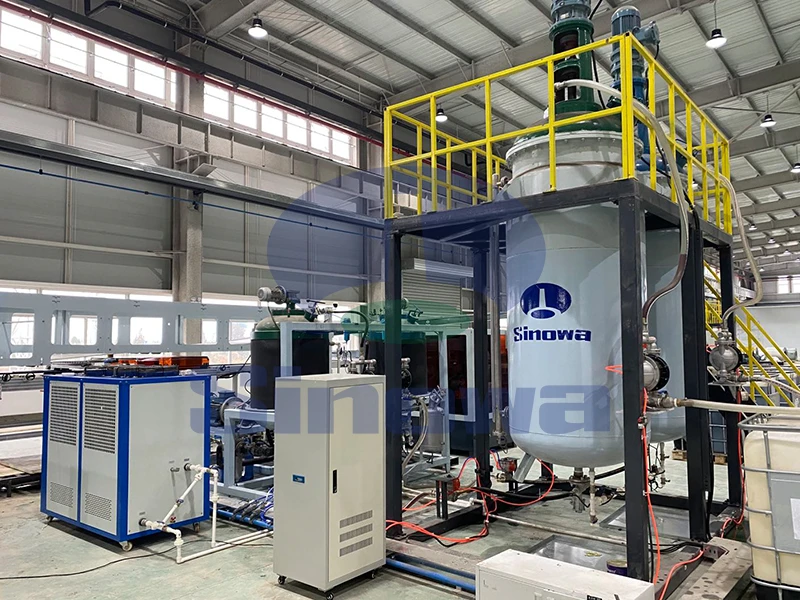
In a continuous polyurethane sandwich panel production line, the formation of rigid polyurethane foam is governed by a tightly coupled set of thermal variables, and the temperature of the raw material streams is the first and most influential parameter to control. The two-component system—a polyol blend containing catalysts, surfactants, blowing agents and water, and a polymeric isocyanate—behaves very differently depending on how much thermal energy it carries into the mixing head. The polyol blend is normally conditioned and held within a relatively narrow window, typically between 20 and 25 degrees Celsius, while the isocyanate is kept slightly cooler, often in the range of 20 to 23 degrees Celsius, because its viscosity and reactivity are more sensitive to heat. Holding these component temperatures within a tolerance of no more than one or two degrees is critical, because the exothermic reaction between hydroxyl groups and isocyanate groups releases a great deal of heat once the two streams are combined, and the temperature at which they enter the mixing process directly dictates the cream time, the gel time, and the rate at which the cellular structure is formed. If the components arrive too cold, the viscosity rises, the mixing becomes less homogeneous, and the reaction slows to the point where the foam may collapse before it reaches sufficient strength; if they arrive too warm, the reaction accelerates dangerously, the cream time shortens, and the foam may over-expand or scorch in the core. For this reason, the conditioning of each component through heated or cooled storage tanks and jacketed circulation loops is not an optional refinement but a fundamental prerequisite for producing a panel with consistent density, dimensional stability and mechanical strength across its entire length.
The temperature of the mixing head and of the material lines that feed it forms the second critical thermal layer, because every degree of heat lost or gained between the conditioning tanks and the point of impingement changes the effective reactivity of the formulation. In a continuous line, the polyol and isocyanate are pumped through long pipelines to a high-pressure or low-pressure mixing head, and the temperature along that entire transit must be maintained so that the material reaches the head at the same temperature at which it was conditioned. This is usually achieved through temperature-controlled jackets on the pipes, circulating water at a fixed set point, and careful insulation, because the flow rates are large and even a modest drop of two or three degrees can shift the reaction profile enough to alter the rise height and the density distribution across the panel thickness. The mixing head itself is also thermally regulated, often held in the same general range as the components, so that no cold spot at the nozzle causes premature nucleation or uneven distribution of the catalyst system. Because the chemical system is extremely sensitive to thermal history, the entire dosing and metering path from tank to head is treated as a single isothermal system, and production engineers pay as much attention to the temperature reading at the head as they do to the temperature in the tanks, since it is the temperature of the material at the moment of mixing, not the temperature at which it was stored, that governs the foaming behavior.
Beyond the liquid chemistry, the temperature of the substrates that form the two faces of the sandwich panel is a parameter that is frequently underestimated yet exerts a decisive influence on the quality of the final composite. In a typical continuous double-belt or laminating line, steel facings or other rigid skins are fed into the machine from coils, and their surface temperature, which is often close to that of the surrounding workshop, must be raised before the foam is laid between them. If the facings are cold, the foam that contacts them chills rapidly, the reaction is retarded at the skin interface, and the result is a layer of weak, thin, or poorly bonded foam adjacent to the metal, which reduces peel strength and can lead to delamination in service. The facings are therefore usually preheated, frequently to temperatures in the range of 30 to 50 degrees Celsius depending on the formulation and line speed, so that the heat of reaction is not drawn away too quickly and the foam can adhere firmly to the metal surface. Similarly, in panel lines that produce panels with a core of paper, fabric or foil, the surface temperature of the covering material must be managed so that it does not act as a heat sink; in some configurations the core material is preheated as it unwinds, and in others the substrate temperature is simply controlled through the environment and the geometry of the line. The requirement is not for an absolute temperature but for thermal compatibility: the substrate must be warm enough that the foam does not cool excessively at the interface, yet not so hot that the adhesive bond is damaged or the surface finish is impaired.
The ambient temperature of the production hall and the temperature of the equipment surfaces constitute the fourth layer of thermal control, and they matter most because they set the baseline against which all the other temperatures are measured. In a continuous sandwich panel line, the reaction proceeds as the composite travels through the forming section, and the heat released by the polyurethane reaction is the principal driver of the foam rise; the surrounding environment acts as a heat sink that either preserves or dissipates this energy. A cold workshop in winter can lower the temperature of the substrates, the belt, the rollers and the atmosphere so much that the effective temperature of the reacting mass falls below the design point, extending the cure and requiring a slower line speed to compensate, whereas an excessively warm environment in summer can push the reaction to accelerate beyond the capacity of the cooling sections to remove heat. For this reason, the production area is typically held within a modest band, commonly between 18 and 30 degrees Celsius, and the line itself is designed so that the reaction can be tuned by line speed and by the temperature settings of the heating and cooling platens rather than by relying on the weather. The temperature profile across the panel thickness is also a function of the balance between the heat generated in the center of the foam and the heat conducted away through the facings and the platens; maintaining the correct relationship between these rates is what determines whether the foam is uniform in density from surface to surface or whether it develops a dense skin and a softer interior.
The management of the exothermic heat of reaction and its removal is the most demanding thermal task in the entire process, and it is where the temperature parameters come together in the curing and cooling sections of the line. After the mixed material is dispensed between the two facings, it rises, gels and cures as it passes through the heated section of the double belt, where platens or heating elements raise the temperature to accelerate the cure and to drive the foam to its full mechanical properties. The temperature of these platens is a key parameter, commonly set in the range of 40 to 70 degrees Celsius for a rigid polyurethane foam, because the reaction cannot complete at room temperature in the short residence time available on a continuous line. The heating must be carefully balanced, however, because too high a platen temperature can cause the blowing agent to expand prematurely, producing an over-blown, weak foam, while insufficient heat leaves the core under-cured and prone to creep. Following the heated zone, the panel moves into a cooling section, where the temperature is reduced gradually so that the foam is not quenched too quickly, which would trap internal stress and cause warping or poor flatness; the cooling must be slow enough to allow the residual heat to dissipate uniformly through the thickness. The whole thermal journey—preheat of the components, heating of the substrates, heat of reaction, platen heating, and controlled cooling—must be orchestrated so that the temperature at every point along the line stays within the window that the formulation demands, and the line speed is ultimately set by the time required to achieve the necessary degree of cure at the operating temperatures.
A further subtlety lies in the fact that the temperature parameters are not fixed values but are interdependent with the line speed, the panel thickness, and the specific formulation, which means that they must be adjusted together as an integrated system. For a given polyol-isocyanate system, the reaction rate roughly doubles for every ten degrees of temperature increase, so small changes in any thermal set point produce large changes in the foaming dynamics; this sensitivity is why the entire line is controlled as a coupled thermal system rather than as a collection of independent temperature readings. Thicker panels, for example, generate more heat in the core and need more careful cooling to avoid internal scorching, while thinner panels lose heat faster through the facings and may need slightly higher platen temperatures or slower speeds to cure fully. The choice of blowing agent also interacts with temperature, because the expansion of the foam depends on the vaporization of the blowing agent at the temperature reached during the exothermic peak, and a formulation that foams correctly at one temperature window may produce a collapsed or over-expanded structure if that window is missed. Consequently, the operating team does not simply read a set of thermometers but instead establishes a set of interrelated temperature ranges for the components, the substrates, the environment, the platens and the cooling sections, and then fine-tunes them empirically against the measured density, the peel strength, and the dimensional stability of the finished panels. It is the consistency of these temperatures across long production runs, not merely their average value, that determines whether the panel line produces uniform product hour after hour.
The practical challenge of maintaining these temperature parameters lies in the fact that they must be held stable over long periods and across changing external conditions, which demands robust thermal regulation and careful attention to heat losses. Recirculating temperature control units on the component tanks, trace-heated and insulated pipelines, preheating stations for the facings, and precisely controlled platen zones are all part of the standard thermal infrastructure, and each one must be monitored because a drift of even a few degrees in any single zone can shift the equilibrium of the whole process. The quality of the final panel—its density profile, its adhesion at the facings, its flatness, its dimensional stability and its thermal insulation performance—is in large measure a direct reflection of how well these temperatures were maintained, and the most common defects in continuous panel production can almost always be traced to a thermal imbalance somewhere along the line. In summary, the temperature parameters required for polyurethane foaming in a sandwich panel line are not a single number but a coordinated family of set points covering the raw material components, the mixing and delivery system, the substrates, the ambient environment, the heating and cooling sections, and the interdependent relationship between temperature and line speed, and it is the disciplined control of this entire thermal envelope that separates a panel line producing strong, uniform, dimensionally stable panels from one producing inconsistent or defective product.
Tags: pu sandwich panel line, pu sandwich panel line manufacturer, pu sandwich panel line supplier, china pu sandwich panel line, pu sandwich panel line for sale