Can A PU Sandwich Panel Production Line Produce Wall And Roof Panels Simultaneously?
Publication Date: Oct 20, 2026
A single PU sandwich panel production line **cannot produce wall and roof panels simultaneously** in most cases. The line needs manual/parameter adjustments for profiles, thickness, sealing and surface layers between wall and roof panel types. But it can quickly switch production between the two products sequentially.
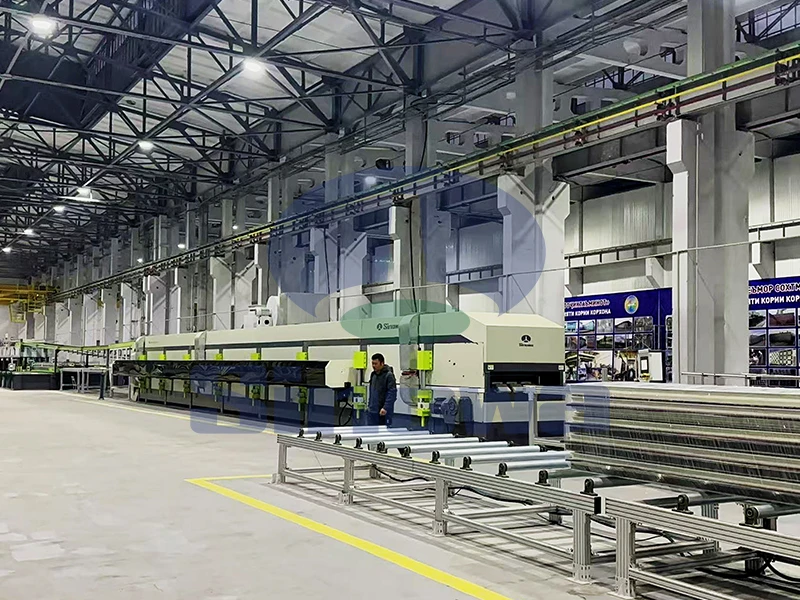
A polyurethane sandwich panel production line can absolutely manufacture wall panels and roof panels. What is technically feasible and what is operationally sensible are two different things, and the distinction depends on how deeply we understand the machinery, the material flow, the tooling, and the production philosophy that governs a modern continuous or semi-continuous line. To appreciate why the answer is not a simple blanket "yes," one must first understand that wall and roof panels are not fundamentally different products manufactured by fundamentally different machines; they are variations of the same core product — a rigid polyurethane foam core bonded between two metal facings — distinguished primarily by dimensional geometry, profile shape, and secondary processing. Because the underlying chemistry and the basic lamination principle are identical, the production line does not need to be redesigned to switch between them. Instead, the line is designed to be reconfigured, and it is the speed and cost of that reconfiguration that determines whether the two products can be produced simultaneously, sequentially, or in a mixed batch.
At the heart of the matter is the difference between the profile of a wall panel and the profile of a roof panel, which drives everything downstream. Wall panels are almost always manufactured with a concealed fastener system: the steel facing is roll-formed with a specific standing seam or interlocking profile along the longitudinal edges, allowing panels to clip together without exposed screws on the exterior face. Roof panels, by contrast, are typically produced with a through-fixed or standing seam profile that is optimized for water shedding, thermal movement, and structural load transfer across long spans. These profiles are not created by the foam lamination process itself; they are created upstream by the roll-forming machines, which shape the flat steel coil into the desired cross-section before the facings enter the laminator. Consequently, the critical tooling that differentiates wall from roof production is the roll-forming station and the associated edge-trimming and cut-to-length equipment, not the core foam-dispensing and pressing machinery. On a well-designed line, changing the profile therefore means changing the roll-forming dies and adjusting the panel width settings, while the double-belt laminator, the foam-mixing head, and the heating and curing sections can continue to run essentially unchanged. This is precisely why many operators run both product families on a single line: the expensive and slow-to-change heart of the line stays in constant operation, while only the comparatively quick tooling changes occur at the edges.
However, "at the same time" in the strictest sense — meaning the line is simultaneously producing a wall panel and a roof panel out of the same machine at the same instant — is not how continuous lines work. A continuous laminator produces one continuous composite slab at a time, with a fixed width determined by the current tooling configuration. The width, the metal facings, and the edge profile are uniform across the entire length of that slab until the line is stopped and reconfigured. So a truly simultaneous production of different profiles on the same continuous line is physically impossible. What the industry means by "simultaneous" in practice is one of three things: the line can alternate between wall and roof batches with minimal downtime, the line can be designed with parallel or tandem roll-forming stations so that profile changeover is nearly instantaneous, or the plant can run multiple lines in parallel where one is dedicated to wall and another to roof. The most common and practical arrangement is the second: a single continuous line equipped with multiple roll-forming heads that can be switched over in a matter of minutes, allowing the operator to change from wall profile to roof profile, adjust the width, and resume production without a lengthy teardown. In this arrangement, the foam core, the facings, and the lamination process are truly shared and truly continuous, while the profile tooling is swapped at the edge. From the perspective of the factory floor, this feels like simultaneous production because the line rarely stops; it is simply continuously manufacturing a mixed sequence of wall and roof panels with short changeover windows between them.
The width dimension adds another layer of nuance. Wall panels and roof panels are commonly manufactured at different standard widths, and width is a hard constraint on a continuous line because the roll-forming stations, the trim knives, and the laminator side-guides must all be set to the same nominal width. Changing width on a continuous double-belt laminator is more involved than changing an edge profile, because it affects the flow of the foam, the pressure distribution across the belt, and the positioning of the side seals. Modern lines handle width changeover through motorized adjustments and recipe-based presets that store the correct settings for each product, allowing the operator to recall a wall-panel recipe or a roof-panel recipe with a single command. The machine then moves its guides, adjusts its roll-formers, changes its trim knives, and re-calibrates the foam dispenser within a few minutes. This recipe-driven approach is what makes mixed production practical, and it is the reason that a single line can legitimately be described as producing both wall and roof panels without the need for two separate factories. The limiting factor is no longer the machinery itself but rather the planning discipline of the production scheduler, who must decide how to sequence batches so that the number of changeovers is minimized and the economic losses associated with each changeover — scrapped start-up sections, wasted foam, and idle labor — are kept under control.
There is also an important distinction between continuous and discontinuous, or semi-continuous, production lines when it comes to flexibility. A fully continuous line is optimized for long, uninterrupted runs of a single product, and while it can be reconfigured, each changeover carries a real cost in terms of scrap and downtime. A discontinuous or semi-continuous line, by contrast, processes panels in individual cycles, where each cycle can be set to a different width, profile, and length with almost no penalty for switching. In this type of machine, the foam is injected between the facings, the platens close and pressurize, the panel cures, and the machine opens to eject the finished product — and each of these cycles is independent of the previous one. Consequently, a semi-continuous line can truly alternate wall and roof panels panel-by-panel, with no meaningful changeover loss, because every cycle can be programmed individually. This makes the discontinuous line inherently more flexible for job-shop production, where a customer orders a mix of wall and roof panels in varying sizes, while the continuous line is more economical for large, standardized projects. The choice between the two is therefore not a question of whether both products can be made, but of which production philosophy matches the plant's order profile. A plant serving large industrial and cold-storage projects with standardized panel dimensions will favor the continuous line and accept occasional changeovers; a plant serving a diverse mix of smaller building projects will favor the semi-continuous line and enjoy near-true simultaneity.
Beyond the geometry and the line architecture, the chemical and physical parameters of the process also interact with the choice of product. Roof panels are frequently manufactured with a slightly different foam formulation or density to enhance rigidity and thermal performance under the more demanding structural and weathering loads they endure, and they are more often produced with thicker foam cores than wall panels to achieve the higher thermal resistance required for roofs. Changing foam density or core thickness is not a trivial operation on a continuous line, because it affects the speed of the line, the reaction profile of the polyurethane, and the pressure settings on the laminator. However, modern lines manage this through the same recipe-based control system, which adjusts the dispensing rate, the belt speed, and the platen gap simultaneously to maintain the correct product quality. The facings also differ: roof panels more often use a thicker gauge of steel or a different coating system to withstand foot traffic and harsh exposure, and changing the coil of steel at the uncoiler is a routine, quick operation on any properly designed line. All of these adjustments are within the normal operating envelope of a versatile line, and together they confirm that the technical barriers to mixed production are low. The real constraints are economic and organizational rather than mechanical: the plant must hold the inventory of multiple steel coils, multiple roll-forming dies, and multiple trim knives; it must train its operators to manage rapid changeovers safely; and it must accept that every changeover introduces a short window of reduced efficiency.
In practical terms, therefore, the honest answer is that a PU sandwich panel production line can absolutely produce wall and roof panels — simultaneously in the sense of sharing one continuous process with rapid changeovers, or truly simultaneously in the case of a semi-continuous machine that switches products panel by panel. The two products are close enough in their fundamental construction that they do not demand separate machinery, yet different enough in profile and dimensions that they do demand thoughtful tooling and scheduling. A well-configured modern line, with multiple roll-forming heads, motorized width adjustment, and recipe-based process control, can switch between wall and roof production in minutes and can run the two product families through the same machine in whatever sequence best suits the order book. The deciding factors for any producer are not whether it can be done — it clearly can — but how frequently the changeovers are required, how much scrap is acceptable, and whether the economics of a continuous or a semi-continuous line better match the plant's customer mix. For the end user, the practical consequence is reassuring: a single manufacturing facility can supply both the walls and the roof of a cold-storage building, an industrial hall, or a logistics center, ensuring consistent quality, consistent thermal performance, and a coordinated delivery schedule from one source. Ultimately, the capability is less a question of machine design and more a question of how intelligently the machine is configured, scheduled, and operated — and on that measure, the modern PU sandwich panel line is more than capable of wearing both hats.
Tags: pu sandwich panel production line, pu sandwich panel production line manufacturer, pu sandwich panel production line supplier, china pu sandwich panel production line, pu sandwich panel production line for sale