What Is The Installation Cycle Of A Complete PU Sandwich Panel Production Line?
Publication Date: Oct 20, 2026
The installation cycle of a full PU sandwich panel production line generally takes **45–90 working days**. It depends on line configuration, site preparation progress, equipment delivery schedule, and commissioning conditions. Simple standard lines need around 45 working days; large, customized multi-functional PU panel production lines may take 60–90 working days for installation, wiring, testing and final commissioning.
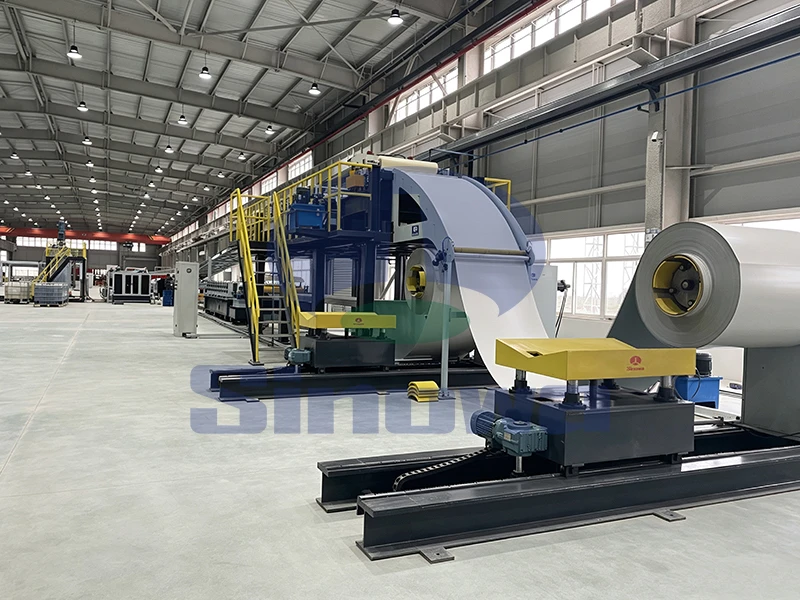
The installation cycle of a complete polyurethane sandwich panel production line is a far more complex undertaking than the phrase "installing a machine" suggests. A sandwich panel line is not a single piece of equipment but an integrated system comprising unwinding and pay-off stations, continuous or discontinuous core injection units, high-pressure polyurethane metering and mixing machinery, double-band or multi-station presses, heating sections, hot/cold forming stations, cutting and stacking devices, plus a sprawling network of hydraulics, pneumatics, electrical cabinets, PLC control loops and safety interlocks. Because all these subsystems must work in precise coordination, the time needed to bring a line from an empty factory floor to a state of stable, repeatable production typically spans somewhere in the range of eight to sixteen weeks for a turnkey installation, though this figure can stretch well beyond that for complex discontinuous lines, or shrink noticeably when the building, the foundations and the utilities are all prepared in advance. Understanding where this time actually goes, and what determines whether a project lands at the short end or the long end of that spectrum, matters far more to a plant owner than memorizing an average number.
The cycle genuinely begins long before the first crate is lifted off a truck, and this pre-installation phase often consumes more calendar time than the physical erection itself, which is why it is so frequently underestimated. Even before equipment shipment, the factory building must be finished to spec: floors leveled to tight flatness tolerances, the structural steel checked for capacity to carry the heavy press frames and reactor skids, and the roof and wall insulation installed so that the line can maintain the stable temperatures that polyurethane chemistry demands. In parallel, the civil foundation work must be completed, cured and grouted, because a double-belt press and the metering unit sit on specially designed foundations with precise leveling points, anchor bolt patterns and, in many cases, isolation pads to dampen vibration. The electrical installation—power distribution boards, transformers, cabling trays, and sufficient reserved capacity for the heavy motor loads and heating elements—as well as compressed air, hydraulic oil reservoirs and the process water or cooling systems must likewise be in place. When an owner insists on starting delivery before these enabling works are ready, the contractor cannot simply proceed; instead, equipment arrives, sits in storage, and the clock keeps running with nothing being produced. In practice, the sequence of civil works, utility provision and only then mechanical installation frequently dictates whether the whole project finishes in ten weeks or takes five months. A realistic assessment of the installation cycle therefore has to count this foundation period, because from the owner's perspective, the "installation" does not truly end until panels of acceptable quality are coming off the line, and no amount of crane time can compensate for a foundation that was never prepared.
Once the building and foundations are genuinely ready, the mechanical installation phase gets under way, and for a full line this is typically a two- to four-week effort carried out by a team of fitters, riggers and specialized engineers. The work proceeds in a deliberate sequence that cannot be safely reordered. First come the heaviest and most load-bearing components: the uncoiler and pay-off systems at the head of the line, the forming section with its roll-forming stands and embossing dies, and the massive curing or pressing station that gives the panel its structure. These are positioned with laser alignment and optical instruments to bring the centerline of every station onto a single straight axis, because even a small misalignment in the panel path will produce dimensional drift, uneven cores and edge defects that are painful to diagnose later. The component machines are then bolted down, shimmed to precise heights, and leveled against the reference plane. Following the main frames come the subsidiary stations: the core injection apparatus and the dosing heads, the heating platens and the various conveyors and transfer rollers that connect everything into one continuous flow. Throughout this phase, tolerances matter enormously: the height of the forming dies, the gap of the press, and the parallelism between upper and lower platens all determine whether the finished panel will have uniform thickness across its width. Because these measurements are taken in millimeters and tenths of millimeters, the mechanical phase is slow, deliberate work, and attempts to rush it almost always surface later as quality problems that cost more time than the shortcut saved.
The mechanical erection is only part of the story, because a polyurethane line is, in essence, a tightly coupled thermodynamic and process control system. Immediately after the frames are set comes the wiring and commissioning phase, which is often the single longest element of the whole cycle. Hundreds of sensors, temperature probes, flow meters, pressure transducers, servo drives and interlocks must be wired into the control cabinets, and every signal must be verified against the drawings and the logic programmed into the PLC. The hydraulic system must be filled, purged of air, and pressure tested; the heating circuits must be brought up to temperature in stages to confirm that the platens heat evenly and hold setpoint without overshoot; and the metering and mixing unit, the heart of the foam chemistry, must be flushed and calibrated so that the two-component polyurethane system delivers the correct ratio, temperature and output rate at every moment. It is at this stage that software and hardware meet: recipe parameters, motor speeds, conveyor timing and the synchronization of the entire line must be tuned so that the metal facesheet and the liquid core meet at exactly the right moment and cure under exactly the right conditions. Commissioning commonly absorbs between two and five weeks, and it is rarely linear, because a problem discovered in one subsystem often requires re-verifying another that seemed complete. For discontinuous lines with several independent stations, each station must be commissioned and proven separately before the whole line is run as one unit, which extends this phase proportionally.
Only after the machinery stands assembled and every subsystem answers its controls does the most instructive stage begin: trial production and process tuning, which typically occupies two to four weeks and is where the cycle reveals its true character. At this point the line is switched from dry test runs to full production with real facesheets and real chemicals, and it is here that the chemistry takes over from the mechanics. The polyurethane system must be brought to the correct reaction temperature, the dwell time in the press tuned so that the core expands fully but does not blister, and the release agents and the facesheet preparation checked so that adhesion is consistent. Trial panels are produced, cut, weighed, checked for density distribution, core uniformity, surface quality and dimensional accuracy, and every defect sends the team back to adjust a parameter—injection rate, press temperature, conveyor speed, platen gap—before the next run. This is a converging, iterative process, and the number of iterations depends heavily on the experience of the commissioning crew and the quality of the chemicals supplied. Some projects converge in a handful of days; others, where the chemistry or the equipment has an unforeseen incompatibility, can consume weeks of troubleshooting. The goal of this phase is not merely to make panels that look acceptable, but to establish a repeatable process window in which the line holds steady quality over sustained runs, because the true acceptance of the line is not one good panel but a stable series of good panels produced back to back.
Beyond the physical and chemical milestones, the installation cycle is bracketed by two further phases that are easy to overlook but impossible to skip: the pre-delivery planning and the final acceptance and handover. On the front end, the schedule depends on how much of the layout, the process recipe and the expected product mix were settled before the equipment even shipped, since a line configured for one panel thickness and then re-tooled for another mid-installation will see its cycle stretched accordingly. On the back end, the last stretch is occupied by operator training, documentation, spare-part familiarization and the formal performance test in which the line must sustain a defined output rate and quality level over a sustained period before the plant is formally signed over. This handover phase, which can run one to three weeks, is not bureaucratic padding: a line handed over without trained operators and verified documentation is a line that will be commissioned all over again by the owner at greater cost. When all these elements are summed—site preparation, mechanical erection, electrical and process commissioning, trial tuning, and acceptance training—the realistic total for a well-run, properly prepared project lands at roughly eight to sixteen weeks, with the understanding that a discontinuous multi-station line, a challenging product specification, or a site that was not ready on schedule can extend the program considerably beyond the upper end.
Finally, it is worth emphasizing that the cycle is governed less by the calendar than by the discipline of the sequence, and that several controllable decisions have an outsized effect on total duration. The single greatest lever is the readiness of the site before the first crate arrives: owners who complete foundations, utilities and environmental approvals in advance routinely finish their projects weeks earlier than those who treat installation as something that happens while construction is still wrapping up. A second lever is the completeness and precision of the pre-delivery engineering—finalized layouts, confirmed electrical load schedules, and a settled product matrix—because every ambiguity that is resolved late is paid for in machine downtime during erection. A third is the depth of the commissioning team's experience and the reliability of the chemical supply, since the trial production phase is where projects either converge quickly or spiral into long debugging loops. The installation cycle, in short, should be read not as a fixed number but as the sum of preparation, erection, commissioning, tuning and handover, each of which can be compressed only by genuine readiness and not by exhortation. For the plant owner, the practical lesson is simple: plan the site and the process completely before the equipment arrives, treat commissioning as the critical path that it is, and budget generously for the trial production stage, because the panels that come off the line at the end of a disciplined cycle are the true measure of whether the installation was ever really complete.
Tags: pu sandwich panel production line, pu sandwich panel production line manufacturer, pu sandwich panel production line supplier, china pu sandwich panel production line, pu sandwich panel production line for sale