What Curing Time Is Required For Panels From A PU Sandwich Panel Production Line?
Publication Date: Oct 21, 2026
Find out the required curing time for PU sandwich panels from continuous production lines. In-line dwell time varies by panel thickness and recipe, with post-curing needed to lock foam strength and skin adhesion.
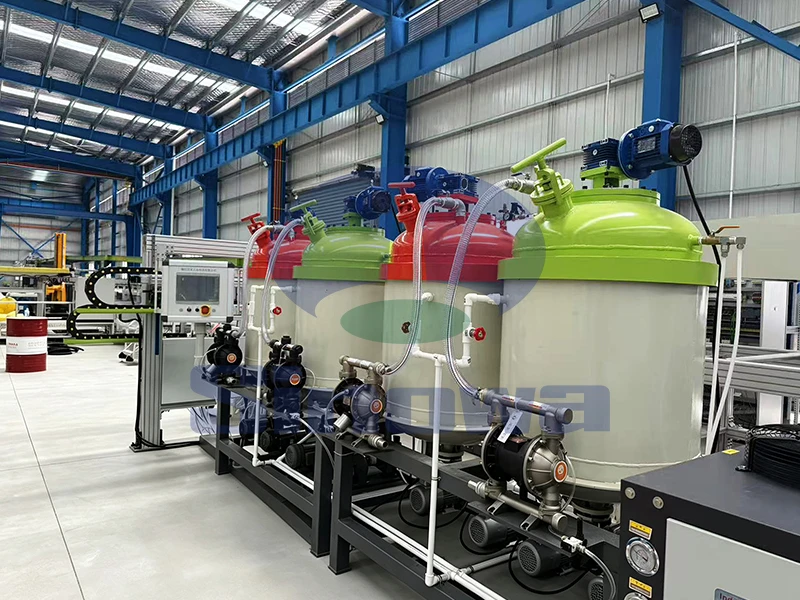
The curing time required for panels coming off a PU sandwich panel production line is not a single fixed number that can be quoted in isolation, but rather a complex variable that shifts with chemistry, geometry, and line design. At its core, the curing step exists to allow the polyurethane foam core to complete its polymerization, develop structural rigidity, and form a reliable adhesive bond with the two metal facings that will carry the panel's load. When a freshly formed panel leaves the double belt laminator, the mixture of polyol, isocyanate, catalyst, and blowing agent has only just reacted enough to hold its shape. The foam is still soft, the internal cell pressure is still settling, and the temperature across the core is far from uniform. What happens during the time that follows, whether measured in minutes, hours, or days, determines whether the finished panel will be flat, dimensionally stable, and strong enough to serve its purpose in a building envelope or a cold storage facility.
The most important distinction to draw is between the initial cure that takes place inside the production line and the post-cure that continues in the stacking area. The initial cure occurs while the panel is still under pressure within the laminator or in the curing section that immediately follows it. During this phase, the panel is held between heated platens or between the moving belts of a continuous line so that the foam can develop enough strength to resist the internal pressure of the expanding blowing agent. If the panel is removed from restraint too early, the still-growing cells will push the facings apart, causing what operators call delamination or blistering, and the surface will lose the flatness that is essential for the panel to be handled and installed. This initial cure typically occupies only a small fraction of the total time that the panel will spend hardening, and it is governed largely by the temperature profile that the heating system applies to the metal skins and through them into the core.
Temperature is the single most influential factor in determining curing time, because the polyurethane reaction follows an Arrhenius relationship in which the rate of polymerization roughly doubles for every ten degrees Celsius that the reacting mixture gains. On a typical line, the facings are preheated before the chemical mixture is dispensed, and additional heat is transferred through the heated belts or platens during the dwell period. The practical consequence is that a line running at higher curing temperatures can operate at higher belt speeds and shorter dwell times while still producing a panel with acceptable early strength. Yet there is a ceiling to this approach, because excessive temperature can drive the blowing agent to expand too quickly, over-pressurizing the foam cells and producing a brittle, coarse-celled core with poor insulating performance. Operators therefore tune the temperature to balance speed against foam quality, and the optimum value depends on the specific formulation, the thickness of the core, and the material of the facings, since aluminum conducts heat far more readily than steel and reaches the core much faster.
The thickness of the panel exerts a direct and sometimes surprising influence on the curing time. In theory, a thicker foam core has more mass to heat and more distance for heat to travel, so it should take longer to cure fully. In practice, however, thicker panels often require a shorter dwell time inside the heated section, because the greater volume of reacting mixture generates more exothermic heat that accumulates in the center of the core and drives the reaction forward from within. This internal heat generation can be so strong in thick panels that the center cures faster than the outer layers, and the risk shifts from incomplete curing to thermal runaway or scorching if the formulation is not adjusted. Thin panels, by contrast, lose heat to the metal facings and to the surrounding air more quickly, so they may actually cure more slowly near the center and remain tacky or under-cured unless the line compensates with higher temperatures or longer dwell. This inversion is a classic example of why curing time cannot be read off a simple table of panel thickness, and why each production line must be characterized empirically for the specific range of panels it is expected to make.
The chemical formulation itself provides the levers that engineers use to set the curing time to the value the line needs. Catalysts are the primary tool, because they accelerate the competing reactions of chain growth and gas generation, allowing the foam to rise and set within the few seconds or minutes available in a continuous process. A formulation tuned for a high-speed line will carry a higher catalyst loading so that the foam gels before it leaves the pressure zone, while a formulation intended for slower, batch-style production can afford a gentler catalyst package that produces a finer, more uniform cell structure. The isocyanate index also matters, because an excess of isocyanate increases crosslink density and raises the final strength of the foam, but it also extends the time needed for the reaction to reach completion. In practice, the panel's curing time is rarely decided on its own; it emerges from the entire recipe, and changing one ingredient to shorten the cure will almost always have knock-on effects on density, adhesion, and dimensional stability that must be accepted or compensated for elsewhere.
Even after a panel has passed through the initial cure and been cut to length, it is not truly finished, because the polyurethane core continues to post-cure for hours and sometimes days after it leaves the line. The reaction is never driven to one hundred percent completion inside the machine; a measurable fraction of the isocyanate remains unreacted when the panel is stacked, and it consumes ambient moisture or slowly reacts with the surrounding polyol over time. This post-cure is what brings the foam to its final mechanical strength and its equilibrium thermal conductivity, and it explains why panels measured immediately after production are softer and slightly less insulating than the same panels measured a week later. For the production planner, this means that curing time must be understood as a sequence of stages: a short mechanical dwell inside the line, a longer cooling and settling period in the stacking racks, and a still longer chemical maturation that runs on in the background while panels wait for delivery. The practical question of how long to hold panels before handling, stacking, or shipping is therefore a question about how much strength is needed at each stage, not about when the panel is chemically complete.
Several practical factors complicate the picture further and explain why experienced operators develop a feel for their own equipment rather than relying on published guidelines. The ambient conditions of the factory matter, because humidity and temperature in the stacking area influence how quickly the exposed foam edges absorb moisture and how the post-cure proceeds. The design of the stacking racks matters, because panels pressed tightly together in tall stacks cannot shed heat or moisture as freely as panels stored with air gaps between them, and poorly ventilated stacks can experience a rise in core temperature that accelerates curing in the center while leaving the edges behind. The quality of the metal facing also plays a role, because a smooth, clean, properly pretreated surface forms a stronger adhesive bond with the foam and reduces the chance of micro-delamination, which in turn reduces the holding time needed before the panel can be cut and handled without damage. Even the cutting process itself imposes a constraint, because a panel must have reached sufficient rigidity to be cut cleanly without the blade dragging foam or pulling the facings away from the core.
For the person responsible for running or commissioning a PU sandwich panel line, the practical answer to the question of required curing time is that it must be established by validation rather than assumed. The correct approach is to instrument the line, measure the temperature at several depths within the core during production, and correlate those measurements with physical tests of early strength, flatness, and adhesion carried out on panels released at progressively shorter dwell times. The curing time that appears in the line's settings is then the shortest value at which every panel released from that setting still meets the required mechanical and dimensional targets across the full range of thicknesses and formulations the line will produce. This empirical process is essential because the optimal value is specific to one line, one formulation, and one set of operating conditions, and it shifts whenever any of these changes. It is also worth remembering that a panel can appear fully cured on the surface while its core remains soft, so a responsible operator verifies performance on cut cross-sections and through full-panel load testing rather than trusting only the appearance of the finished surface.
In the end, the curing time required for panels from a polyurethane sandwich panel production line is best understood as a balance between competing priorities rather than a single number. The production manager wants it short, because a shorter dwell means higher line speed, greater output, and less capital tied up in curing sections and floor space. The quality engineer wants it long enough to guarantee that every panel leaves the plant with adequate strength, flatness, and adhesion, and that it will not distort, delaminate, or lose insulating performance during its service life. The two pressures are reconciled through careful control of temperature, formulation, and panel geometry, and through a disciplined program of testing that verifies the chosen settings on real production. A line that has been validated in this way can run with confidence, releasing panels that continue to mature in the stacking area without ever compromising the properties that the installer and the building owner rely on. The curing time, in other words, is not something a producer inherits from a specification; it is something the producer earns through measurement, adjustment, and verification on the equipment and materials actually in use.
Tags: pu sandwich panel production line, pu sandwich panel production line manufacturer, pu sandwich panel production line supplier, china pu sandwich panel production line, pu sandwich panel production line for sale