Why Do PU Panels Produced By The Sandwich Panel Machine Have Uneven Thickness?
Publication Date: Oct 20, 2026
Common causes: raw material feeding issues, incorrect roller gap, abnormal PU foaming, equipment wear & unstable line speed for PU sandwich panel production.
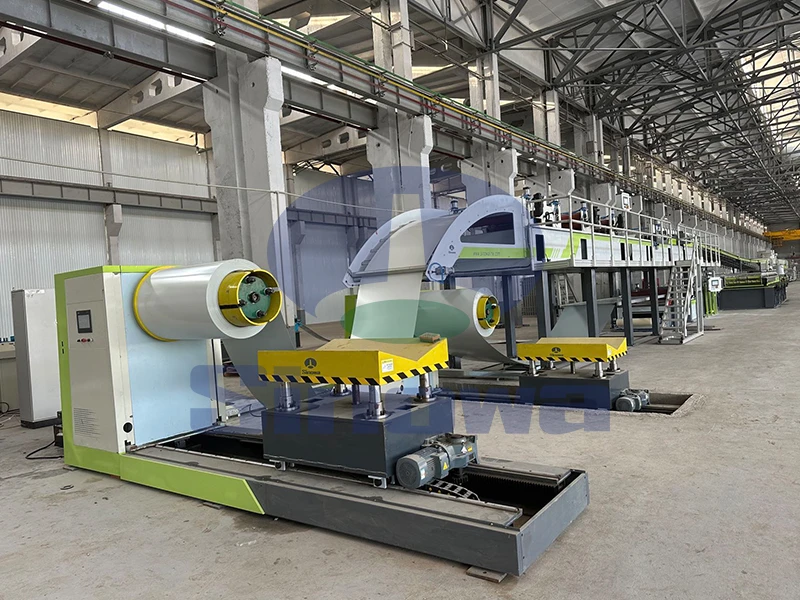
Uneven thickness in polyurethane sandwich panels emerging from a sandwich panel production line is rarely the fault of a single component. It is almost always the cumulative result of interactions among raw materials, processing conditions, machine geometry, and environmental variables that must be understood as a coupled system rather than isolated defects. A panel whose core is thicker in the middle and thinner at the edges, or whose facesheet separation varies subtly from one end to the other, tells a story about pressure distribution, chemical reactivity, and heat flow that occurred moments after the liquid foam was poured.
The most immediate cause lies in how the polyurethane chemical system itself behaves during the reaction. Polyurethane foam is formed through the simultaneous polymerization and gas generation of an isocyanate and a polyol mixture, and the balance between the rise rate and the gel time determines the internal structure of the core. If the catalyst package is too aggressive, the foam rises quickly and gels before it can be distributed evenly across the full width of the panel, leaving the material to pile up near the injection point and starve the far end. Conversely, an under-catalyzed system rises so slowly that the cream time extends and the material begins to flow and settle under gravity, producing a density gradient where the lower portion of the panel becomes denser and the upper portion thinner. Because the pour line meters the liquid onto the moving substrate in a continuous stream, any slight variation in the isocyanate-to-polyol ratio, the mixing temperature, or the resin throughput translates directly into local differences in expansion, and these differences are frozen into the panel as it cures. Even a small change in ambient humidity can shift the reactivity, since moisture reacts with isocyanate to generate carbon dioxide and consumes the available reactive groups, changing both the density and the uniformity of the resulting foam.
Beyond chemistry, the mechanical design of the sandwich panel machine imposes its own constraints on thickness consistency. The double-belt system, which carries the bottom facesheet forward while the top facesheet is applied from above, defines the nominal cavity through which the expanding foam travels. If the two conveyor belts are not perfectly parallel, the gap between them widens or narrows along the length of the line, and the foam, being a fluid under pressure, will simply occupy whatever space is available. A slight upward bow in the upper belt, for example, creates a wedge-shaped cavity that produces a panel thicker at one edge and thinner at the other. Similarly, the pressure applied to hold the facesheets against the foam must be uniform across the entire width; if the roller or platen system exerts more force in the center than at the edges, the core is compressed more severely at that point, yielding a depression that shows up as uneven thickness once the panel is released and allowed to relax. The tracking and tension of the belts also matter, because a belt that drifts laterally or runs at an uneven tension stretches the facesheet and changes the effective cavity height in a way that is rarely visible during production but becomes obvious in the finished dimensions.
The raw materials feeding into the process are another source of variability that is frequently underestimated. The facesheets themselves, whether steel or aluminum, come from a coil that has been rolled to a nominal gauge, but real coils carry thickness tolerances and surface profiles that are never perfectly flat. When a facesheet has residual waviness or an uneven coating, it does not lie perfectly against the belt, and the foam core therefore sees a non-uniform boundary that it faithfully reproduces. The same applies to the foam system's own batch consistency: polyol and isocyanate delivered in different drums may differ slightly in viscosity, water content, or acid number due to storage conditions and age, and these differences alter the flow and expansion behavior. In continuous production, operators often find that panels made at the beginning of a drum are slightly different from those made at the end, simply because the material properties drift as the drum is emptied and as temperature equalizes with the surrounding environment. When combined, these small material variations can produce thickness differences that exceed the acceptable tolerance even though every individual step appeared to be running normally.
Temperature control is arguably the single most influential process variable, and its effects propagate through nearly every other cause. The viscosity of the polyurethane reactants is highly sensitive to temperature, and the reaction rate roughly doubles with every ten degrees of temperature increase within normal operating ranges. If the raw materials are not heated and maintained within a narrow band before mixing, the foam rises faster in some parts of the pour than in others. The surface temperature of the conveying belt and the facesheet also matters, because the foam cures from the surfaces inward; a cold belt conducts heat away from the outer skin quickly, leaving the interior of the core hot and fluid for longer, which allows the material to redistribute and sag before it sets. This thermal gradient produces panels that are uniform in appearance but subtly inconsistent in internal density and, consequently, in final thickness. Seasonal changes are especially telling: the same machine and the same formulation may produce perfectly uniform panels in summer and visibly uneven ones in winter unless the material conditioning and belt heating systems are adjusted to compensate.
The condition and calibration of the metering and mixing unit deserves special attention, because it is here that the liquid streams are combined and delivered, and any defect in this stage is amplified downstream. The gear pumps that feed the isocyanate and polyol must deliver a consistent volumetric flow, and wear in the pump gears, clogged filters, or pulsations in the feed lines produce an unsteady pour that translates into periodic thickness variations along the length of the panel. The mixing head, meanwhile, must combine the two streams thoroughly and quickly; poor mixing leaves regions of unreacted material that never expand fully, creating localized thin spots, while over-mixing can generate air entrapment that produces voids and irregular surfaces. Calibration drift is insidious because it happens gradually: the ratio of the two components may shift by one or two percent without any dramatic alarm, yet such a shift is enough to change the rise profile and produce a panel whose thickness is consistent in direction but off from the target value, or uneven across the width because the spray pattern from the mixing head is not symmetrical.
Finally, the operators and the surrounding environment play a role that is easy to overlook when analyzing a hardware problem. The speed of the conveyor is set to match the cure rate of the foam, and if the line speed is increased beyond what the formulation can support, the foam is still rising when it reaches the end of the heating section, so the panel leaves the machine undercured and continues to move after being cut, distorting the final thickness. Conversely, a line running too slowly allows the foam to cure prematurely in the feed zone, causing blockages and uneven build-up. The operator's control over the pour length, the position of the mixing head, and the tension adjustments all require experience and consistent procedure; small, undocumented changes in how the line is set up from shift to shift produce thickness variations that have no single mechanical cause. Environmental factors such as drafts across the line, uneven shop-floor temperatures, and fluctuations in relative humidity also alter the cure from one panel to the next, and because these variables are not part of the machine's control loop, they often go unnoticed until a batch is rejected.
Diagnosing uneven thickness therefore requires treating the machine, the materials, and the environment as one interconnected system. A panel that varies in thickness across its width most often points to a mechanical or cavity problem, such as belt misalignment, uneven pressure, or a bowed facesheet, whereas a panel that varies along its length more often indicates a flow, temperature, or metering problem, such as an unstable pour, drifting reactant temperature, or inconsistent line speed. In practice, the two effects superimpose, so the first step in troubleshooting is to measure the thickness systematically across both directions and to correlate the pattern with the positions of the mixing head, the heating zones, and the belt supports. Only by isolating whether the variation is periodic, random, or location-specific can an operator separate a worn pump from a cold belt or a bad batch of chemicals. With careful documentation of the process parameters for each panel, and a willingness to control the raw material conditioning, belt heating, and mixing calibration before blaming the machine, most thickness uniformity problems can be traced to a handful of adjustable causes rather than to a fundamental design failure, and resolved by restoring consistency to the process rather than by replacing equipment.
Tags: pu sandwich panel machine, pu sandwich panel machine manufacturer, pu sandwich panel machine supplier, china pu sandwich panel machine, pu sandwich panel machine for sale