What Steel Coil Specifications Are Suitable For A PU Sandwich Panel Production Line?
Publication Date: Oct 13, 2026
Choosing the right steel coil for a PU sandwich panel production line is the single most decisive factor in the final panel's flatness, edge locking strength, surface durability, and long-term weather performance.
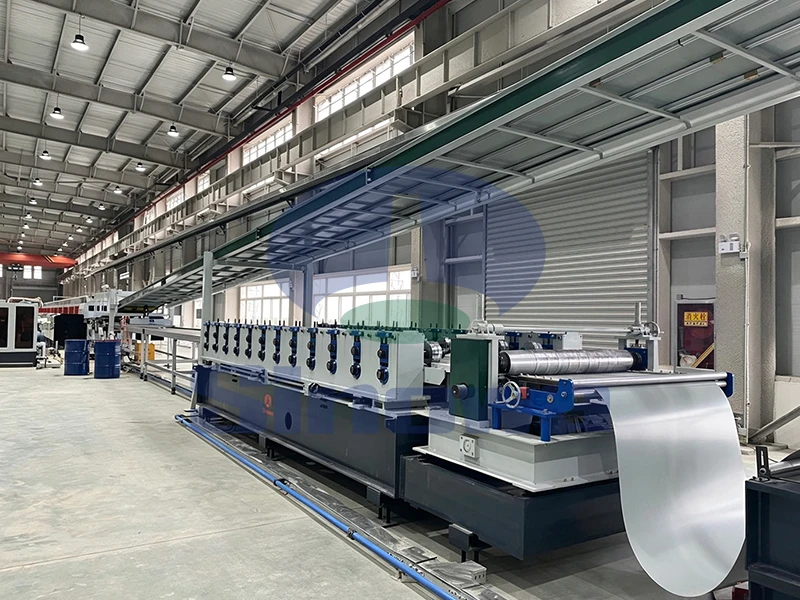
Because the line continuously decoils, leveler-flattens, roll-forms ribs and profiles, injects polyurethane foam between two facing skins, then cuts to length, every incoming coil must match the forming stations, the foam lamination nip, and the curing tunnel without slipping, delaminating, springing back, or cracking. The core parameters that must be agreed before a coil ever reaches the line are base metal type and thickness, metallic coating system and mass per square meter, organic paint system and topcoat finish, coil width and inside diameter, yield strength and elongation tolerance, edge condition, and surface protection film. Getting these specifications right avoids the most common line problems—wrinkles at the forming rollers, fractured paint film after bending, corrugation on the finished panel, poor foam adhesion, and coil jams at the entry station.
The base metal of choice for nearly all continuous PU sandwich panel lines is a thin-walled cold-reduced carbon steel sheet supplied in coil form. For structural and economic reasons, the gauge that works most reliably on a standard panel line typically sits between roughly 0.4 mm and 0.7 mm for external facings, while internal or underside skins can go as thin as 0.3 mm where stiffness is provided mainly by the foam core and profiled ribs. Gauge matters beyond raw cost: a skin that is too thin will ripple between the forming rollers, telegraph foam cell structure through the paint film, and fail to resist dents during transport and installation. A skin that is too thick, on the other hand, overloads the roll-former's bending power, increases springback after each forming station, raises the force required for the side-lock hemming, and pushes the whole line toward its torque limit. Incoming coils should therefore be specified with a narrow thickness tolerance band, and the production engineer should pair the chosen gauge with the corresponding roll-pass design; attempting to run several very different gauges on the same pass line without re-tooling is a common source of panel skew and out-of-tolerance widths after cut-to-length.
Beneath the organic paint, the metallic coating is what gives the facing its real corrosion life. Two families of metallic-coated steel dominate the sandwich panel industry: hot-dip galvanized steel, in which a layer of zinc is metallurgically bonded to the cold-rolled substrate, and zinc-aluminum alloy coated steel, often recognized by its higher aluminum content and finer spangle. The zinc-aluminum family generally performs better in humid, coastal, or chemically aggressive atmospheres because the aluminum forms a stable oxide barrier while the zinc provides sacrificial protection at cut edges. For a production line, the practical specification is the coating mass per square meter, usually quoted per side of the sheet; external panels facing rain, sun, and pollution should carry a heavier coating mass than internal liners. It is also important that the coating be applied continuously and uniformly, because any bare spot on the substrate will bloom into rust under the paint within months of installation. Coils that show uneven spangle, bare patches, or visible oxide stains on inspection should be rejected at the entry station rather than run through the line, since downstream foam and paint cannot repair a defective metallic layer.
The organic coating is what the end user actually sees, and it must survive both the line's own processes and decades of outdoor exposure. A PU sandwich panel line exposes the painted skin to bending in the roll former, heat from the curing tunnel, shear and guillotine cutting, friction against guide rollers, and contact with chemical release agents on the foam. The topcoat family must therefore be selected to match the expected service environment: polyester-based topcoats are the standard choice for general building façades and interior liners because they offer a good balance of color, flexibility, and cost; durable modified polyesters perform better where fade resistance and chalk resistance are priorities; and fluoropolymer-based topcoats are reserved for premium architectural projects where twenty-plus years of gloss retention and color stability are required. The paint film thickness—both primer and topcoat combined—should be specified within a consistent band, because too thin a film gives poor corrosion and scratch resistance, while too thick a film becomes brittle on the bend radius of roll-formed ribs and will craze or crack in the field. The backside coating, often thinner than the topcoat, must still be present and compatible with the polyurethane foam so that the skin-to-core bond does not peel under thermal cycling.
Color consistency across an order is almost as important as the coating itself, because sandwich panels are installed side by side and any shade difference between coils becomes glaring on a finished building façade. Coils intended for the same project should therefore be ordered from a single paint batch or, at minimum, from coils with matched color codes and recorded ΔE values measured against the agreed standard. On the line itself, operators typically sort coils by batch number before threading, because mixing two slightly different lots on the same wall pattern will produce visible panel-to-panel variation. Surface finish is another linked parameter: smooth, matte, silk, and high-gloss finishes each reflect light differently, and the choice affects both the forming behavior (high-gloss films scratch more easily) and the final aesthetic. A fine textured or embossed finish is often preferred for exterior panels because it hides minor scratches, finger marks, and the natural ripple that can appear after foam lamination. Regardless of finish, the coils should arrive with a protective peel-off film on the exposed side, applied at the coating mill with controlled adhesive strength—strong enough to survive line handling, weak enough to strip cleanly on site without leaving residue.
The physical dimensions of the coil directly determine how smoothly the decoiler and entry station feed the line. Width is the first dimension: the panel line is built around a specific finished panel width, and the incoming coil width must be wide enough to accommodate that profile plus the hemmed edge locks on both sides, with a small overcut allowance for the flying saw. Coils that are slightly too narrow will produce panels that cannot lock together; coils that are too wide waste material and overload the side-trimming station. In practice, the line is usually commissioned around one or two coil widths, and switching width means adjusting the edge trimmer, the side pinch rollers, and the forming guides. The inner diameter of the coil must match the mandrel of the hydraulic decoiler, with a common dimension being six hundred millimeters; a mismatch forces the use of adapters or causes the coil to slip on the mandrel under line tension. Outer diameter and total coil weight are also specified, because the decoiler's maximum payload, the overhead crane lifting plan, and the operator's ability to splice tails all depend on them. Heavier coils reduce splice frequency and line downtime but require robust lifting equipment and a stable decoiler drive.
Mechanical properties of the substrate are what let the skin be roll-formed without splitting or springing back. Yield strength defines how much stress the steel can take before it permanently deforms, and it must be high enough to give the finished panel stiffness after installation but low enough that the forming rollers can bend it to the required rib radii without cracking the paint. Elongation, measured on a tensile test, tells how ductile the steel is; a coil with very low elongation will fracture at tight bend radii, especially at lower shop temperatures, and hairline cracks under the paint film will become rust spots within a season. For continuous PU panel lines, a substrate with controlled yield point and good ductility is preferred over a high-strength steel that resists forming. The line's entry leveler also matters in this context: because coils arrive with coil set and cross-bow, the tension leveler must be able to flatten the strip without over-stretching it; otherwise residual stresses will reappear after cutting and the panel will warp or cup. Suppliers typically deliver coils in a temper-rolled skin-pass condition that balances flatness, yield behavior, and surface roughness, all of which influence paint adhesion and foam lamination.
Edge condition and strip flatness are routinely underestimated but cause a large share of line stoppages. Slit edges, in particular, must be clean and free of burr, because a burred edge will scrape the forming rollers, tear the protective film, and cut operators' gloves; sharp edges also prevent the side-lock hem from folding cleanly. When coils are slit from wider parent coils, the slit quality depends on the slitting knives, knife clearance, and line speed, so panel producers often request deburred edges or accept slit edges only after checking a sample on the actual line. Camber—the lateral curvature of the strip as it leaves the decoiler—must be kept within a small tolerance, because excessive camber will make the strip drift sideways in the forming stations and produce panels with skewed edge locks. The coil should also arrive with a stable, tight outer wrap secured by steel or plastic straps at the mill, and the inner tail should be clearly marked so the operator can find it quickly when threading. Any coil that arrives loose, oval, or with strap damage should be rejected before it is set on the decoiler; once a loosely wound coil collapses on the mandrel, the repair time often runs into hours and the damaged outer wraps are scrapped.
Foam lamination compatibility is a set of requirements that is specific to PU sandwich panel lines and does not apply to general roll-formed steel profiles. During the process, polyurethane is poured or injected between the top and bottom skins, expands as it reacts, and cures while the skins are held at a fixed distance by the forming line's side guides. The steel facing must therefore withstand the heat of the exothermic reaction, the chemical nature of the isocyanate and polyol components, and the expansion pressure without shifting, corroding from beneath the paint, or failing to bond. The backside primer on external skins and the inside coating on internal liners must be chemically compatible with the specific polyurethane system being used; a paint that is incompatible may show adhesion loss, blistering, or foam delamination between skin and core after a few years. Surface energy of the backside also matters: paint that is too smooth or too heavily lubricated gives the foam nothing to grip, while a controlled, slightly textured primer provides mechanical anchorage. Producers often run a small peel-strength trial with each new coil lot, pulling a sample strip of foam from the skin, before committing a full shift of production. If the failure mode is cohesive within the foam rather than adhesive between skin and foam, the bond is good; if the foam peels cleanly off the steel, the lot must be quarantined.
Ordering and incoming inspection are where specifications become operational rather than theoretical. A well-run PU panel line will maintain a coil specification sheet that lists, for each skin type, the substrate gauge, metallic coating mass, topcoat system, paint film thickness, color code, finish, protective film thickness, coil ID, maximum OD, maximum coil weight, slit width tolerance, camber limit, and required mill test data. When a coil delivery arrives, the receiving team cross-checks each of these against the packing list, measures gauge and coating weight on sample strips, inspects the slit edges for burr, verifies color and gloss against the approved standard panel, and records the coil batch number against the production order. This traceability is essential because, if a batch of panels later returns from the field with paint blistering or rust at cut edges, the producer can trace the failure back to a specific coil lot, supplier batch, or even a specific day's run at the coating mill. Without that discipline, field complaints become impossible to diagnose, and the same defective coils can be run again. A short, well-audited incoming inspection routine—typically completed before the coil is lifted onto the decoiler—costs minutes per coil and prevents hours of line downtime and weeks of warranty exposure.
Finally, it is worth looking at how all the above parameters work together on a real PU sandwich panel line rather than in isolation. A 0.5 mm external skin with a zinc-aluminum metallic coating, a modified polyester topcoat in a light neutral color, a thin backside primer compatible with the chosen polyurethane system, a peel-off protective film, a six-hundred-millimeter inner diameter, and a stable slit width will run smoothly on a standard double-belt PU line at typical production speeds, will form ribs without paint crazing, will laminate to the foam core without delaminating, and will leave the customer with panels that stay flat, color-stable, and corrosion-resistant through years of outdoor exposure. Deviating from any one of these choices—whether driven by a cheaper offer, a shorter lead time, or a one-off substitution—tends to show up not immediately but after months or years in service, by which point the coil has already been converted into installed panels. That is why the most profitable PU panel producers treat coil specification not as a purchasing negotiation but as a core engineering input to the line, locking it down alongside the roll-former setup, the foam chemistry, and the curing tunnel settings, and revisiting it only when a new coating technology, a new building environment, or a new customer project genuinely demands a change.
Tags: pu sandwich panel production line, pu sandwich panel production line manufacturer, pu sandwich panel production line supplier, china pu sandwich panel production line, pu sandwich panel production line for sale