What Is The Hourly Production Capacity Of A Continuous PU Sandwich Panel Production Line?
Publication Date: Oct 13, 2026
Continuous PU sandwich panel lines typically produce 800–1,200 square meters per hour, depending on panel thickness, width, raw material reactivity, and line speed settings.
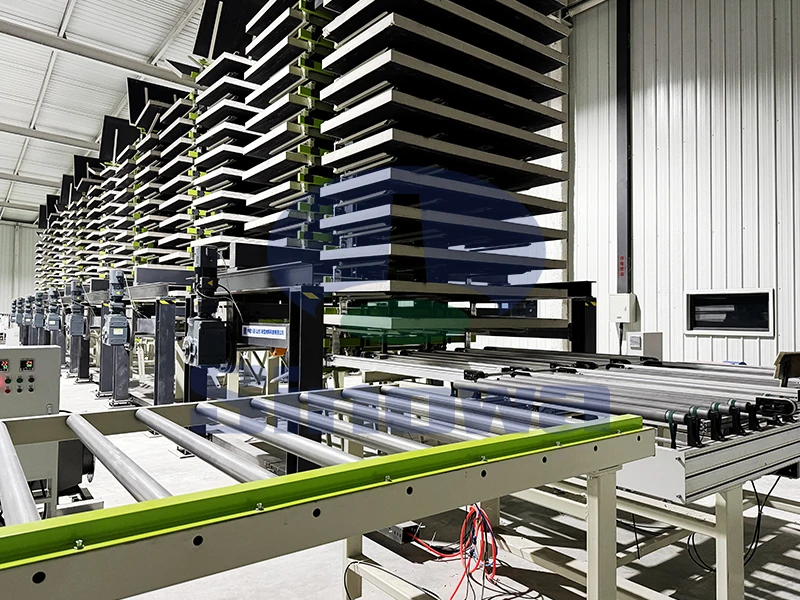
A continuous PU sandwich panel production line is a fully automated system that combines unwinding of metal coils, foaming of polyurethane or polyisocyanurate core material, lamination between top and bottom skins, and cutting to length in one uninterrupted process. Unlike discontinuous batch systems, which mold panels one by one in presses, the continuous line moves materials through a tunnel oven where chemical reaction and curing happen on the fly. This architectural difference is the primary reason its output is measured in square meters per hour rather than panels per shift. The hourly capacity therefore reflects the combined effect of belt speed, panel width, foaming time required at a given thickness, and how efficiently the downstream cut-off and stacking stations keep pace.
The most direct driver of output is line speed, expressed in meters per minute. A well-tuned continuous line running standard wall panels might travel between 8 and 12 meters per minute, while thinner ceiling or interior panels can move faster, sometimes above 15 meters per minute, because they require less foaming time and cure more quickly. Conversely, thick insulation panels used in cold rooms or freezer warehouses slow the belt down substantially, since the chemical exotherm needs more residence time to reach dimensional stability before the panel exits the oven. Multiplying belt speed by panel width gives the hourly area output, so even a modest drop in speed can translate into a noticeable reduction in daily production.
Panel width is the second major variable. Most continuous lines are built for widths between 1,000 and 1,200 millimeters, with some capable of reaching 1,250 millimeters. A line running 1,200 millimeter panels at 10 meters per minute delivers 720 square meters per hour before accounting for changeovers and scrap; running the same speed at 1,000 millimeter width drops theoretical output to 600 square meters. In practice, manufacturers often quote capacity at the maximum width the machine supports, because that is the configuration that yields the highest nominal figure. When comparing numbers from different suppliers, it is important to check both the assumed width and the assumed thickness, since these two inputs explain most of the gap between advertised and real-world output.
Chemical formulation and raw material quality also play a role that is easy to overlook. The reactivity of the polyol blend, the temperature of the components, the humidity in the factory, and even the ambient air temperature affect how quickly the foam rises and gels. A formulation designed for fast demold can shave several seconds off residence time, allowing the belt to run faster without risking dimensional distortion or delamination. Conversely, poor mixing, dirty injection heads, or inconsistent component temperatures can cause incomplete reaction, surface defects, or voids that force the operator to reduce speed. This is why two identical-looking lines in different facilities can report meaningfully different hourly outputs even when the hardware is the same.
Oven design and length matter because they determine the available curing window. A longer oven gives the foam more time to stabilize before cutting, which allows a faster belt speed for the same thickness. Shorter ovens, or ovens with uneven temperature zones, force operators to slow down to prevent panels from bowing, shrinking, or sticking to the belt. Modern lines often use segmented heating zones with independent temperature control, so each stage of the reaction—from cream time through rise to cure—happens at the optimal thermal condition. When the oven is well matched to the foam system, the line can sustain its rated speed for hours without quality intervention.
Downstream equipment sets the ceiling on how fast the line can run. The cut-off saw must be able to chop a moving panel cleanly to length without burring the metal skins, and the output conveyor, stacker, and packaging station must accept panels at the same rhythm. If the saw or the stacking mechanism becomes a bottleneck, the line cannot run at the speed the oven and foaming section would otherwise allow. Many lines include buffer conveyors that absorb short-term fluctuations, but sustained high output requires every station downstream to be sized for the same peak rate. A common rule of thumb is that the cut-off and stacking section should be rated 10 to 15 percent higher than the forming speed, so it never becomes the limiter.
Human factors and changeover routine have a surprisingly large effect on realized capacity. Coil changes, glue pot refills, color or profile switches, and scheduled cleaning of the injection heads all take the line down. A line that nominally runs at 1,000 square meters per hour may, over an eight-hour shift, deliver only 600 to 750 square meters per hour on average because of these interruptions. The best operators minimize downtime by pre-loading coils, staging new raw material batches, and performing routine cleaning during changeovers rather than after a fault occurs. Planning around the panel mix—running similar widths and thicknesses consecutively—reduces the number of slow-downs and helps the line stay near its peak speed for longer stretches.
Quality assurance and in-line inspection influence the steady-state speed as well. Vision systems that detect surface defects, thickness gauges that verify foam density, and weight checks that ensure chemical dosing is accurate all allow the operator to run at higher confidence. When a defect is caught early, the operator can adjust the chemical ratio or temperature without scrapping a long run. Conversely, a line without reliable in-line measurement tends to run conservatively, because the operator does not want to discover delamination or skin bond problems after hundreds of panels have already been stacked. This means that the investment in sensing and automation is not just a quality feature—it is also a productivity feature, because it permits faster, more confident operation.
Energy consumption and environmental controls are often cited as secondary, but they shape how long the line can run at peak capacity. Heated belts and ovens draw significant power, and if the facility's compressed air supply, cooling water, or exhaust ventilation is undersized, the line may need to slow down or pause to let systems recover. Proper insulation of the foaming section and recovery of waste heat can keep component temperatures stable, which in turn keeps the chemical reaction consistent. A line that is well integrated with its factory utilities will hold its rated output more reliably than one that is constantly compensating for marginal support systems.
For planning and budgeting purposes, it is wise to use a conservative realized figure rather than the theoretical peak. A continuous line rated at 1,000 square meters per hour may, in normal production with a realistic panel mix and typical changeovers, deliver 700 to 850 square meters per hour as a sustainable shift average. Buyers and production planners should ask suppliers for both the peak speed at a given width and thickness, and the expected average speed over a full shift accounting for normal interruptions. Matching those numbers to the order book—how many square meters per day are needed, what thicknesses and widths dominate, and how often the line must switch products—gives a much clearer picture of whether a given line size is the right fit, and prevents the common mistake of buying based on a headline capacity that the operation cannot actually realize.
Tags: continuous pu sandwich panel production line, continuous pu sandwich panel production line manufacturer, continuous pu sandwich panel production line supplier, china continuous pu sandwich panel production line, continuous pu sandwich panel production line for sale