What Edge Profile Types Can A PU Sandwich Panel Production Line Process?
Publication Date: Oct 27, 2026
Learn what edge profiles PU sandwich panel production lines can process, including square, rebated, shiplap, tongue & groove, concealed fastener interlocking edges, plus key production considerations.
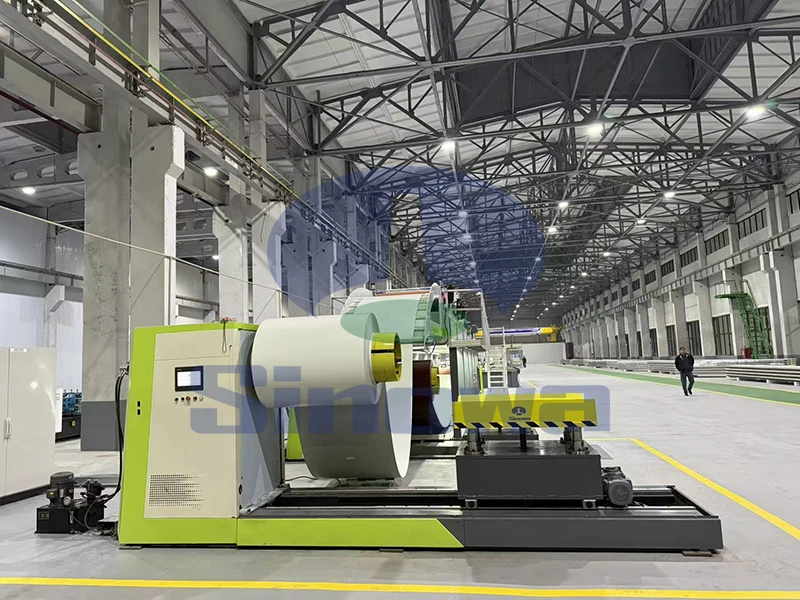
A polyurethane sandwich panel production line is, at its core, a highly coordinated system in which continuous facings, a liquid polyurethane foam core, and a set of precision-forming equipment must work together within a single continuous process. Among the many design decisions that determine what such a line can actually produce, few are as consequential as the edge profile of the finished panel. The edge profile is not a cosmetic afterthought; it defines how panels join to one another, how they are sealed, how they accommodate thermal movement, and how they are handled during installation. In practice, a well-configured line can process a surprising diversity of edge geometries, ranging from the simplest flush-cut square edge to elaborate interlocking systems with concealed fixing channels, and the real scope of what the machinery can handle depends on a careful balance of foaming pressure, molding surfaces, cutting and profiling stations, and the physical behavior of the rising foam itself.
The most fundamental edge type, and the one every sandwich panel line can process without special modification, is the plain square or butt edge. Here the two facings run parallel and the foam core is flush with the panel sides, producing a simple rectangular cross-section that is cut cleanly at the forming and slitting stage. Such panels are inexpensive to produce, straightforward to cut and trim, and they find their natural home in internal partitions, temporary enclosures, and applications where the joint will be covered by an independent capping strip or concealed by another building element. The production line handles this profile with minimal tooling: the foaming head deposits the reactive mixture between the moving facings, the profile rollers or platens hold the edges open to a controlled thickness, and the cured board is subsequently slit to width and cut to length with plain blades. Because there is no interlocking feature, dimensional tolerance is comparatively forgiving, and the line can run at its maximum speed with the least risk of foam leakage at the edges.
A logical step up in complexity is the rebated or step joint, in which one facing is offset from the other so that the panel presents an L-shaped or stepped cross-section at each longitudinal edge. This creates a natural overlap when two panels are placed side by side, providing a built-in barrier against water ingress and a modest degree of mechanical interlock. From the perspective of the production line, the rebated edge requires the facings to be pre-formed or fed at different vertical positions before the foam is introduced, and the molding station must hold this asymmetric geometry while the foam expands. This demands more careful control of foam pressure so that the step is not distorted, and it also requires the slitting and trimming equipment to cut through a section of varying thickness without tearing the facing. Despite these demands, the rebated edge is a workhorse profile that many lines process routinely, and it represents a good intermediate point where a producer gains functional benefit without committing to fully interlocking tooling.
Moving further into the range of profiles, the tongue and groove system represents one of the most widely produced edge geometries in the sandwich panel industry. In this configuration one longitudinal edge carries a protruding tongue, formed either from the foam core alone or from a shaped steel facing, while the opposite edge carries a matching recessed groove. When panels are assembled, the tongue of one panel seats into the groove of its neighbor, creating a positive mechanical connection that resists racking and helps to maintain alignment across the width of a wall. Producing a true tongue and groove edge on a continuous line is considerably more demanding than producing a square or rebated edge. The profile must be formed consistently along the entire length of the panel, which means the tooling at the molding station has to reproduce the same convex and concave geometry without interfering with the release of the cured board. Foam density and expansion pressure become critical, because a low-pressure or under-filled core will leave voids in the tongue, while an over-pressurized core may push foam into the groove tooling and create surface defects. Some lines achieve the tongue and groove by shaping only the foam core after it has sufficiently hardened, using profiled cutting wheels or hot-wire heads that carve the geometry in a dedicated finishing station rather than forming it in the mold. This approach decouples the shaping step from the chemical reaction and often yields cleaner, more consistent results, at the cost of an additional station and the loss of some facing material that must be trimmed away.
Related to the tongue and groove, and often combined with it, is the shiplap edge, in which each longitudinal edge carries a stepped or L-shaped configuration that overlaps with the adjacent panel. The shiplap profile is prized for its simplicity of assembly, since panels can be slid into place with a clean visual joint, and it provides an effective water-shedding overlap when installed with a slight slope. On the production line, the shiplap is typically achieved through the same molding and profiling approaches as the rebated edge, but with a deeper and more pronounced step. Because the overlap relies on the two facings being held at different planes across a wider band, the line must maintain very stable facing tension and feed alignment; any lateral wander in the steel facings will be immediately visible as a mismatched joint. Consequently, a line processing shiplap profiles generally needs upgraded edge guidance rollers, tighter tracking control, and more frequent calibration of the forming rollers than a line dedicated to plain square edges.
At the higher end of the complexity spectrum lie the concealed fastener and interlocking edge profiles, which are increasingly common in modern architectural panels where visible fasteners on the exterior face are undesirable. These profiles typically incorporate a female pocket or hook on one edge and a matching male flange on the other, such that panels interlock positively and are fixed to the substructure through clips or cleats that engage hidden channels. From a manufacturing standpoint, the concealed fastener edge is among the most difficult to produce reliably on a continuous line. The geometry is often complex, with multiple bends, undercuts, and captive voids that are nearly impossible to form purely by shaping the foam core after cure; instead, the steel facing must be pre-profiled by a roll-forming machine immediately upstream of the foaming station, so that the finished contour is present in the metal before the foam ever touches it. The molding platens or rollers then have to close around this pre-profiled metal without crushing the intricate bends, which imposes strict limits on allowable foam pressure and on the height of the profile. Because the foam fills a cavity of non-uniform cross-section, the line must be tuned to deposit more material in the thicker regions and less in the thin webs, a task usually handled by a controllable multi-head or variable-output foaming system. The payoff is a panel with a clean, uninterrupted exterior surface, but the engineering burden on the line is considerable, and not every producer chooses to carry the associated tooling and calibration costs.
Regardless of the specific edge geometry, the ability of a given production line to process a particular profile is governed by a handful of interrelated factors that operators must weigh carefully. The first is the stiffness and thickness of the facings, since thin steel or soft facing materials may not hold a complex pre-formed shape, while very thick facings may exceed the bending capability of the roll-forming heads. The second is the reactivity and density of the polyurethane foam formulation, which determines whether the rising foam will faithfully reproduce the mold geometry or instead leave voids, blisters, or distorted features at the edges. The third is the design of the forming section itself: a line equipped with interchangeable molding cassettes, adjustable platens, or modular roll-forming heads can be converted between profiles within a shift, whereas a line with fixed, permanently welded tooling is locked into a single geometry until it is shut down for major rework. Finally, the downstream cutting and trimming equipment must be capable of parting the board cleanly through the profiled edge without delaminating the facing from the foam, which is a real risk when blades meet an asymmetric cross-section at speed.
In practical terms, most modern PU sandwich panel lines are designed with a degree of modularity precisely because producers rarely commit to a single edge profile forever. A line built around a flexible forming station can move from square edges to rebated joints, and from shiplap to tongue and groove, simply by exchanging the relevant tooling inserts and recalibrating the foaming parameters. The concealed fastener profiles, however, tend to be reserved for dedicated or semi-dedicated lines, because the upstream roll-forming investment and the precision required in the molding section make rapid profile changes uneconomical. The choice therefore comes down to a trade-off between flexibility and throughput: a line that can process the full range of edge types offers a producer unmatched product diversity and the ability to serve many market segments from a single asset, while a line specialized around one or two interlocking profiles can be tuned more aggressively for speed and consistency, producing a narrower catalog with superior edge quality. Both strategies are commercially valid, and the decision rests on the markets the producer intends to serve, the volume they expect, and how willing they are to absorb the tooling and downtime costs that come with profile changeovers.
Understanding what edge profiles a PU sandwich panel production line can process is ultimately a question about the balance between the chemistry of the foam, the mechanics of the forming equipment, and the economics of tooling flexibility. The square edge sits at the base of the capability pyramid and is universally supported, while rebated and shiplap edges are well within reach of any line with modest forming adjustability. Tongue and groove represents a genuinely demanding but broadly achievable step that rewards careful foam control and dedicated profiling stations. At the top, concealed fastener and fully interlocking geometries push the line to its limits, requiring pre-profiled facings, low-pressure molding precision, and a commitment to specialized tooling. A producer who understands these relationships can select a line configuration that matches their product strategy, and an engineer evaluating a line's capability should ask not merely which profiles are nominally listed as supported, but how those profiles are formed, what tooling changes they require, and how the foaming system has been configured to fill the resulting cavities. Only with that deeper understanding does the nominal capability translate into panels that meet the performance expectations of the buildings they will ultimately form.
Tags: pu sandwich panel production line, pu sandwich panel production line manufacturer, pu sandwich panel production line supplier, china pu sandwich panel production line, pu sandwich panel production line for sale