Can A Sandwich Panel Production Line Produce Fireproof PU Sandwich Panels?
Publication Date: Oct 21, 2026
Yes, standard continuous lines can be adjusted with modified foam formulations and precise process settings to produce fire-resistant PU/PIR sandwich panels, though they cannot manufacture non-combustible mineral wool core panels.
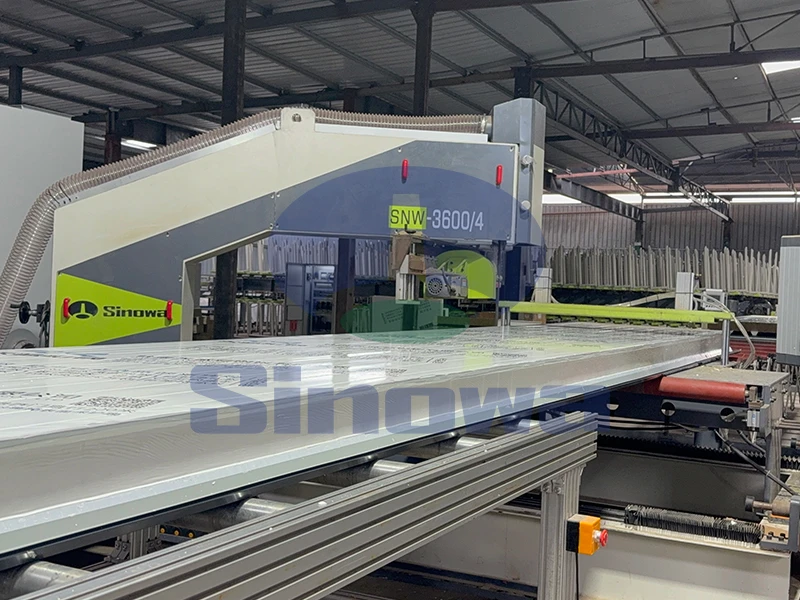
The short answer is yes — but with a qualification that matters more than the yes itself. A standard sandwich panel production line, the kind built around continuous foaming, is not a rigid machine that can only ever make one kind of panel. It is a system of coordinated processes — surface sheet decoiling and profiling, a double-belt or continuous laminator, a chemical mixing and dispensing head, a curing tunnel, and a flying cut-off saw. Change the chemistry that feeds into that mixing head, adjust a handful of process parameters, and the same physical line can turn out panels whose cores behave very differently in a fire. Yet "fireproof" is a word that deserves careful unpacking, because what the market calls fireproof panels are rarely non-combustible in any absolute sense, and the ability of a line to make them depends less on the steel-frame machinery than on how precisely the manufacturer controls the formulation and the thermal profile that the foam passes through.
To see why the answer is nuanced, it helps to understand what actually makes a conventional polyurethane core burn and what makes a modified one resist fire. Standard polyurethane foam is, at its chemical heart, a highly combustible organic polymer. When it ignites, it burns readily, releases heat quickly, and — if the foam is open to the air and allowed to burn freely — can propagate flame with surprising speed. A panel made with an unmodified PU core will pass no fire test worth trusting and will not meet the expectations of anyone building a warehouse, a cold store, or a plant where fire safety is a regulatory and moral priority. This is the fundamental fact that frames the entire discussion: the fire performance of a sandwich panel is decided almost entirely in the mixing head and the curing zone, not in the thickness of the steel or the width of the belt. Two panels made on identical machinery can have opposite fire behaviour if their foam chemistry differs.
The first and most direct route is to shift the foam chemistry from pure polyurethane toward polyisocyanurate, usually abbreviated PIR. The difference is a matter of stoichiometry and recipe. In a standard PU system, the isocyanate and the polyol react in a ratio balanced to form the familiar urethane linkages. In a PIR formulation, the manufacturer raises the isocyanate index sharply — well beyond the amount needed to react with the polyol — so that an excess of isocyanate drives the formation of a dense, highly cross-linked isocyanurate ring structure. That structure is fundamentally more thermally stable than the urethane polymer. When it is exposed to heat it tends to char rather than to drip and feed the flame; the char layer then acts as a barrier that slows heat transmission into the core and retards further decomposition. In practical terms, a PIR core will not burn the way a conventional PU core does, and this is precisely why so many so-called fireproof or fire-retardant panels are, in fact, PIR panels produced on what was originally a PU line.
So the chemistry change is the first answer, and it is a real one. But converting a line from PU to PIR is not simply a matter of buying a new drum of chemicals and pouring it in. The switch imposes demands on the equipment and the process that a maker must respect or the output will be unusable. The higher isocyanate content changes the reaction kinetics — the mix foams, gels, and cures on a different time scale. The dosing pumps must be capable of delivering the new ratio accurately and consistently, because the fire performance is exquisitely sensitive to how close the actual ratio sits to the intended one; drift a few points and the foam may either under-react and stay flammable or over-react and become brittle and poorly adhered to the facings. The mixing head must blend a more viscous, more reactive stream without dead zones where the chemistry cures prematurely. And because the exotherm of a PIR reaction is higher and the foam denser, the curing tunnel's temperature control and the belt's speed and pressure profile often need to be re-mapped, or the manufacturer will end up with a core that has cured unevenly, blistered at the facings, or shown voids along the length of the panel.
Beyond the chemistry, there is the matter of additives, and this is the second layer of the answer. Even a well-made PIR core can be made substantially more fire-resistant through the deliberate inclusion of fire-retardant compounds blended into the polyol side of the formulation before it reaches the mixing head. Some of these work in the gas phase, scavenging the free radicals that sustain combustion; others work in the condensed phase, promoting char formation and reducing the release of flammable volatiles. A manufacturer serious about fire resistance will install an accurate additive dosing and pre-blending station upstream of the dispenser so that the retardant loading is uniform from batch to batch and from panel to panel. Uniformity is the quiet discipline that separates a credible fireproof panel from a claim on paper. Fire tests are unforgiving about inconsistency: a single local patch of poorly blended foam, a bubble of air trapped near the facings, or a thickness variation across the width can turn a nominally fire-resistant panel into one that fails. The production line, therefore, has to be run with a tighter tolerance than the one a maker of standard building panels would tolerate, and this is where equipment quality starts to show.
It is also worth being honest about the limits of the word "fireproof." No organic foam core — PU, PIR, or any modification of them — is non-combustible in the way a mineral core is. Under a sustained and intense fire, even a well-formulated PIR core will eventually decompose, char, and lose structural integrity, because it is still a hydrocarbon-based material. What the flame-retardant chemistry buys is time and behaviour: the panel resists ignition, limits flame spread across its surface, restricts the release of smoke and heat, and maintains its load-bearing capacity long enough for people to evacuate and for emergency response to act. In the industry's own language, this is fire reaction and fire resistance rather than absolute immunity to fire. So when someone asks whether a line can make fireproof panels, the honest and useful answer is that it can make panels with a substantially improved, engineered fire performance — panels that will hold a flame test that a standard PU panel would fail — but it cannot make an organic-foam core that is truly immune to fire. Anyone promising that is promising something the chemistry cannot deliver.
A further subtlety is that the phrase "fireproof sandwich panel" is sometimes used to mean a panel with a non-combustible core, most commonly mineral wool rather than any foam at all. This is a different product made by a different process, and it is the one genuine case where a PU foam line is not the right tool. Mineral wool cores are not produced by chemical foaming; they are formed from spun fibres of rock or slag, and the panel is assembled by a dry, mechanical process in which the mineral wool slab is placed between the facings and bonded with adhesive under pressure in a laminator. There is no mixing head, no isocyanate chemistry, no curing tunnel, and no need for foam-dosing precision. A continuous PU line cannot simply be switched to make mineral-wool panels, because the core-forming technology is entirely different. What a PU line can do is produce PIR panels that are genuinely fire-resistant in the sense described above, and this is a perfectly legitimate and widely used product. The key is to distinguish, in any discussion of "fireproof," between an engineered fire-resistant organic core and a genuinely non-combustible mineral core, and to be clear that a foam line addresses the former and not the latter.
There is one more consideration that shapes the practical answer, and it concerns process control rather than chemistry. Fire-resistant PIR panels are more demanding to make than ordinary PU panels, and a line that is mechanically sound but operated loosely will not deliver them. The manufacturer must control the substrate temperature and the foaming temperature within narrow windows, because the rate of rise and the density of the foam are what determine whether the core is uniformly consolidated. Density matters enormously for fire performance: a denser, more closed-cell core resists heat transmission better and holds its shape longer, whereas a low-density core full of voids and thin spots is a weak link. The line must therefore hold the panel thickness within tight limits, keep the facings properly profiled and adhered so that no channel exists for flame to travel between the core and the steel, and maintain clean, consistent cutting so that every panel has the same edge geometry and the same core-to-facing bond. All of this is achievable on a well-maintained continuous line, and many manufacturers in fact run dedicated PIR lines that are built on the same fundamental architecture as standard PU lines, with upgraded dosing, better temperature control, and stricter quality gates. The machinery itself is rarely the barrier; the barrier is the discipline with which it is run.
So the final answer to the question is a considered yes. A sandwich panel production line can absolutely be adapted — usually by shifting its core chemistry to polyisocyanurate, adding fire-retardant additives, and tightening process control — to produce panels with a strong, engineered fire performance that is a world apart from standard polyurethane foam. What it cannot do is produce a genuinely non-combustible core, and what it cannot cheaply or directly do is produce mineral-wool panels, because those come from a dry manufacturing process, not from chemical foaming. The practical guidance for anyone considering this step is to look past the label "fireproof" and ask three questions: what fire behaviour is actually required for the intended application, what formulation and additive system the line is equipped to run, and what quality control will be applied to keep every panel consistent. With those questions answered honestly, a PU line is a very capable platform for fire-resistant panel production; without them, the word "fireproof" becomes marketing rather than engineering.
Tags: sandwich panel production line, sandwich panel production line manufacturer, sandwich panel production line supplier, china sandwich panel production line, sandwich panel production line for sale