What Energy Consumption Does A Running Continuous PU Sandwich Panel Line Generate Per Hour?
Publication Date: Oct 20, 2026
A running continuous PU sandwich panel line consumes several hundred kWh per hour. Total energy use consists mainly of thermal load for the laminating press & curing tunnel, mechanical power for belt drives, plus auxiliary loads from metering units, ventilation and air compression. Actual hourly consumption varies with line width, running speed, foam formulation, equipment insulation and workshop ambient temperature.
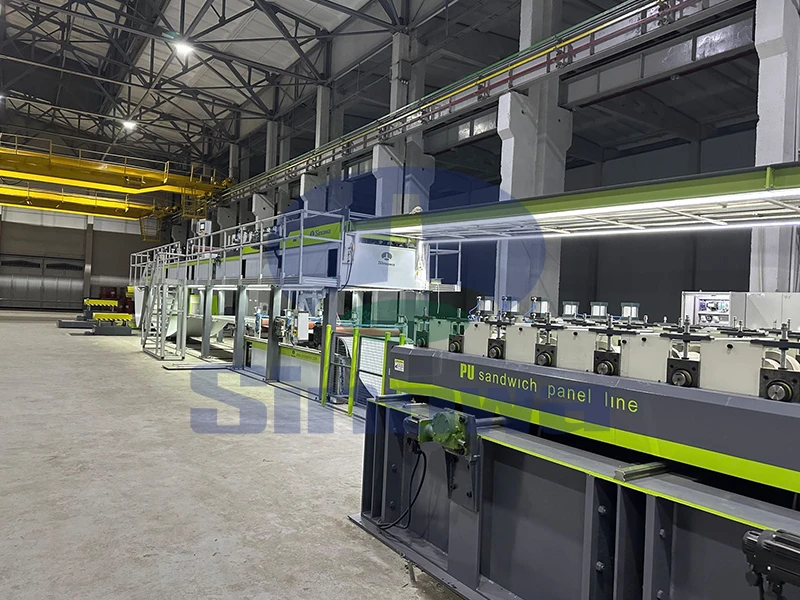
A continuous polyurethane (PU) sandwich panel production line is among the most energy-intensive single-pass operations in modern building materials manufacturing, and understanding its hourly energy profile is essential for anyone responsible for plant economics, carbon accounting, or operational efficiency. Unlike discrete batch processing, a continuous line runs in a steady state once commissioned, meaning that the energy drawn in any given hour is not a static number but a composite figure assembled from many subsystems, each with its own duty cycle, thermal inertia, and sensitivity to ambient conditions. The total hourly consumption of such a line typically falls in a broad range that spans from several hundred kilowatt-hours on a modest, well-insulated installation to well over a thousand kilowatt-hours on a high-speed, wide-format line running dense formulations. The figure is best understood not as a single value but as a sum of distinct loads, and the most instructive approach is to decompose that sum into its thermal, mechanical, and auxiliary components, because each behaves differently under load and each offers different opportunities for reduction.
The single largest consumer of energy on any continuous PU sandwich panel line is almost always the heating system that sustains the double-belt laminating press. The panels are formed by feeding steel facings and a liquid polyurethane reaction mixture between two moving steel belts, and the chemical reaction that transforms the liquid into rigid foam must be carefully managed through temperature control across the heated platens that back the belts. Maintaining these platens at their operating temperature, which is typically well above ambient, requires a substantial and continuous input of heat, because the belts, the platens themselves, the facing steel, and the curing foam all conduct heat away, and because the entire system radiates and convects heat to the surrounding hall. In a steady-state hour, this heating demand is dominated not by the energy needed to warm the line from cold, but by the energy needed to replace losses and to drive the exothermic-but-still-insufficient reaction toward completion. The heating medium, usually thermal oil or hot water circulating through the platens, must be kept at temperature constantly, and even during brief pauses or low-speed running the line continues to lose heat to its surroundings. As a result, the press heating load is both the largest hourly figure and the most stubbornly constant one, and it is here that the difference between a modern, well-insulated press and an older, uninsulated one becomes most apparent.
The second major mechanical consumer is the drive system that moves the facings, the belts, and the finished panel through the line. The unwinding stands that pay out the steel coils must resist the tension of heavy coils; the forming and profiling rollers that shape the steel profiles exert significant forces; and the double belts themselves are driven through the laminating section against friction with the platens and against the resistance of the moving foam. Each of these contributes to a continuous electric load drawn by the drive motors and their associated gearboxes and frequency converters. Unlike the thermal load, the mechanical load is far more directly proportional to line speed and to the width and thickness of the material being processed: running faster, running wider material, or running a denser core all increase the torque demanded by the drives. In practice this mechanical component is usually smaller than the thermal component, but it is not trivial, and it scales with throughput in a way that makes it the most responsive to production decisions. An operator who can slow the line during non-peak periods or run narrower coils will see an immediate, measurable drop in this portion of the hourly total.
Beyond the press heating and the main drives, a continuous line carries a host of supporting systems that together form a significant and often underestimated base load. The metering and mixing machine that proportions and blends the polyol, isocyanate, and additives must keep its pumps, heaters, and mixing head in a ready state, and it typically runs continuously even when the line itself is idle, because the chemical components must be maintained at precise temperatures and the recirculation loops must remain primed. The cutting system at the exit, whether a flying saw or a cross-cut shear, draws energy in bursts synchronized to the line cycle, adding a pulsed component to the otherwise steady load. Ventilation and extraction systems, which remove airborne isocyanate vapors, solvent fumes, and dust for both safety and product quality, run essentially around the clock and contribute a continuous fan load that is easy to overlook because it is spread across many small motors. Compressed air, used for pneumatic controls, belt tensioning, and cleaning, is produced by compressors that are notoriously inefficient and can draw as much power at partial load as at full load. When all of these auxiliaries are summed, they can account for a surprisingly large fraction of the total, sometimes approaching a quarter of the hourly figure, and they are the portion that offers the quickest wins because much of their consumption is not strictly tied to the amount of panel produced in that hour.
A meaningful share of the hourly energy is also consumed by the curing process itself, understood not only as the heat added by the press but as the total thermal management of the panel as it travels through the laminating and post-curing sections. The rigid polyurethane foam core develops its final mechanical properties partly through the exothermic reaction of the components and partly through continued exposure to elevated temperature after the press, often in a post-heating or curing tunnel. That post-curing section represents an additional thermal load that, depending on line design, can be comparable to or even exceed the heat applied in the main press. The relationship between the reaction heat and the externally applied heat is delicate: the reaction releases its own heat, which helps drive curing, but the rate of heat release is itself a function of temperature, so the system must balance the two. In an efficient design, the self-heating of the foam reduces the external energy required, while in a poorly controlled design, excessive external heat is applied to compensate for a formulation that reacts too slowly, wasting energy and degrading product consistency. The net hourly energy for curing is therefore not purely a function of the equipment, but a consequence of the interplay between formulation, temperature set points, and line speed.
Two additional factors complicate any attempt to state a single meaningful hourly figure: ambient conditions and line utilization. The heating load is strongly affected by the temperature of the production hall and by the outside climate, because heat loss from the press and from the curing sections increases as the ambient temperature drops. A line running in a cold, poorly sealed building in winter will draw materially more thermal energy per hour than the same line in a warm, well-sealed hall in summer, all other factors held equal. Similarly, the true hourly consumption depends on how the line is actually operated across the day. During sustained full-speed production the energy is spread across a large output, giving a low energy-per-unit figure; during warm-up, ramp-down, short stops for coil changes, or low-speed running, the fixed thermal and auxiliary loads continue unabated while output collapses, so the hourly consumption may fall only slightly even as productivity falls sharply. The meaningful metric for a plant manager is therefore rarely the raw hourly draw in isolation, but the energy consumed per unit area or per unit length of panel produced, which folds in both the load and the throughput. An operator comparing two hours of operation will find that the hour with more starts, stops, and speed changes consumes nearly as much energy but produces far less panel, which is precisely why steady, continuous running is so strongly favored in the economics of these lines.
Several practical levers emerge from this decomposition, and they matter because energy is typically one of the largest variable costs in PU panel production. On the thermal side, improving insulation of the press platens, the piping, and the curing tunnel directly reduces the standing loss that dominates the base load; recovering waste heat from the curing tunnel or from the panel cooling sections and returning it to the preheat or to the hall heating is an increasingly common and effective measure. On the mechanical side, matching drive capacity to actual duty, using efficient motors and variable-speed drives, and avoiding oversizing of pumps and fans all reduce the electric component. On the operational side, the highest-impact changes are usually behavioral: consolidating production into longer, uninterrupted runs, minimizing the number of speed changes and idle periods, coordinating coil changes to avoid full line stops, and scheduling energy-intensive operation during periods of lower energy tariffs. The auxiliary systems, while individually small, reward attention too, because compressed-air leaks, oversized fans running at full speed, and continuously recirculating chemical heating loops that could be turned down during idle periods all represent continuous drains that never appear in any single dramatic figure but accumulate relentlessly across every hour of the day.
In practical terms, a well-managed continuous PU sandwich panel line of moderate width and speed can be expected to draw an hourly total in the range of roughly several hundred kilowatt-hours, with the exact number depending on width, speed, formulation, insulation quality, and ambient conditions. Of that total, the heating of the press and curing sections typically accounts for the largest share, often roughly half or more; the drives for the belts, rollers, and cutters represent a substantial second component; and the metering unit, extraction, compressed air, and other auxiliaries make up the remainder. What the decomposition makes clear is that the hourly figure is neither fixed nor mysterious: it is the sum of a large, nearly constant thermal base load, a throughput-proportional mechanical load, and a persistent auxiliary load, and each of these can be measured, benchmarked, and improved independently. For any operator, the value of understanding the hourly profile is not in quoting a number but in being able to see, hour by hour, which subsystems are consuming energy that is not contributing to output, and in having a clear map of where the next reduction should come from. Energy on a continuous line behaves like the line itself: steady, cumulative, and highly responsive to disciplined operation.
Tags: continuous pu sandwich panel line, continuous pu sandwich panel line manufacturer, continuous pu sandwich panel line supplier, china continuous pu sandwich panel line, continuous pu sandwich panel line for sale