What Causes Foam Voids In Panels Made By A PU Sandwich Panel Machine?
Publication Date: Oct 26, 2026
Learn what causes foam voids in PU sandwich panels, including mixing issues, ratio errors, moisture, temperature drift, poor foam flow, machine wear & reaction imbalance, plus quick defect troubleshooting tips.
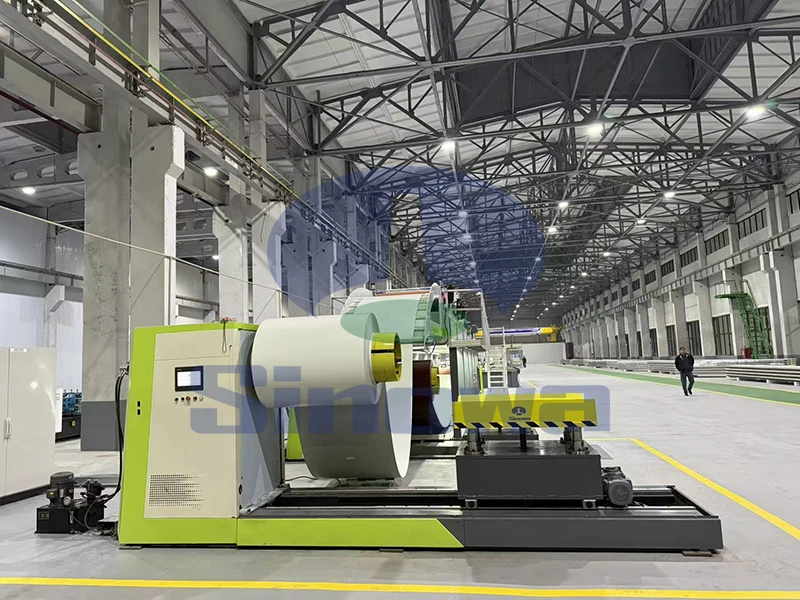
Foam voids are among the most persistent quality defects encountered during the production of polyurethane sandwich panels. When a finished panel is cut open or inspected under a scanning device, voids appear as irregular cavities, pinholes, or honeycomb-like pockets within the otherwise dense insulating core, sometimes visible to the naked eye and sometimes lurking just beneath the surface. Their presence is not merely a cosmetic nuisance; it compromises thermal insulation, reduces structural rigidity, undermines adhesion between the foam and the metal facings, and in the worst cases can allow moisture ingress that slowly corrodes the steel skin from within. Understanding why these voids form is therefore essential, because a panel that looks acceptable on the outside may already be carrying hidden defects that shorten its service life and erode the performance guarantees a manufacturer relies on.
The most fundamental cause of voids lies in the chemistry of the foaming reaction itself and the way it interacts with the process window. Polyurethane foam is created when an isocyanate component and a polyol component are mixed together, triggering an exothermic reaction that simultaneously generates gas from a blowing agent and polymerizes the liquid into a solid matrix. For a sound core to form, the expansion of gas bubbles must be closely synchronized with the gelation of the polymer network. If the reaction proceeds too quickly and the polymer sets before the gas has fully expanded, the trapped bubbles cannot grow to their intended size and the foam remains dense and under-expanded, with only tiny voids forming. Conversely, if the reaction is too slow or the temperature is too low, the liquid remains mobile for too long, allowing large gas bubbles to coalesce, rise to the surface, and collapse, leaving behind large irregular cavities. This delicate balance is governed by the precise ratio of the two components, the type and dosage of the blowing agent, and the formulation of catalysts, all of which must be tuned to match the ambient conditions and the speed of the production line.
Metering and mixing quality form the second major family of causes, and they are often the most easily overlooked because the equipment appears to be functioning normally. The two liquid streams are delivered to the mixing head by high-pressure metering pumps, and the ratio between them must be held within a tight tolerance. If one pump drifts slightly, the mixture becomes off-ratio; an excess of isocyanate produces a brittle, starved foam prone to shrinkage cracks, while an excess of polyol leaves unreacted material that never fully expands, resulting in soft spots and voids. Beyond the ratio, the quality of mixing is equally critical. Modern machines rely on high-speed impingement mixing, in which the two streams collide at high velocity to achieve molecular-level blending within milliseconds. Inadequate mixing pressure, worn nozzle inserts, or a partially clogged mixing chamber produce a heterogeneous mixture in which some regions contain too much catalyst and others too little. The result is a foam with uneven cell structure and localized void clusters, even when the overall formulation is correct.
The thermal environment of the panel itself plays a decisive and frequently underestimated role. The foam reaction is exothermic, but the rate at which heat is released and dissipated depends heavily on the temperature of the metal facings, the temperature of the raw materials, and the ambient temperature of the production hall. Cold steel skins act as a heat sink, rapidly drawing heat away from the foam adjacent to the surface, which slows the reaction there and prevents full expansion near the metal interface. This produces a phenomenon sometimes described as a thin, poorly expanded "skin layer" that can detach and leave elongated voids along the facing. Conversely, if the raw materials are overheated, the reaction accelerates so dramatically that the foam expands too quickly, outstripping the ability of the panel to accommodate the pressure, which can cause the skins to bow and the foam to tear. Temperature drift during a production run—whether from a cold morning start, a warm afternoon, or seasonal changes—therefore needs to be compensated by adjusting catalyst levels, but many operations continue at fixed settings and silently accumulate voids.
Moisture is another insidious contributor that is frequently blamed for voids even when the root cause lies elsewhere. Isocyanates react readily with water, consuming the isocyanate that should have reacted with the polyol and generating carbon dioxide gas in the process. If any water—from humid raw materials, condensation on cold steel skins, or a damp production environment—enters the system, it produces an uncontrolled release of gas that disrupts the orderly expansion of the foam. The result is a characteristic pattern of large, irregular voids scattered through the core, often accompanied by a noticeable odor and a brittle, powdery foam. Controlling moisture therefore requires attention to the storage of raw materials in sealed drums, to the dehumidification of the production area, and to the cleanliness of the steel coils, which can carry a thin film of condensation when brought from a cold warehouse into a warmer hall. A seemingly minor moisture issue can, over a long run, account for a substantial proportion of apparent void defects.
The geometry and design of the panel also exert a strong influence on where voids are most likely to appear. Sandwich panels are not uniform slabs; they contain edge profiles, grooves, recesses, and changes in thickness that disturb the flow of the expanding foam. As the liquid mixture is injected and begins to rise, it must fill every corner of the mold cavity. Narrow channels and sharp corners slow the flow, trap air, and create shadow zones where the foam cannot reach or where gas accumulates before the polymer sets. Deep profiles with undercuts are particularly vulnerable, because the foam must climb over obstacles while still liquid, and any trapped air becomes a permanent void. The injection position and the injection volume also matter: an injection point placed incorrectly, or a shot size that is too large for the cavity, causes turbulence and over-fill that entrain air, while a shot size that is too small leaves the panel starved. Designers must therefore ensure that the foam can flow freely, and operators must verify that the injection parameters match the specific panel geometry being produced.
Finally, the condition and maintenance of the machine itself represent a class of causes that grows worse with time if left unaddressed. The mixing head, delivery hoses, and metering pumps all suffer from wear, and the polyol component, containing catalysts and surfactants, can leave deposits that gradually restrict flow. A nozzle that has worn unevenly changes the spray pattern and degrades mixing quality, while a slightly blocked recirculation line alters the pressure balance and permits momentary ratio deviations that are impossible to detect by eye. Even the release agent applied to the mold surfaces, if applied unevenly, can create localized barriers that interfere with foam adhesion and contribute to surface voids. Because these effects develop gradually, they are easily mistaken for formulation problems, and many manufacturers chase the recipe for weeks while the true culprit is a deteriorating mechanical component. A rigorous preventive maintenance schedule—regular calibration of pumps, replacement of wear parts, cleaning of mixing heads, and verification of temperature controls—is therefore not a luxury but a core tool in the fight against voids.
In practice, the appearance of voids is rarely traced to a single cause, and the most effective response is a systematic diagnostic approach rather than a single adjustment. When a batch of panels shows void defects, the prudent first step is to inspect the pattern of the voids: voids concentrated at the edges point toward geometry and flow issues, voids spread evenly through the core point toward formulation or mixing problems, voids near the metal facings point toward temperature or adhesion issues, and large irregular voids with a characteristic odor point toward moisture contamination. Armed with this pattern, the operator can then check the metering ratio, verify the mixing pressure, measure the skin and material temperatures, inspect the condition of the nozzles and pumps, and confirm that the raw materials are dry. Corrective action usually involves adjusting one variable at a time and producing test panels to confirm the improvement before proceeding. This disciplined approach, combining a proper understanding of the chemistry, meticulous control of the process, careful attention to the thermal and moisture environment, thoughtful panel design, and disciplined machine maintenance, is what separates a production line that occasionally ships a defective panel from one that consistently produces a dense, uniform, high-quality core.
Tags: pu sandwich panel machine, pu sandwich panel machine manufacturer, pu sandwich panel machine supplier, china pu sandwich panel machine, pu sandwich panel machine for sale