What Automation Level Does A Modern PU Sandwich Panel Manufacturing Line Support?
Publication Date: Oct 22, 2026
Modern PU sandwich panel production lines deliver high-level integrated automation: synchronized material feeding, closed-loop PU metering, inline quality inspection, robotic cutting & stacking, recipe management and data traceability, lowering manual work while stabilizing panel consistency.
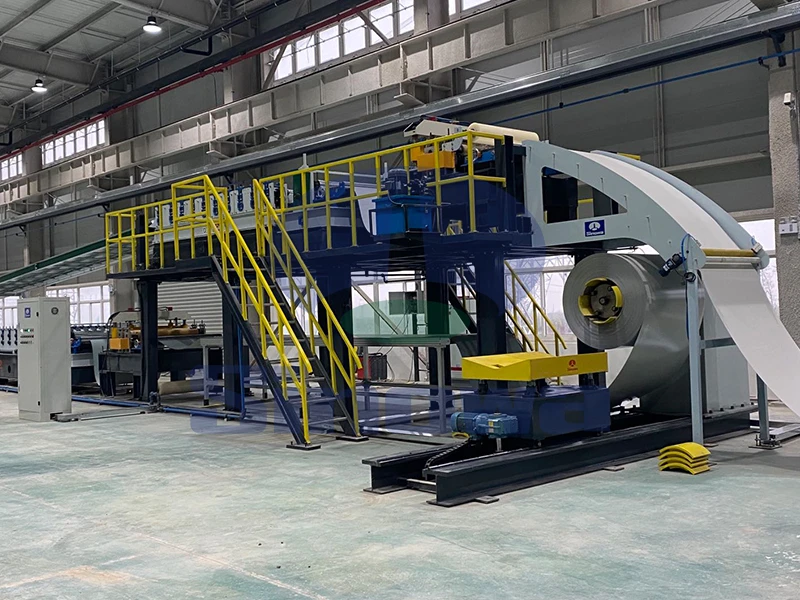
Modern PU sandwich panel manufacturing has evolved from a largely operator-driven craft into a deeply automated, data-coupled process that sits at the center of the contemporary building envelope industry. The automation level of a state-of-the-art line is best understood not as a single switch, but as a layered stack of capabilities that operate together: continuous material handling, metering and dispensing precision, forming and pressing control, curing management, dimensional inspection, robotic downstream processing, and finally the software layer that ties every step into one orchestrated flow. When a buyer asks how "automated" a line really is, the honest answer is that the term no longer refers to whether a machine replaces a hand, but to how many decisions the system can make for itself, how consistently it can reproduce quality across a full shift, and how much of the process it can observe, correct, and document without a person stepping in.
The most visible layer is mechanical automation, where the line performs the physical sequence of manufacturing end to end. A modern continuous line begins with coil unwinding and tension control, passes through profile forming, and moves the continuously formed metal faces toward the point where the core material is introduced. What separates a truly modern line from an older one is that this movement is no longer piecemeal. Metal coils are loaded automatically, spliced with strip welding when one roll runs out, and threaded through the forming mill with servo-driven roll stations that keep the profile geometry stable at high speeds. The core, whether mineral wool, extruded foam, or injected polyurethane, is fed with synchronized speed matching so that faces and core meet at the exact moment and position required. After pressing, the sandwich emerges as a continuous board that is cut to length by a flying saw synchronized to the belt speed, then separated and stacked. Each of these steps is executed with sensors and actuators that communicate, so that a pause at any point propagates backward and forward through the line rather than causing a pile-up or a gap.
The second and arguably more consequential layer is process automation, which governs the chemistry and physics of the panel itself. Polyurethane panels are not merely assembled; they are manufactured in a chemical sense, because the insulating core is created in situ as the isocyanate and polyol components react. This makes metering accuracy critical. A modern line employs high-precision high-pressure metering units that weigh and pump the two or more components with tolerances that are extremely tight, and it continuously monitors the ratio, temperature, pressure, and output rate of each stream. The mixing is done in a self-cleaning mixing head that cycles on and off thousands of times a day, and the system automatically recalibrates itself between shots to compensate for thermal drift and viscosity changes in the raw materials. Because the reaction is exothermic and time-sensitive, the line also manages the cream time, gel time, and rise profile by controlling the temperature of the substrate and the environment. In effect, the machine is continuously solving the question of how to deliver a chemistry that produces a foam of uniform density, closed cell structure, and dimensional stability, and it does so by closing a feedback loop that a human operator could not realistically manage at this speed and frequency.
What elevates a modern line beyond its predecessor is the degree to which quality assurance has been pulled inside the process rather than left to an end-of-line inspection. Instead of sampling panels occasionally and measuring them in a laboratory, a contemporary line embeds sensors directly in the manufacturing stream. Thickness is measured inline by laser or ultrasonic gauges across the width of the board, so any deviation in flatness or core thickness is detected the moment it occurs rather than after a batch has been produced. Density and adhesion characteristics are monitored through the mechanical response of the panel and through parameters such as the pressure profile in the double-belt press. Deflection, delamination, surface quality, and edge condition are tracked continuously, and the control system correlates these readings back to the specific setpoints at the moment the section was formed. When a measurement drifts outside an acceptable window, the line either adjusts its own parameters in real time or flags the offending section so that it can be automatically marked and diverted. This inline inspection layer is the practical difference between a line that produces good panels and a line that produces consistently excellent panels, because it turns quality from a hope into a monitored, managed variable.
Beyond the forming section, downstream automation has become one of the strongest signals of a line's sophistication. The cut panels are handled by robots rather than by human hands, and these robots perform operations that once required considerable skilled labor. Longitudinal and transverse cutting, edge profiling, groove cutting, and the milling of complex shapes for corners, windows, or architectural details are all executed by numerically controlled machines. What is notable is that these robots are not simply following fixed programs; they are receiving work orders directly from the production planning system. Each panel is cut, notched, and labeled according to the exact dimensions required for a specific order, and the system knows the full context of that order, including which building it belongs to, where in the facade it will sit, and what tolerances apply. This means that a modern line can run what is effectively a highly customized, one-piece-flow manufacturing model while retaining the efficiency of continuous production. Panels of different lengths, thicknesses, and profiles can follow one another down the line in sequence, and the robots reconfigure themselves automatically between jobs, so the flexibility that once demanded retooling and downtime now happens between consecutive boards.
The layer that binds all of the physical automation together is the digital control and information architecture. A modern line operates on a network that connects the programmable logic controllers of each machine, the sensor networks, the metering systems, the robotics, and the enterprise planning software into a single consistent picture of production. This architecture performs three essential functions. First, it executes the recipe: every product has a defined set of parameters for speeds, temperatures, pressures, metering ratios, press clearances, and curing times, and the system loads the correct recipe when an order changes rather than relying on an operator to remember or dial in values. Second, it collects data continuously and in high resolution, creating a record of exactly how every meter of every panel was made. This data becomes the basis for traceability, for root-cause analysis when a problem appears, and for continuous improvement, because the line can correlate a subtle defect with the exact process conditions that produced it. Third, it acts as a decision engine. With sufficient data, the system can detect patterns that precede failures, schedule predictive maintenance before a component breaks, optimize the order sequence to minimize changeover time, and adjust process parameters proactively. The result is a line that does not merely execute instructions but learns from its own operation and becomes more stable and more efficient the longer it runs.
Two further capabilities distinguish the highest level of automation currently available and point toward the direction the industry is moving. The first is remote and centralized supervision. On a fully modern line, the physical production floor may run largely unattended, with a small team of engineers and supervisors monitoring the entire process from a control room or even from a remote location through a comprehensive dashboard. The system handles the routine adjustments, alarms only for genuine exceptions, and provides the human team with a prioritized, understandable view of what needs attention. The second is the integration of automation with order management and supply logistics, so that the line does not exist in isolation. When a customer order enters the system, the line automatically calculates the required panel dimensions, the material requirements, the sequence of production, and the optimal cutting plan to minimize waste. It synchronizes with raw material availability, so that the right coils and the right chemistry are ready at the right time, and it feeds the finished production data back to inventory, dispatch, and installation planning. In the most advanced installations, the boundary between manufacturing and the rest of the enterprise has effectively dissolved, and the line is best understood as one continuous, responsive node in a larger digital operation.
It would be a mistake, however, to equate automation with the complete removal of people, and the realistic picture is more nuanced. Even the most automated line depends on a skilled technical team for tasks that remain genuinely hard to automate: setting up a new product geometry, troubleshooting a subtle chemical problem, optimizing a recipe for a new raw material batch, and responding to the kind of complex, unforeseen situation that no algorithm yet handles gracefully. The nature of the human role shifts from manual labor to engineering judgment, data analysis, and exception handling. Moreover, the practical automation level a facility actually achieves depends as much on the discipline of the organization as on the hardware. A line is only as effective as its data hygiene, its maintenance culture, and the consistency of its raw materials, because automation amplifies the quality of what it is given. Inconsistent input materials, poorly maintained tooling, or sloppy data will produce inconsistent results even on the most advanced machinery. The realistic conclusion is that a modern PU panel line reaches its full potential only when the physical automation is matched by a capable and well-organized technical team and by disciplined process management.
Taken together, the automation level of a modern PU sandwich panel line is best described as a spectrum that advances along several independent axes rather than a single level that can be stated in one number. On the material-handling axis, the line moves from manual feeding to fully synchronized, self-regulating continuous flow. On the process axis, it moves from operator-controlled chemistry to closed-loop metering and reaction management. On the quality axis, it moves from end-of-line sampling to continuous inline measurement and automatic correction. On the downstream axis, it moves from fixed manual fabrication to order-driven, self-reconfiguring robotics. On the information axis, it moves from fragmented machine control to a unified data architecture that enables traceability, predictive maintenance, and continuous learning. A buyer evaluating a line, therefore, should not ask whether it is automated or not, but should examine where it stands on each of these axes, because two lines sold with the same broad label can differ enormously in throughput consistency, flexibility, waste, labor requirement, and the quality of the data they generate. The most advanced modern lines are already approaching a state where the human's primary contribution is strategic rather than operational, and the trajectory of the industry is clearly toward lines that are not only faster but also more self-aware, more flexible, and more deeply integrated into the digital economy of the building sector.
Tags: pu sandwich panel manufacturing line, pu sandwich panel manufacturing line manufacturer, pu sandwich panel manufacturing line supplier, china pu sandwich panel manufacturing line, pu sandwich panel manufacturing line for sale