What Raw Material Mixing Ratio Is Optimal For A PU Sandwich Panel Production Line?
Publication Date: Oct 22, 2026
Discover the optimal PU raw material mixing ratio for sandwich panel lines. The practical isocyanate index sits at 105–110, balanced with blowing agents and catalysts for stable foam, bonding and insulation performance.
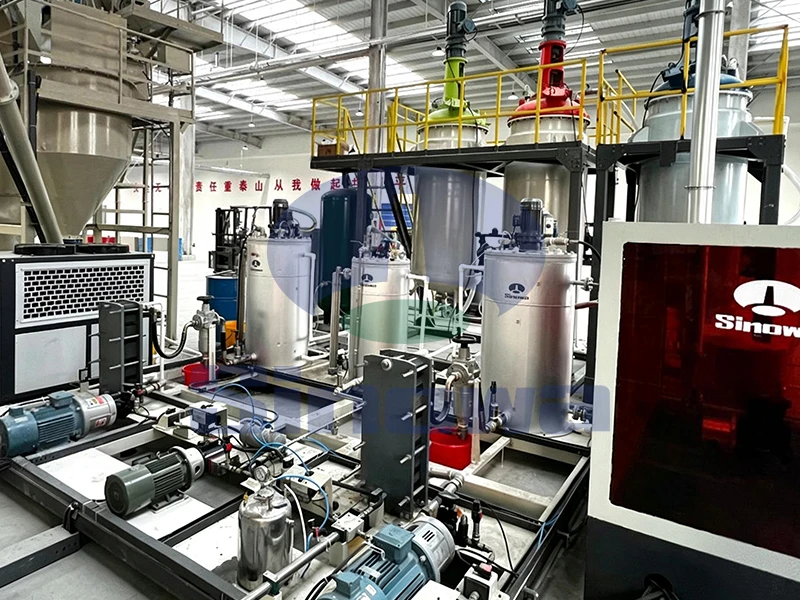
Producing polyurethane (PU) sandwich panels is, at its core, a delicate exercise in chemistry staged inside a fast-moving production line. The finished composite—a rigid polyurethane foam core bonded between two metal or non-metal facings—owes its insulation, load-bearing capacity, dimensional stability, and long-term durability to a few grams of formulation that are blended and poured in a matter of seconds. The question of the "optimal" mixing ratio is therefore never a single magic number; it is a working window within which foam quality, processability, and economics all pull in different directions. The most practical way to approach it is to regard the formulation not as a recipe but as a set of interdependent variables, with the isocyanate-to-polyol ratio acting as the anchor that everything else must be balanced against.
The single most important parameter in any rigid PU foam is the mixing ratio between the two reactive streams, commonly expressed as the isocyanate index—the ratio of actual isocyanate groups to the theoretical amount needed to react with all the hydroxyl groups present in the polyol blend. In practice, rigid PU sandwich panels are most often run at an index somewhere in the range of 100 to 115, with values around 105 to 110 being the most common commercial compromise. An index of exactly 100 is the stoichiometric ideal, where every isocyanate group finds a partner hydroxyl group and the network is fully cross-linked; in theory this yields the most complete reaction and the highest possible cross-link density. Yet in real production, small losses of isocyanate to side reactions with moisture, and slight weighing or metering inaccuracies, mean that running exactly at 100 leaves virtually no safety margin. Raising the index modestly ensures that the polyol is fully consumed and the foam cures to a firmer, more dimensionally stable part. Pushing the index too high, however, wastes expensive isocyanate, leaves unreacted material that can impart brittleness and a brittle, friable surface, and drives up the exothermic heat of reaction, which raises the risk of scorching in thick panels.
The balance of polyols and cross-linkers determines how much of the foam's final performance comes from the hard segments versus the flexible structure. Rigid PU foam relies heavily on polyols with a high hydroxyl number, because those hydroxyl groups provide the cross-linking sites that build a stiff, three-dimensional network. The base polyol is usually a polyester or polyether polyol with a high functionality and a low equivalent weight; its hydroxyl value directly controls the amount of isocyanate that must be supplied and therefore sits hand-in-hand with the index calculation. Around this base, the formulator adds smaller amounts of cross-linking agents and chain extenders—low-molecular-weight glycols or amines—that raise the cross-link density and improve the foam's compressive strength and heat resistance. Getting this secondary ratio right is a matter of tuning stiffness without making the foam too brittle and tuning flow without making it too weak. A formulation that is too lean in cross-linkers will yield a soft, poorly supporting core, while an over-cross-linked system becomes rigid enough to crack under thermal cycling and hard to wet out on the facings.
The blowing and cell-structure system is the other half of the equation and is often the part that most visibly affects whether a panel runs smoothly on the line. Rigid PU foam for panels is nearly always blown with a combination of chemical and physical blowing agents, and the ratio between them controls both density and cell quality. Chemical blowing is provided by water, which reacts with isocyanate to release carbon dioxide; this reaction is exothermic, helps drive cure, and produces a fine, uniform cell structure. Physical blowing agents, by contrast, vaporize under the reaction heat and expand the foam, contributing more aggressively to overall volume growth and thus to low density. The balance between these two is chosen to hit a target core density, typically in the range of roughly 30 to 45 kilograms per cubic meter for standard insulation panels. Too little total blowing agent and the panel comes out heavy, wasting raw material and increasing thermal conductivity; too much, and the foam becomes so low in density that it loses compressive strength, suffers from poor adhesion to the facings, and can collapse or form large, irregular cells that degrade insulation performance. The surfactant—a silicone-based stabilizer—also enters here, because it controls cell wall stability and prevents coalescence; its dosage is small, often well under two percent by weight of the polyol stream, yet it has an outsized effect on whether the foam rises evenly or forms voids and striations.
Temperature and the exact point where the ratio meets the line conditions are what turn a well-designed formula into a reliable panel. The polyol blend is usually held at a controlled temperature, and the isocyanate at its own, before the two are metered and mixed in a high-pressure impingement head. The ratio between the two streams determines not only the chemistry but also the working life and the flow characteristics of the reacting mixture. Because the reaction begins immediately at mixing, the formulator must engineer the cream time, gel time, and tack-free time so that the liquid has enough time to fill the mold cavity and wet the facing surfaces before it begins to gel. This is why the index and the catalyst package are adjusted together: higher isocyanate content tends to shorten the cream time and increase reactivity, while the catalyst blend—usually a combination of amine and tin catalysts—fine-tunes the balance between the foaming reaction and the gelling reaction. A formulation tuned for hot weather may gel too quickly on a cold day, and the same physical formula run at different line temperatures will produce panels of different densities and strengths. So the truly optimal ratio is not fixed for all seasons; it must be verified by small trial runs under the actual ambient conditions of the plant.
Density and adhesion requirements complete the picture, because the panel core does not stand alone but must bond firmly to both facings. The strength of the bond between foam and facing is influenced by the cell structure at the interface, the wetting behavior of the reacting liquid, and the amount of foam that forms an integral skin at the facing surface. A higher index and a properly balanced catalyst produce a foam that wets the metal surface cleanly and develops good adhesion, whereas an under-cured or over-blown foam can blister and delaminate as trapped gases expand during the cure. Similarly, panels intended for load-bearing wall or roof applications generally require a higher density and a stiffer core, which nudges the optimal ratio toward a higher index and less aggressive blowing, while panels intended mainly for insulation can tolerate a lighter, lower-density core. Because the same production line may run multiple panel thicknesses and facing types, the optimal ratio is best defined as a calibrated set of values for each product rather than one universal number; the line operator must know which combination of index, blowing level, and catalyst suits each job.
Ultimately, the "optimal" mixing ratio is best understood as the combination that delivers consistent foam quality across the range of thicknesses and temperatures the line actually encounters, while keeping the process stable enough to run for long periods without scrap. This usually translates to an isocyanate index near 105 to 110, a blowing system tuned to hit the target density with a comfortable margin, a well-judged catalyst package, and a surfactant level that gives fine, stable cells. The real skill lies in the verification loop: taking a candidate ratio to a small trial pour, measuring density, compressive strength, adhesion, and dimensional change after cure, and adjusting one variable at a time until the panel meets the application's requirements with the lowest reasonable material cost. Since every plant has its own metering accuracy, temperature control, mold design, and raw material lot variations, the ratio that works flawlessly in one facility may need adjustment in another. The optimal ratio is therefore not a single recipe to be copied, but a well-characterized operating window that a production team has mapped through disciplined experimentation—and the team that understands the chemistry behind each component is the team that can defend and refine that window over the life of the line.
Tags: pu sandwich panel production line, pu sandwich panel production line manufacturer, pu sandwich panel production line supplier, china pu sandwich panel production line, pu sandwich panel production line for sale